Important Details
IJCRT - International Peer Reviewed, Open Access Journal, Multidisciplinary, Monthly, Nominal(Low) Fees for Professional Research Services International Journal of Creative Research Thoughts - IJCRT Peer Review Journal, Refereed Journal, Peer Reviewed Journal , Referred Journal and Indexed Journal, Open access, Online and Print Journal,international Journal Open Access, Accepted by Indian and foreign university ,IJCRT Followed Norms, guidelines, requirement, listing criteria and methodology of score/point also applied from: Scopus , Web of Science , UGC Approved , UGC CARE, UGC-CARE .
UGC Approved Journal No: 49023 (18)
UGC approval Link
https://ijcrt.org/ugc%20approval.jpg
All Policy and Approval
Please Like Our Facebook Page | CrossRef DOI and Hard copy of Certificate Provide if required. | www.IJCRT.org | editor@IJCRT.org | IJCRT WhatsApp +91 94294 58311
Publication Details:
- Paper Submission : 30-Sep-2026. Call For Paper (Volume 14 | Issue 8 | Month- August 2026)
- Acceptance/Rejection Notification: Within 02-04 Days.
- Paper Publish: Within 02-04 Days after submitting all documents.
-
Submit Your Paper Any time There No deadline.
-
Publication fees : 1570 INR for Indian author & 59$ for foreign International author.
Please Like Our Facebook Page | CrossRef DOI and Hard copy of Certificate Provide if required.
Licence and Indexing
Indexing In Google Scholar, SSRN, ResearcherID-Publons, Semantic Scholar | AI-Powered Research Tool, Microsoft Academic, Academia.edu, arXiv.org, Research Gate, CiteSeerX, ResearcherID Thomson Reuters, Mendeley : reference manager, DocStoc, ISSUU, Scribd, and many more | High Impact Factor: 7.97 | Digital object identifier (DOI) and Hard Copy of certificate Provided.




























Licence
DOI
ISSN Approved impact factor: 7.97 
Creative Common 
Valid as per new UGC Gazette regulations 

INTERNATIONAL JOURNAL OF CREATIVE RESEARCH THOUGHTS - IJCRT (IJCRT.ORG)
International Peer Reviewed & Refereed Journals, Open Access Journal
IJCRT Peer-Reviewed (Refereed) Journal as Per New UGC Rules.
ISSN Approved Journal No: 2320-2882 | Impact factor: 7.97 | ESTD Year: 2013
Call For Paper - Volume 14 | Issue 8 | Month- August 2026
Scholarly open access journals, Peer-reviewed, and Refereed Journals, Impact factor 7.97 (Calculate by google scholar and Semantic Scholar | AI-Powered Research Tool) , Multidisciplinary, Monthly, Indexing in all major database & Metadata, Citation Generator, Digital Object Identifier(CrossRef DOI)
IJCRT WhatsApp Contact
IJCRT Search Xplore - Search all paper by Paper Name , Author Name, and Title
Volume 9 | Issue 3
Volume 9 | Issue 3 | Month
Downlaod After Publication 1) Table of content index in PDF
2) Table of content index in HTML 2)Table of content index in HTML
3) Front Page 3) Front Page
4) Back Page 4) Back Page
5) Editor Board Member 5)Editor Board Member
6) OLD Style Issue 6) OLD Style Issue
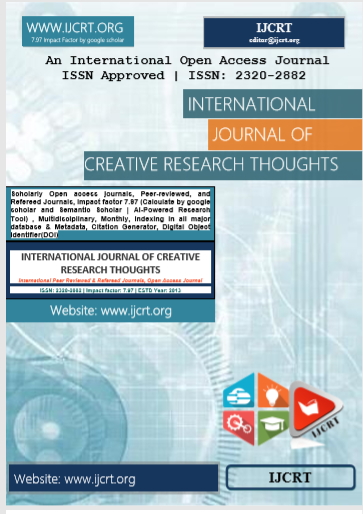 |
 |
|---|---|
| IJCRT Journal front page | IJCRT Journal Back Page |
Paper Title: GENDER EQUALITY
Publisher Journal Name: IJCRT
Your Paper Publication Details:
Published Paper ID: - IJCRT2103007
Register Paper ID - 204013
Title: GENDER EQUALITY
Author Name(s): Diksha Deka
Publisher Journal name: IJCRT
Volume: 9
Issue: 3
Pages: 45-52
Year: March 2021
Downloads: 1866
Abstract
Licence: creative commons attribution 4.0
License
Creative Commons Attribution 4.0 and The Open Definition

Paper Title: PERICOPE OF DANAKARMA IN AYURVEDA FOR VYADHI CHIKITSA- A NEW OUTLOOK.
Publisher Journal Name: IJCRT
Your Paper Publication Details:
Published Paper ID: - IJCRT2103006
Register Paper ID - 204015
Title: PERICOPE OF DANAKARMA IN AYURVEDA FOR VYADHI CHIKITSA- A NEW OUTLOOK.
Author Name(s): Dr.Satish Digambar Urhe, Dr.Ankush Haushiram Gunjal, Dr.Amol Chandrakant Gulve
Publisher Journal name: IJCRT
Volume: 9
Issue: 3
Pages: 42-44
Year: March 2021
Downloads: 1932
Abstract
Licence: creative commons attribution 4.0
License
Creative Commons Attribution 4.0 and The Open Definition
Keywords
Ayurveda, Dana karma, Daivavyaprashaya chikitsa, Harita Samhita.
License
Creative Commons Attribution 4.0 and The Open Definition
Paper Title: A STUDY ON SAVINGS AND INVESTMENT PATTERNS OF YOUNG INVESTORS OF PUNE CITY
Publisher Journal Name: IJCRT
Your Paper Publication Details:
Published Paper ID: - IJCRT2103005
Register Paper ID - 203953
Title: A STUDY ON SAVINGS AND INVESTMENT PATTERNS OF YOUNG INVESTORS OF PUNE CITY
Author Name(s): Mr.Rajeev Kumar, Dr. Narendra Singh Chawda, Dr. Rajan K. Shrikhande
Publisher Journal name: IJCRT
Volume: 9
Issue: 3
Pages: 34-41
Year: March 2021
Downloads: 2121
Abstract
Licence: creative commons attribution 4.0
License
Creative Commons Attribution 4.0 and The Open Definition
Keywords
Savings, Investment, Youth, income.
License
Creative Commons Attribution 4.0 and The Open Definition
Paper Title: SAFFLOWER IN MADHYA PRADESH - AN OVERVIEW OF 25 YEARS OF RESEARCH AND DEVELOPMENT
Publisher Journal Name: IJCRT
Your Paper Publication Details:
Published Paper ID: - IJCRT2103004
Register Paper ID - 195297
Title: SAFFLOWER IN MADHYA PRADESH - AN OVERVIEW OF 25 YEARS OF RESEARCH AND DEVELOPMENT
Author Name(s): M. K. Saxena, Usha Saxena, Sudhanshu Jain, Yashwant indapurkar, H.L.Khapadia
Publisher Journal name: IJCRT
Volume: 9
Issue: 3
Pages: 26-33
Year: March 2021
Downloads: 2224
Abstract
Madhya Pradesh is a non-traditional region for safflower production, therefore it is significant that over a period of nearly three decades it has developed multiple varieties of Safflower, in three categories, namely Spiny, Spineless and Semi-Spiny. JSF-1 (Shweta) was the first Safflower variety released in 1984 even before theestablishment of AICRP centre at Indore .Thereafter AICRP development work on safflower started in 1986 in Indore. This pushed the production area upward from small acreage to a splendid amount of 10,000 hectares (1988-89) in the Indore and Ujjain division. Fast forward to 2019, Nimar region farmers have now come forward for cultivation of Nonspiny Safflower varieties. After the establishment of AICRP centre m JSI-7 which is a high yielding spineless variety was released in 1990 for farmers. This was followed by the release of The JSI-73 (variety) in 1997, and quickly thereafter in 2004 came the bold seeded spineless variety JSI-97.
Licence: creative commons attribution 4.0
License
Creative Commons Attribution 4.0 and The Open Definition
Keywords
spiny cultivars, adoption, yield, oil content, petals, medicinal use
License
Creative Commons Attribution 4.0 and The Open Definition
Paper Title: STRENGTHENING THE ROLE OF INSTITUTIONAL ARBITRATION AND IT'S ENFORCEMENT IN INDIA
Publisher Journal Name: IJCRT
Your Paper Publication Details:
Published Paper ID: - IJCRT2103003
Register Paper ID - 203919
Title: STRENGTHENING THE ROLE OF INSTITUTIONAL ARBITRATION AND IT'S ENFORCEMENT IN INDIA
Author Name(s): Vanshika Kapoor, Muskan Sharma
Publisher Journal name: IJCRT
Volume: 9
Issue: 3
Pages: 18-25
Year: March 2021
Downloads: 1984
Abstract
India is moving towards the modern economy and establishing the country as a hub for arbitration so to reduce the burden of courts. Traditionally, India seemed towards ad-hoc arbitration and due to lack of enforcement of institutional arbitration in the country, it took part at Singapore and other countries. But, recently in the year 2019, India promoted the country as an arbitral destination. All the matters of commercial disputes should have a neutral arbitral institution in resolving such disputes. Moreover, there has been the establishment of institutions for conducting arbitration like MCIA in 2017, NDIAC in 2019, etc, to promote international best practices in the Country. This will give effect to prefer international commercial arbitration in the country as well as there is a need to look over the enforcement of such institutions effectively in India to achieve its objectives. The paper will be conducted as Non-Empirical/Doctrinal research. The main objective of this research paper is to find out the current situation of institutional arbitration in India. Further, the research paper is divided into four parts. Part I will be dealing with the introduction. Part II will be dealing in challenges with respect to existing institutions. Part III will be dealing with enforcement of institutional arbitration in India till 2019. Part IV will be dealing with conclusion and suggestions. This paper seeks to deal with the functioning of the existing institutions for governing arbitration in India. Lastly, finishing the study by evaluating all the situations in the current scenario as well as measures should be adopted. By writing this research paper, the researcher would like to get a new conclusion.
Licence: creative commons attribution 4.0
License
Creative Commons Attribution 4.0 and The Open Definition
Keywords
Institutional, Arbitration, Enforcement
License
Creative Commons Attribution 4.0 and The Open Definition
Paper Title: GENDER INEQUALITY AS MANIFESTED THROUGH DECLINE IN THE SEX RATIO: AN EMPIRICAL ANALYSIS OF JAMMU AND KASHMIR
Publisher Journal Name: IJCRT
Your Paper Publication Details:
Published Paper ID: - IJCRT2103002
Register Paper ID - 203816
Title: GENDER INEQUALITY AS MANIFESTED THROUGH DECLINE IN THE SEX RATIO: AN EMPIRICAL ANALYSIS OF JAMMU AND KASHMIR
Author Name(s): Dr. Deepti Gupta
Publisher Journal name: IJCRT
Volume: 9
Issue: 3
Pages: 11-17
Year: March 2021
Downloads: 1967
Abstract
Gender disparity and inequality is detrimental in achieving the goals of human development. For inclusive development of a society, people should have equal access to all the choices they can make and should also have equality related to various opportunities. Sex Ratio is one of the tools to determine gender equality of the population. It is defined by the number of females per 1000 males in the population. Historically, sex ratio in India has remained favourable to males. In 2011 census, sex ratio in India increased to 940 from 934 as recorded in the 2001 census. Increase has also been noted in twenty nine states and Union territories of India. Only three major states i.e. Gujarat, Bihar and Jammu and Kashmir have shown a decline in the sex ratio in 2011 census. A change in child sex ratio (0-6 years) index reflects underlying socio-economic and cultural patterns of the society, especially its attitude towards the girl child. Though the sex ratio has increased in India but the child sex ratio, according to 2011 census, has declined in both rural and urban areas. Of all the Indian states the decline in child sex ratio is highest in Jammu and Kashmir. It has declined to 862 in 2011 from 941 as in 2001 census. The present paper tries to analyse the levels and trends of sex ratio and child sex ratio in Jammu and Kashmir. While doing the comparative study of various districts of Jammu and Kashmir in order to examine the pattern of declining child sex ratio, attempt has been made to trace out the factors which are responsible for variations in regional patterns in sex bias against female child.
Licence: creative commons attribution 4.0
License
Creative Commons Attribution 4.0 and The Open Definition
Keywords
Sex Ratio, Female, Gender, Inequality
License
Creative Commons Attribution 4.0 and The Open Definition
Paper Title: IDENTIFYING OPPORTUNITIES OF GREEN SUPPLY CHAIN IN LOGISTIC OF LED TELEVISION
Publisher Journal Name: IJCRT
Your Paper Publication Details:
Published Paper ID: - IJCRT2103001
Register Paper ID - 203909
Title: IDENTIFYING OPPORTUNITIES OF GREEN SUPPLY CHAIN IN LOGISTIC OF LED TELEVISION
Author Name(s): Abhi Thaker, Avadh Lalpurwala, Shantanu Nirgude
Publisher Journal name: IJCRT
Volume: 9
Issue: 3
Pages: 1-10
Year: March 2021
Downloads: 1884
Abstract
Licence: creative commons attribution 4.0
License
Creative Commons Attribution 4.0 and The Open Definition
Keywords
Green supply chain, Reusable packaging, 32 inch Led television
License
Creative Commons Attribution 4.0 and The Open Definition
All Published Paper Details Search Through Above Search Option.
About IJCRT
The International Journal of Creative Research Thoughts (IJCRT) aims to explore advances in research pertaining to applied, theoretical and experimental Technological studies. The goal is to promote scientific information interchange between researchers, developers, engineers, students, and practitioners working in and around the world.
Indexing In Google Scholar, ResearcherID Thomson Reuters, Mendeley : reference manager, Academia.edu, arXiv.org, Research Gate, CiteSeerX, DocStoc, ISSUU, Scribd, and many more International Journal of Creative Research Thoughts (IJCRT) ISSN: 2320-2882 | Impact Factor: 7.97 | 7.97 impact factor and ISSN Approved. Provide DOI and Hard copy of Certificate. Low Open Access Processing Charges. 1500 INR for Indian author & 55$ for foreign International author. Call For Paper (Volume 14 | Issue 8 | Month- August 2026)
Call For Paper August 2026
Call For Papers
August 2026
Volume 14 | Issue 8
Last Date :
30-Sep-2026
Submit Manuscript Online Impact Factor: 7.97 Review Results : Within 02-03 Days Paper Publication : Within 02-03 Days
August 2026
Volume 14 | Issue 8
Last Date :
30-Sep-2026
Submit Manuscript Online Impact Factor: 7.97 Review Results : Within 02-03 Days Paper Publication : Within 02-03 Days
Published Issue Details
For Authors
Forms / Downloads
Other IMP Links
Indexing Partner
Research Area
LICENSE





ISSN and 7.97 Impact Factor Details
ISSN: 2320-2882 Impact Factor: 7.97 and ISSN APPROVED Journal Starting Year (ESTD) : 2013


ISSN and 7.97 Impact Factor Details
ISSN: 2320-2882 Impact Factor: 7.97 and ISSN APPROVED Journal Starting Year (ESTD) : 2013
DOI Details
CONFERENCE
CONFERENCE MANAGMENT & PUBLICATION CONFERENCE PROPOSAL
RECENT CONFERENCE

CONFERENCE PROPOSAL CONFERENCE PROCEEDINGS
CONFERENCE PROPOSAL CONFERENCE PROCEEDINGS
For Reviewer /Referral (RMS) Earn 500 per paper
Important Links
NEWS & Conference
Digital Library
IJCRT RMS | Earn 500 Per Paper.

Open Access


LICENSE
Indexing Partner
Scholarly open access journals, Peer-reviewed, and Refereed Journals, Impact factor 7.97 (Calculate by google scholar and Semantic Scholar | AI-Powered Research Tool) , Multidisciplinary, Monthly, Indexing in all major database & Metadata, Citation Generator, Digital Object Identifier(DOI)