Important Details
IJCRT - International Peer Reviewed, Open Access Journal, Multidisciplinary, Monthly, Nominal(Low) Fees for Professional Research Services International Journal of Creative Research Thoughts - IJCRT Peer Review Journal, Refereed Journal, Peer Reviewed Journal , Referred Journal and Indexed Journal, Open access, Online and Print Journal,international Journal Open Access, Accepted by Indian and foreign university ,IJCRT Followed Norms, guidelines, requirement, listing criteria and methodology of score/point also applied from: Scopus , Web of Science , UGC Approved , UGC CARE, UGC-CARE .
UGC Approved Journal No: 49023 (18)
UGC approval Link
https://ijcrt.org/ugc%20approval.jpg
All Policy and Approval
Please Like Our Facebook Page | CrossRef DOI and Hard copy of Certificate Provide if required. | www.IJCRT.org | editor@IJCRT.org | IJCRT WhatsApp +91 94294 58311
Publication Details:
- Paper Submission : 31-Aug-2026. Call For Paper (Volume 14 | Issue 8 | Month- August 2026)
- Acceptance/Rejection Notification: Within 02-04 Days.
- Paper Publish: Within 02-04 Days after submitting all documents.
-
Submit Your Paper Any time There No deadline.
-
Publication fees : 1570 INR for Indian author & 59$ for foreign International author.
Please Like Our Facebook Page | CrossRef DOI and Hard copy of Certificate Provide if required.
Licence and Indexing
Indexing In Google Scholar, SSRN, ResearcherID-Publons, Semantic Scholar | AI-Powered Research Tool, Microsoft Academic, Academia.edu, arXiv.org, Research Gate, CiteSeerX, ResearcherID Thomson Reuters, Mendeley : reference manager, DocStoc, ISSUU, Scribd, and many more | High Impact Factor: 7.97 | Digital object identifier (DOI) and Hard Copy of certificate Provided.




























Licence
DOI
ISSN Approved impact factor: 7.97 
Creative Common 
Valid as per new UGC Gazette regulations 

INTERNATIONAL JOURNAL OF CREATIVE RESEARCH THOUGHTS - IJCRT (IJCRT.ORG)
International Peer Reviewed & Refereed Journals, Open Access Journal
IJCRT Peer-Reviewed (Refereed) Journal as Per New UGC Rules.
ISSN Approved Journal No: 2320-2882 | Impact factor: 7.97 | ESTD Year: 2013
Call For Paper - Volume 14 | Issue 8 | Month- August 2026
Scholarly open access journals, Peer-reviewed, and Refereed Journals, Impact factor 7.97 (Calculate by google scholar and Semantic Scholar | AI-Powered Research Tool) , Multidisciplinary, Monthly, Indexing in all major database & Metadata, Citation Generator, Digital Object Identifier(CrossRef DOI)
IJCRT WhatsApp Contact
IJCRT Search Xplore - Search all paper by Paper Name , Author Name, and Title
Volume 13 | Issue 4
Volume 13 | Issue 4 | Month
Downlaod After Publication 1) Table of content index in PDF
2) Table of content index in HTML 2)Table of content index in HTML
3) Front Page 3) Front Page
4) Back Page 4) Back Page
5) Editor Board Member 5)Editor Board Member
6) OLD Style Issue 6) OLD Style Issue
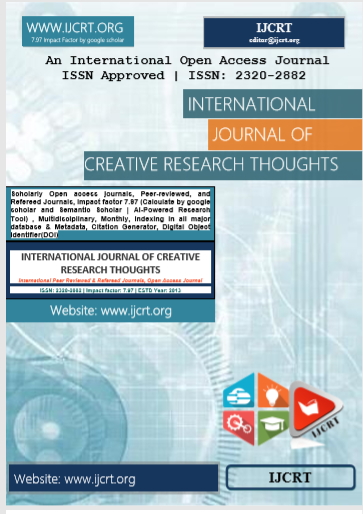 |
 |
|---|---|
| IJCRT Journal front page | IJCRT Journal Back Page |
Paper Title: Beyond Godot: Modern Absurdities and the Crisis of Meaning in Contemporary Television
Publisher Journal Name: IJCRT
Your Paper Publication Details:
Published Paper ID: - IJCRT2504075
Register Paper ID - 281268
Title: BEYOND GODOT: MODERN ABSURDITIES AND THE CRISIS OF MEANING IN CONTEMPORARY TELEVISION
Author Name(s): Akanksha Saini
Publisher Journal name: IJCRT
Volume: 13
Issue: 4
Pages: a582-a585
Year: April 2025
Downloads: 342
Abstract
What if all this chaos of everyday lives were not a harbinger of despair but rather a doorway to deeper self-discovery? From Beckett's portrayal of meaninglessness in Waiting for Godot to the self-aware cynicism of Fleabag and the never-ending loops of Russian Doll, absurdism has been ever-changing and constantly taking on new forms. Which is no longer limited to the stage but can be seen in contemporary storytelling, blending dark humor with self-aware narration to mirror the challenges of the present world. This paper aims to explore how absurdism has transformed from being a bleak narrative of post-war theater into a multidisciplinary exploration of personal identity, trauma, and the fractured nature of reality. Together, these series merge absurdity with personal narratives, feminist ideas, and psychological depth. By tracing absurdism from its theatrical beginnings to its modern forms, this paper shows the present relevance of absurdism in contemporary times. In an era where meaning is often hard to find, absurdity not only reveals chaos but also offers a way to organize it.
Licence: creative commons attribution 4.0
License
Creative Commons Attribution 4.0 and The Open Definition

Keywords
Absurdism, Existentialism, Crisis of Meaning, Contemporary Television, Fourth-Wall Breaking, Cyclical Narrative, Trauma, Self-Discovery, Female Empowerment, Dark Humor, Time Loop, Existential Dread, Digital Age, Hyperconnectivity, Identity Fragmentation, Psychological Exploration, Existential Ambiguity, Feminist Perspectives, Self-Referential Storytelling, Healing, Nihilism, Agency, Sociocultural Issues, Postmodern Storytelling, Repetition, Meaninglessness, Psychological Complexity, Social Media
License
Creative Commons Attribution 4.0 and The Open Definition
Paper Title: Physical and Mental Agony through Power Domination from the Perspective of Benyamin
Publisher Journal Name: IJCRT
Your Paper Publication Details:
Published Paper ID: - IJCRT2504074
Register Paper ID - 281282
Title: PHYSICAL AND MENTAL AGONY THROUGH POWER DOMINATION FROM THE PERSPECTIVE OF BENYAMIN
Author Name(s): Mrs.S.Athisayamani, Dr.S.Joy Isabella
Publisher Journal name: IJCRT
Volume: 13
Issue: 4
Pages: a574-a581
Year: April 2025
Downloads: 300
Abstract
The concept of alienation has been a part of an ordinary persons life. The alienation can be associated with the people who have gone out of the society and the young generation who have gone out of the values of life. So, it could be called the separation of one set from society. The alienation concept has been used in sociology by Karl Marx. Now a day the concept of alienation had become part of ordinary language, much used in the media. We may be told, for example, that those groups are becoming alienated from society, or that young people are alienated from mainstream values. With such usage of the concept we get the impression of the feeling of separation of one group from society, but the concept has traditionally been used in sociology. The Indo-English literature conjointly, couldnt stay unaffected by historical and socio-cultural reasons. Alienation is a basic theme and repeated motif in several Indo-English novels. The earlier Indo-English novelists were so conscious of the dilemma ensuing from alienation. Their works bear witness to a definite involvement with the ever-changing national scene and a real concern for the destiny of the country. Even after they felt bring to an end, their sense of isolation was never therefore acute as that of the later novelists. The explanation for the sooner Indo-English novelists feeling rather lonely was mainly socio-political. Whereas delineating alienated persons, their main aim appears to possess been to demonstrate the potential dangers of two cultures meeting in one and also the same person and leading to his unfortunate isolation.
Licence: creative commons attribution 4.0
License
Creative Commons Attribution 4.0 and The Open Definition
Keywords
Culture, alienation, physical agony, sociology, isolation, socio cultural relation
License
Creative Commons Attribution 4.0 and The Open Definition
Paper Title: Decentralized Ai Powered Fake News Detection
Publisher Journal Name: IJCRT
Your Paper Publication Details:
Published Paper ID: - IJCRT2504073
Register Paper ID - 280885
Title: DECENTRALIZED AI POWERED FAKE NEWS DETECTION
Author Name(s): Sachin
Publisher Journal name: IJCRT
Volume: 13
Issue: 4
Pages: a564-a573
Year: April 2025
Downloads: 309
Abstract
This research presents a decentralized platform that combines artificial intelligence with blockchain technology to combat fake news. Our proposed system leverages a Web3 architecture to create transparent verification processes while ensuring data privacy through federated learning. Experimental results demonstrate 92% accuracy in detecting misinformation using multimodal deep learning models, with verification results immutably stored on blockchain. The platform's decentralized voting mechanism successfully identified and corrected AI misclassifications in over 92% of contested cases, even with significant adversarial participation. Blockchain integration provides unprecedented transparency in the verification process, addressing trust deficits in traditional fact-checking systems. While technical users showed high adoption rates, interface simplification remains necessary for broader public participation. This framework represents a significant advancement in combating misinformation by combining AI capabilities with blockchain transparency.
Licence: creative commons attribution 4.0
License
Creative Commons Attribution 4.0 and The Open Definition
Keywords
Decentralized Verification, Fake News Detection, Web3, Artificial Intelligence, Natural Language Processing, Blockchain, IPFS, Decentralized Voting, Transparency, Data Integrity.
License
Creative Commons Attribution 4.0 and The Open Definition
Paper Title: Trade Unions in India: Role and Significance in the Changing World.
Publisher Journal Name: IJCRT
Your Paper Publication Details:
Published Paper ID: - IJCRT2504072
Register Paper ID - 280921
Title: TRADE UNIONS IN INDIA: ROLE AND SIGNIFICANCE IN THE CHANGING WORLD.
Author Name(s): Dr Surya Aravindakshan
Publisher Journal name: IJCRT
Volume: 13
Issue: 4
Pages: a559-a563
Year: April 2025
Downloads: 350
Abstract
Trade Unions are necessary for protecting labour rights in all walks of life. They have the responsibility to closely observe the developments in the employment sector and act as the agency to empower the capability of the labour classes to meet the requirements of the globalised era. The Indian trade union movement has had a long history since the national movement. But globalisation brings certain challenges to employees and their unions. In this situation, trade unions should redefine their strategies and play a more active role in upholding and protecting labour rights.
Licence: creative commons attribution 4.0
License
Creative Commons Attribution 4.0 and The Open Definition
Keywords
Trade Union, Globalisation, Liberalisation, Priviatisation.
License
Creative Commons Attribution 4.0 and The Open Definition
Paper Title: A comparative study of customer satisfaction towards online shopping in amazon and flipkart with special reference to Coimbatore city
Publisher Journal Name: IJCRT
Your Paper Publication Details:
Published Paper ID: - IJCRT2504071
Register Paper ID - 281236
Title: A COMPARATIVE STUDY OF CUSTOMER SATISFACTION TOWARDS ONLINE SHOPPING IN AMAZON AND FLIPKART WITH SPECIAL REFERENCE TO COIMBATORE CITY
Author Name(s): Mr.S.Vinothkumar, Ms. S.Pavithra
Publisher Journal name: IJCRT
Volume: 13
Issue: 4
Pages: a554-a558
Year: April 2025
Downloads: 331
Abstract
E-commerce's explosive expansion has changed how consumers purchase, making online retailers like Amazon and Flipkart major players in the Indian retail sector. With an emphasis on Coimbatore city specifically, this study compares how satisfied customers are with online purchasing on these platforms. The study assesses a number of variables that affect consumer satisfaction, such as product diversity, cost, payment security, delivery services, user interface, and special offers. A standardized questionnaire was used to survey a sample of 120 people, and chi-square tests, correlation analysis, rank analysis, and percentage analysis were used to examine the data. The results show that both platforms provide a competitive purchasing experience, but Amazon is more trusted for product quality and delivery dependability, while Flipkart is preferred for pricing and offers. Furthermore, it was discovered that promotional activity and security concerns affected consumer trust and purchasing decisions
Licence: creative commons attribution 4.0
License
Creative Commons Attribution 4.0 and The Open Definition
Keywords
Indian retail sector, purchasing
License
Creative Commons Attribution 4.0 and The Open Definition
Paper Title: AI Applications in Food Waste Management: A Pathway to Circular Economy
Publisher Journal Name: IJCRT
Your Paper Publication Details:
Published Paper ID: - IJCRT2504070
Register Paper ID - 280801
Title: AI APPLICATIONS IN FOOD WASTE MANAGEMENT: A PATHWAY TO CIRCULAR ECONOMY
Author Name(s): Dr. Surbhi Ghai, Mamata Ashok Iskape, Navjot
Publisher Journal name: IJCRT
Volume: 13
Issue: 4
Pages: a547-a553
Year: April 2025
Downloads: 365
Abstract
The integration of artificial intelligence (AI) in food waste illustrates a transformational approach to promoting the principles of a circular economy. This study examines how Ai controlled technologies, food persecution, classification and redistribution can be optimized, including machine learning, computer vision, and predictive analytics. Ai driven systems enable real time monitoring, demand forecasting and efficient selection mechanisms, reducing waste at various stages of the supply chain. Although AI is used in a wide range of waste disposal areas, such as construction and recycling of electronic equipment, food management possibilities remain underdeveloped. Existing research demonstrates the effectiveness of AI in optimizing waste classification and recycling and demonstrating its applicability to food loss solutions. By integrating AI into IoT sensors and blockchain technology, it dramatically improves food surveillance transparency and traceability, promotes efficient resource recovery and minimizes reliance on landfills. This study highlights the need for Ai controlled innovation to improve food system sustainability, mitigate environmental impacts, and support cyclical economic goals. Future research should focus on developing solutions for AI applications tailored to food waste to ensure efficiency, cost-effectiveness and scalability for various sectors.
Licence: creative commons attribution 4.0
License
Creative Commons Attribution 4.0 and The Open Definition
Keywords
Artificial Intelligence (AI), Food Waste Management, Circular Economy, IoT Sensors.
License
Creative Commons Attribution 4.0 and The Open Definition
Paper Title: India - Pakistan Relations: Analysing Political Dynamics, Societal Tensions and Economic Implications in South Asian Region
Publisher Journal Name: IJCRT
Your Paper Publication Details:
Published Paper ID: - IJCRT2504069
Register Paper ID - 281220
Title: INDIA - PAKISTAN RELATIONS: ANALYSING POLITICAL DYNAMICS, SOCIETAL TENSIONS AND ECONOMIC IMPLICATIONS IN SOUTH ASIAN REGION
Author Name(s): Shambhavi Mishra, Dr Nilanjana Saha
Publisher Journal name: IJCRT
Volume: 13
Issue: 4
Pages: a536-a546
Year: April 2025
Downloads: 330
Abstract
India and Pakistan, two neighboring countries, were once part of a unified territory known as Hindustan during the British Raj. The partition of India in August 1947 was a significant and unique historical event, driven by the demand for independence and the divergent aspirations of two major political entities. The Indian National Congress, led by Jawaharlal Nehru, sought a united India free from colonial rule. At the same time, the Muslim League, under the leadership of Muhammad Ali Jinnah, advocated for the creation of Pakistan, a separate state for Muslims. Despite facing numerous challenges and criticisms, the partition eventually led to the birth of two nations: India and Pakistan. August 1947 marked a bittersweet period; while independence from the British was achieved, the partition brought about immense suffering, displacement, and loss for millions on both sides. The partition of India left a lasting impact on the subcontinent, deeply embedding itself in the collective consciousness of India, Pakistan, and Bangladesh. The legacy of this tumultuous period continues to influence the socio-political landscape and the lives of its citizens today.
Licence: creative commons attribution 4.0
License
Creative Commons Attribution 4.0 and The Open Definition
Keywords
Partition of India (1947), Two-Nation Theory, India Independence Act (1947), Mass Migration & Refugee Crisis, Communal Violence, Radcliffe Line & Territorial Division, Jawaharlal Nehru & Nation-Building, First Indo-Pak War (1947-48), 1971 Bangladesh Liberation War, Political Instability in Pakistan, India-Pakistan Diplomatic Relations & Conflicts
License
Creative Commons Attribution 4.0 and The Open Definition
Paper Title: Formulation and Evaluation of Safe Herbal Mosquito Repellent Dhoop Sticks
Publisher Journal Name: IJCRT
Your Paper Publication Details:
Published Paper ID: - IJCRT2504068
Register Paper ID - 281047
Title: FORMULATION AND EVALUATION OF SAFE HERBAL MOSQUITO REPELLENT DHOOP STICKS
Author Name(s): Wagh Saiprasad Rameshrao, Wagh Shailesh Suresh, Prachi murkute
Publisher Journal name: IJCRT
Volume: 13
Issue: 4
Pages: a526-a535
Year: April 2025
Downloads: 362
Abstract
These days, mosquito-borne illnesses are a serious health concern. Mosquitoes are largely responsible for the transmission of several diseases, such as dengue, malaria, and yellow fever Herbal dhoop is a natural product made from plant parts that naturally repel mosquitoes. It is safe, non-toxic, and environmentally friendly. It is manufactured from a special combination of plant extracts and aromatic oils that keep insects and mosquitoes away. The essential oils and plant extracts used in this study were evaluated at varying doses using a handcrafted mosquito stick in a room with a lot of insects. The findings showed that certain herbal plant combinations have mosquito-repelling properties. Use of camphor, neem, tulsi, marigold, and other plants that have been shown to have the strongest insect repellents and no irritation is safe and environmentally beneficial
Licence: creative commons attribution 4.0
License
Creative Commons Attribution 4.0 and The Open Definition
Keywords
Herbal Dhoop, Mosquito repellent, Sandalwood, Marigold flower.
License
Creative Commons Attribution 4.0 and The Open Definition
Paper Title: Real Time Robotic Prosthetic Arm Using Arduino
Publisher Journal Name: IJCRT
Your Paper Publication Details:
Published Paper ID: - IJCRT2504067
Register Paper ID - 281046
Title: REAL TIME ROBOTIC PROSTHETIC ARM USING ARDUINO
Author Name(s): Viswanatha K P, Trissa Martin, Aswathy Chandran, Rubeena A. A., Linu Jose
Publisher Journal name: IJCRT
Volume: 13
Issue: 4
Pages: a520-a525
Year: April 2025
Downloads: 359
Abstract
In our society there are people who suffer from paralytic diseases that cause them sev eral disabilities like damage to brain or spinal cord, that can happen in a car accident, fall, or sports injury. An EMG (electromyography) signal is a biomedical signal that measures the electrical activity of muscles. EMG signals are used to study neuromuscu lar activities and muscle force. Prostheses are artificial replacements that a person can wear in place of a missing body part. Here we are using a robotic arm for a handicapped person. The project is working under the principle of EMG. The Signals are generated when muscles contract, which creates charged particles in the muscle membrane and these signals are measured using electrodes placed on the skin. Different types of upper limb exoskeletons are deployed in the robotic-based rehabilitation purposes according to the functionality of the robotic devices.
Licence: creative commons attribution 4.0
License
Creative Commons Attribution 4.0 and The Open Definition
Paper Title: Consumer Perceptions of Credit Card Tokenization: Privacy and Convenience Paradox
Publisher Journal Name: IJCRT
Your Paper Publication Details:
Published Paper ID: - IJCRT2504066
Register Paper ID - 281022
Title: CONSUMER PERCEPTIONS OF CREDIT CARD TOKENIZATION: PRIVACY AND CONVENIENCE PARADOX
Author Name(s): Dr. Amutha R
Publisher Journal name: IJCRT
Volume: 13
Issue: 4
Pages: a508-a519
Year: April 2025
Downloads: 337
Abstract
This study explores the key factors influencing consumer trust in credit card tokenization systems, focusing on aspects such as privacy concerns, ease of use, user experience, and reliability. Through a combination of descriptive statistics, correlation analysis, and multiple regression analysis, we analyzed data collected from 150 respondents to identify the most significant determinants of trust in tokenization. The descriptive analysis revealed that respondents generally hold moderate perceptions of tokenization, with a slight inclination towards viewing the system as reliable. Correlation analysis indicated positive relationships between trust in tokenization and factors such as reliability and security perception, though privacy concerns showed a weaker correlation with trust. The multiple regression analysis identified reliability as the most significant predictor of trust, with a strong positive impact, while other factors like privacy concerns, ease of use, and user experience did not show statistically significant effects. These findings underscore the importance of enhancing the reliability of tokenization systems to build and maintain consumer trust. The study concludes that while privacy and usability are important, the perceived reliability of tokenization systems is the most critical factor in fostering consumer confidence and ensuring widespread adoption of tokenized payment methods.
Licence: creative commons attribution 4.0
License
Creative Commons Attribution 4.0 and The Open Definition
Keywords
Credit Card Tokenization, Privacy Concerns, Consumer Trust, Digital Payments
License
Creative Commons Attribution 4.0 and The Open Definition
Paper Title: A STUDY ON THE USAGE OF LIBRARY RESOURCES OF COLLEGE STUDENTS AFTER COLLEGE HOURS
Publisher Journal Name: IJCRT
Your Paper Publication Details:
Published Paper ID: - IJCRT2504065
Register Paper ID - 281137
Title: A STUDY ON THE USAGE OF LIBRARY RESOURCES OF COLLEGE STUDENTS AFTER COLLEGE HOURS
Author Name(s): Dr. S. Arunpriya, V. Padma rajee
Publisher Journal name: IJCRT
Volume: 13
Issue: 4
Pages: a503-a507
Year: April 2025
Downloads: 324
Abstract
This research examines the patterns of how college students utilize library resources beyond regular academic hours. Due to the rising expectations of students to perform well academically, students often advance their study times beyond what is scheduled and need a space on campus to study, carry out research, complete an assignment, or engage in self-study, and libraries are often these spaces. The study examines elements that affect student after-hour library use such as accessibility to library resources, types of available resources, use of digitally-based tools, and student preferences. Student data were collected through online surveys and observations which helped to notify the research on understanding and making improvements to the library's services for student engagement. The findings are intended to assist educational institutions in optimizing library resources to provide improved support to student learning.
Licence: creative commons attribution 4.0
License
Creative Commons Attribution 4.0 and The Open Definition
Keywords
Library Usage, College Students, After-Hours Study, Academic Resources, Digital Libraries, Student Engagement, Library Services.
License
Creative Commons Attribution 4.0 and The Open Definition
Paper Title: A Study on the Adoption and Usage of UPI among the GEN Z
Publisher Journal Name: IJCRT
Your Paper Publication Details:
Published Paper ID: - IJCRT2504064
Register Paper ID - 281152
Title: A STUDY ON THE ADOPTION AND USAGE OF UPI AMONG THE GEN Z
Author Name(s): Arunpriya.S, Aarthi.J
Publisher Journal name: IJCRT
Volume: 13
Issue: 4
Pages: a498-a502
Year: April 2025
Downloads: 355
Abstract
The study explains that Gen Z users prioritize speed and simplicity when using UPI, with 78% valuing instant transaction processing as a key factor. Security concerns, however, remain a significant barrier, as 62% express apprehension about potential fraud or data breaches. Despite this, the convenience of cashless payments, coupled with the ability to split bills and make seamless online purchases, drives consistent usage. The research further highlights that while rewards and cashback offer attract initial adoption, sustained usage depends more on reliable service, ease of dispute resolution, and minimal transaction failures. Additionally, the study underscores the growing preference for contactless payments, with QR code scanning emerging as the most common method of UPI transactions. To foster long-term loyalty, fintech platforms must prioritize robust security measures, personalized offers, and enhanced app features tailored to Gen Z preferences.
Licence: creative commons attribution 4.0
License
Creative Commons Attribution 4.0 and The Open Definition
Keywords
UPI, Gen Z, digital payments, fintech, Google Pay, social influence, rewards.
License
Creative Commons Attribution 4.0 and The Open Definition
Paper Title: A CYBERCRIME AGAINST WOMEN IN INDIA: A CRTICAL ANALYSIS
Publisher Journal Name: IJCRT
Your Paper Publication Details:
Published Paper ID: - IJCRT2504063
Register Paper ID - 280930
Title: A CYBERCRIME AGAINST WOMEN IN INDIA: A CRTICAL ANALYSIS
Author Name(s): Balreen Kaur Brar, Ms. Parul
Publisher Journal name: IJCRT
Volume: 13
Issue: 4
Pages: a491-a497
Year: April 2025
Downloads: 472
Abstract
Cybercrime cases against women are increasing tremendously. This study will discuss about reasons of targeting women and various kinds of cybercrime as well as its critical analysis. It is essential to combat these crimes against women because it is against fundamental rights. Strict laws must be implemented and awareness must be created among women about technology and must gain knowledge about new cybercrimes.
Licence: creative commons attribution 4.0
License
Creative Commons Attribution 4.0 and The Open Definition
Keywords
Cybercrime, women, cybercriminals
License
Creative Commons Attribution 4.0 and The Open Definition
Paper Title: Hinsa Prabhavit mahilao hetu sarkar ki ek pahal:one stop centre
Publisher Journal Name: IJCRT
Your Paper Publication Details:
Published Paper ID: - IJCRT2504062
Register Paper ID - 280965
Title: HINSA PRABHAVIT MAHILAO HETU SARKAR KI EK PAHAL:ONE STOP CENTRE
Author Name(s): Kiran Snehi, Dr. Reena Tiwari
Publisher Journal name: IJCRT
Volume: 13
Issue: 4
Pages: a486-a490
Year: April 2025
Downloads: 324
Abstract
Hinsa Prabhavit mahilao hetu sarkar ki ek pahal:one stop centre
Licence: creative commons attribution 4.0
License
Creative Commons Attribution 4.0 and The Open Definition
Keywords
Hinsa Prabhavit mahilao hetu sarkar ki ek pahal:one stop centre
License
Creative Commons Attribution 4.0 and The Open Definition
Paper Title: GROWTH, STRUCTURAL, OPTICAL, THERMAL AND MECHANICAL STUDIES OF SEMICARBOZIDEHYDROCLORIDE ADIPATE FOR NONLINEAR OPTICAL APPLICATIONS
Publisher Journal Name: IJCRT
Your Paper Publication Details:
Published Paper ID: - IJCRT2504061
Register Paper ID - 280994
Title: GROWTH, STRUCTURAL, OPTICAL, THERMAL AND MECHANICAL STUDIES OF SEMICARBOZIDEHYDROCLORIDE ADIPATE FOR NONLINEAR OPTICAL APPLICATIONS
Author Name(s): R. VASUGHI, Dr. L.JOTHI - CORRESPONDING AUTHOR
Publisher Journal name: IJCRT
Volume: 13
Issue: 4
Pages: a474-a485
Year: April 2025
Downloads: 303
Abstract
Non- linear optical crystals have a great impact on information technology and industrial applications.The present paper deals with the growth and characterization of Semicarbozidehydrocloride adipate (SCHA). An organic non-linear optical material of SCHA was synthesized ethanol as a solvent .The single crystals were grown by slow evaporation technique at room temperature. The cell dimensions obtained by single crystal X-ray diffraction studies reveal that the crystal belongs to the orthorhombic system. The occurrence of prospective functional groups was initially identified by FTIR and FT-Raman spectroscopic studies. The optical transparency of the crystals was determined by UV- Visible studies in the wavelength range of 200-1200 nm. Second harmonic generation conversion efficiency found using the Kurtz and Perry method is about 4.2 times that of KDP. The thermal stability of the compound was determined by TG-DTA analysis of the specimen. The microhardness test was carried out and the load dependent hardness was measured.
Licence: creative commons attribution 4.0
License
Creative Commons Attribution 4.0 and The Open Definition
Keywords
X-ray diffraction, FT-IR, Optical transmission, Second harmonic generation, TGA/DTA
License
Creative Commons Attribution 4.0 and The Open Definition
Paper Title: A Study on Analysis of Life Insurance Products for Investment Purposes
Publisher Journal Name: IJCRT
Your Paper Publication Details:
Published Paper ID: - IJCRT2504060
Register Paper ID - 281078
Title: A STUDY ON ANALYSIS OF LIFE INSURANCE PRODUCTS FOR INVESTMENT PURPOSES
Author Name(s): Nishil Poojara
Publisher Journal name: IJCRT
Volume: 13
Issue: 4
Pages: a470-a473
Year: April 2025
Downloads: 335
Abstract
Life insurance is a vital financial tool that offers protection and serves as a long-term investment avenue. This study investigates consumer perceptions, preferences, and the factors influencing investment decisions in life insurance products. Based on a survey of 63 respondents, the study evaluates various insurance policies and their investment potential. Findings indicate that a majority of investors consider life insurance for tax benefits and financial security, yet concerns regarding high premiums, complex policy structures, and lack of transparency impact their decision-making. The study also presents comparative insights between life insurance and other investment options like mutual funds and fixed deposits. Recommendations include enhancing policy transparency, reducing premium costs, and increasing awareness regarding investment-linked insurance products.
Licence: creative commons attribution 4.0
License
Creative Commons Attribution 4.0 and The Open Definition
Keywords
Life Insurance, Investment, Risk Management, Tax Benefits, Financial Planning, Consumer Behavior
License
Creative Commons Attribution 4.0 and The Open Definition
Paper Title: Analysing The Joint Impact Of Funding And Incubation Towards Entrepreneurs Startup Success
Publisher Journal Name: IJCRT
Your Paper Publication Details:
Published Paper ID: - IJCRT2504059
Register Paper ID - 281289
Title: ANALYSING THE JOINT IMPACT OF FUNDING AND INCUBATION TOWARDS ENTREPRENEURS STARTUP SUCCESS
Author Name(s): Dr.V.Sengani, Ms.P.Srimahalakshmi
Publisher Journal name: IJCRT
Volume: 13
Issue: 4
Pages: a467-a469
Year: April 2025
Downloads: 303
Abstract
The research suggests the joint effect of incubation and funding towards entrepreneurial start-up success. Funding supplies strategic capital that is needed for product development, marketing, and expansion, while incubation provides strategic advice, networking, and business expansion services. The research analyzes the joint effects of these two towards start-up survival, expansion, and long-term viability.With a mixed-methodology, the study applies quantitative assessment to analyze the interconnection of startup success, funding, and incubation, and qualitative case studies to gather more information. Results show that startups that receive both incubation and funding support perform better than those receiving funding support or incubation support separately. It suggests that there is a necessity for integrated support systems with a mix of financial and non-financial forms of assistance to obtain the best entrepreneurial outcomes.
Licence: creative commons attribution 4.0
License
Creative Commons Attribution 4.0 and The Open Definition
Keywords
Entrepreneurship, Startup Success, Funding, Business Incubation, Venture Capital, Business Growth, Startup Ecosystem, Innovation, Entrepreneurial Support, Small Business Development
License
Creative Commons Attribution 4.0 and The Open Definition
Paper Title: Leakage current detection nad electric hazard prevention safety footware
Publisher Journal Name: IJCRT
Your Paper Publication Details:
Published Paper ID: - IJCRT2504058
Register Paper ID - 281240
Title: LEAKAGE CURRENT DETECTION NAD ELECTRIC HAZARD PREVENTION SAFETY FOOTWARE
Author Name(s): Prathamesh Rajendra Taskar, Prasad Rajendra Patil, Shubham Bhaskar Gaikwad, Ajay Kushaba Dhage, Aditya Yogesh Patole
Publisher Journal name: IJCRT
Volume: 13
Issue: 4
Pages: a464-a466
Year: April 2025
Downloads: 309
Abstract
Electrical hazards pose serious risks in industrial, commercial, and household environments, often leading to electric shocks, fires, and equipment damage. This project focuses on designing a wearable electrical hazard detection system using a transistor-based circuit instead of complex microcontrollers. The system detects live electrical fields and leakage currents, providing real-time alerts through an led and buzzer. The circuit is lightweight, portable, and energy- efficient, making it suitable for electricians, industrial workers, and general users. Rigorous testing and troubleshooting ensured accuracy, stability, and reliability. This project contributes to enhanced safety measures and can be further improved with wireless alerts, smart integration, and advanced hazard prediction.
Licence: creative commons attribution 4.0
License
Creative Commons Attribution 4.0 and The Open Definition
Keywords
Leakage current, Hazard, Electrical shocks ,Real time alert
License
Creative Commons Attribution 4.0 and The Open Definition
Paper Title: Rigorous Approach to the Stability of Cubic Functional Equation in Quasi-Beta Banach Space
Publisher Journal Name: IJCRT
Your Paper Publication Details:
Published Paper ID: - IJCRT2504057
Register Paper ID - 281142
Title: RIGOROUS APPROACH TO THE STABILITY OF CUBIC FUNCTIONAL EQUATION IN QUASI-BETA BANACH SPACE
Author Name(s): M.Arunkumar, V.Chandiran, E.Sathya
Publisher Journal name: IJCRT
Volume: 13
Issue: 4
Pages: a455-a463
Year: April 2025
Downloads: 320
Abstract
In this pioneering research, we leverage the direct and fixed-point approaches to meticulously prove the Ulam-Hyers-Rassias stability of a cubic functional equation characterized by a complex and innovative mean sum formulation of successive function variables in quasi-?-Banach space.
Licence: creative commons attribution 4.0
License
Creative Commons Attribution 4.0 and The Open Definition
Keywords
Cubic functional equation, UHR Stability, Quasi-Beta- Banach space, Complete Normed Space, Fixed point, Hyers Approach, Contractive Mapping.
License
Creative Commons Attribution 4.0 and The Open Definition
Paper Title: A Value Chain Analysis of the Solid Liquid Separator Industry in Gujarat
Publisher Journal Name: IJCRT
Your Paper Publication Details:
Published Paper ID: - IJCRT2504056
Register Paper ID - 281284
Title: A VALUE CHAIN ANALYSIS OF THE SOLID LIQUID SEPARATOR INDUSTRY IN GUJARAT
Author Name(s): Swapnil Borude, Raj Bhatt, Mohit Parekh
Publisher Journal name: IJCRT
Volume: 13
Issue: 4
Pages: a448-a454
Year: April 2025
Downloads: 303
Abstract
The value chain in Gujarat's solid-liquid separator sector is examined in this research report. The study analyzes Rotofilt Engineers Ltd.'s major and supporting activities using a descriptive research design. Surveys and questionnaires were used to collect primary data, and corporate records and industry reports were used to obtain secondary data. The results highlight important obstacles and potential opportunities for value chain optimization, especially with regard to resource allocation, cost structure comprehension, and customer value delivery. The analysis advances our knowledge of this industry's competitive advantage and strategic decision-making.
Licence: creative commons attribution 4.0
License
Creative Commons Attribution 4.0 and The Open Definition
Keywords
Supply Chain, Manufacturing, Competitive Advantage, Process Efficiency, Solid-Liquid Separation, Gujarat, Industrial Equipment, Value Chain Analysis
License
Creative Commons Attribution 4.0 and The Open Definition
All Published Paper Details Search Through Above Search Option.
About IJCRT
The International Journal of Creative Research Thoughts (IJCRT) aims to explore advances in research pertaining to applied, theoretical and experimental Technological studies. The goal is to promote scientific information interchange between researchers, developers, engineers, students, and practitioners working in and around the world.
Indexing In Google Scholar, ResearcherID Thomson Reuters, Mendeley : reference manager, Academia.edu, arXiv.org, Research Gate, CiteSeerX, DocStoc, ISSUU, Scribd, and many more International Journal of Creative Research Thoughts (IJCRT) ISSN: 2320-2882 | Impact Factor: 7.97 | 7.97 impact factor and ISSN Approved. Provide DOI and Hard copy of Certificate. Low Open Access Processing Charges. 1500 INR for Indian author & 55$ for foreign International author. Call For Paper (Volume 14 | Issue 8 | Month- August 2026)
Call For Paper August 2026
Call For Papers
August 2026
Volume 14 | Issue 8
Last Date :
31-Aug-2026
Submit Manuscript Online Impact Factor: 7.97 Review Results : Within 02-03 Days Paper Publication : Within 02-03 Days
August 2026
Volume 14 | Issue 8
Last Date :
31-Aug-2026
Submit Manuscript Online Impact Factor: 7.97 Review Results : Within 02-03 Days Paper Publication : Within 02-03 Days
Published Issue Details
For Authors
Forms / Downloads
Other IMP Links
Indexing Partner
Research Area
LICENSE





ISSN and 7.97 Impact Factor Details
ISSN: 2320-2882 Impact Factor: 7.97 and ISSN APPROVED Journal Starting Year (ESTD) : 2013


ISSN and 7.97 Impact Factor Details
ISSN: 2320-2882 Impact Factor: 7.97 and ISSN APPROVED Journal Starting Year (ESTD) : 2013
DOI Details
CONFERENCE
CONFERENCE MANAGMENT & PUBLICATION CONFERENCE PROPOSAL
RECENT CONFERENCE

CONFERENCE PROPOSAL CONFERENCE PROCEEDINGS
CONFERENCE PROPOSAL CONFERENCE PROCEEDINGS
For Reviewer /Referral (RMS) Earn 500 per paper
Important Links
NEWS & Conference
Digital Library
IJCRT RMS | Earn 500 Per Paper.

Open Access


LICENSE
Indexing Partner
Scholarly open access journals, Peer-reviewed, and Refereed Journals, Impact factor 7.97 (Calculate by google scholar and Semantic Scholar | AI-Powered Research Tool) , Multidisciplinary, Monthly, Indexing in all major database & Metadata, Citation Generator, Digital Object Identifier(DOI)