Important Details
IJCRT - International Peer Reviewed, Open Access Journal, Multidisciplinary, Monthly, Nominal(Low) Fees for Professional Research Services International Journal of Creative Research Thoughts - IJCRT Peer Review Journal, Refereed Journal, Peer Reviewed Journal , Referred Journal and Indexed Journal, Open access, Online and Print Journal,international Journal Open Access, Accepted by Indian and foreign university ,IJCRT Followed Norms, guidelines, requirement, listing criteria and methodology of score/point also applied from: Scopus , Web of Science , UGC Approved , UGC CARE, UGC-CARE .
UGC Approved Journal No: 49023 (18)
UGC approval Link
https://ijcrt.org/ugc%20approval.jpg
All Policy and Approval
Please Like Our Facebook Page | CrossRef DOI and Hard copy of Certificate Provide if required. | www.IJCRT.org | editor@IJCRT.org | IJCRT WhatsApp +91 94294 58311
Publication Details:
- Paper Submission : 31-Aug-2026. Call For Paper (Volume 14 | Issue 8 | Month- August 2026)
- Acceptance/Rejection Notification: Within 02-04 Days.
- Paper Publish: Within 02-04 Days after submitting all documents.
-
Submit Your Paper Any time There No deadline.
-
Publication fees : 1570 INR for Indian author & 59$ for foreign International author.
Please Like Our Facebook Page | CrossRef DOI and Hard copy of Certificate Provide if required.
Licence and Indexing
Indexing In Google Scholar, SSRN, ResearcherID-Publons, Semantic Scholar | AI-Powered Research Tool, Microsoft Academic, Academia.edu, arXiv.org, Research Gate, CiteSeerX, ResearcherID Thomson Reuters, Mendeley : reference manager, DocStoc, ISSUU, Scribd, and many more | High Impact Factor: 7.97 | Digital object identifier (DOI) and Hard Copy of certificate Provided.




























Licence
DOI
ISSN Approved impact factor: 7.97 
Creative Common 
Valid as per new UGC Gazette regulations 

INTERNATIONAL JOURNAL OF CREATIVE RESEARCH THOUGHTS - IJCRT (IJCRT.ORG)
International Peer Reviewed & Refereed Journals, Open Access Journal
IJCRT Peer-Reviewed (Refereed) Journal as Per New UGC Rules.
ISSN Approved Journal No: 2320-2882 | Impact factor: 7.97 | ESTD Year: 2013
Call For Paper - Volume 14 | Issue 8 | Month- August 2026
Scholarly open access journals, Peer-reviewed, and Refereed Journals, Impact factor 7.97 (Calculate by google scholar and Semantic Scholar | AI-Powered Research Tool) , Multidisciplinary, Monthly, Indexing in all major database & Metadata, Citation Generator, Digital Object Identifier(CrossRef DOI)
IJCRT WhatsApp Contact
IJCRT Search Xplore - Search all paper by Paper Name , Author Name, and Title
Volume 14 | Issue 8 |
Volume 14 | Issue 8 | Month
Downlaod After Publication 1) Table of content index in PDF
2) Table of content index in HTML 2)Table of content index in HTML
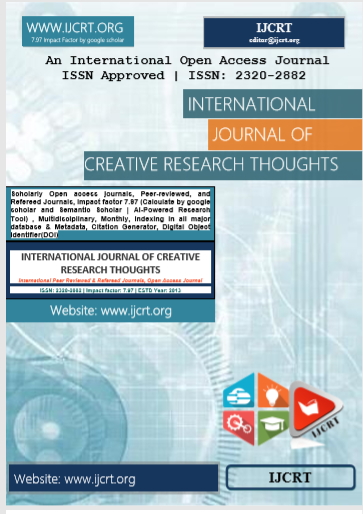
3) Front Page 3) Front Page
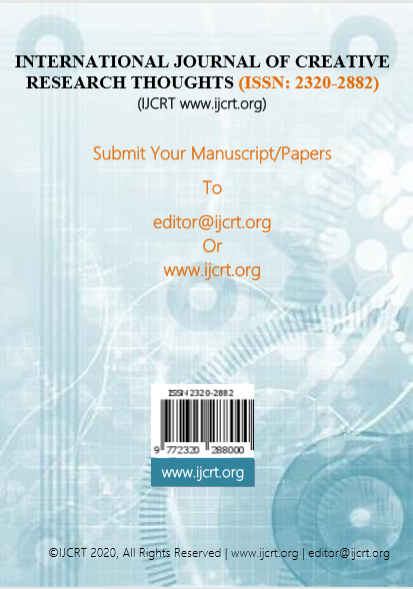
4) Back Page 4) Back Page
5) Editor Board Member 5)Editor Board Member
6) OLD Style Issue 6)OLD Style Issue
 |
 |
|---|---|
| IJCRT Journal front page | IJCRT Journal Back Page |
Paper Title: Understanding the Impact of Omnichannel Retailing on Consumer Experience: An Empirical Study of Retail Customers in Nashik
Author Name(s): Dr. Sachin Haushiram Patole
Published Paper ID: - IJCRT2608300
Register Paper ID - 312743
Publisher Journal Name: IJPUBLICATION, IJCRT
DOI Member ID: 10.6084/m9.doi.one.IJCRT2608300 and DOI :
Author Country : Indian Author, India, 422003 , Nashik, 422003 , | Research Area: Commerce and Management, MBA All Branch Published Paper URL: http://ijcrt.org/viewfull.php?&p_id=IJCRT2608300 Published Paper PDF: download.php?file=IJCRT2608300 Published Paper PDF: http://www.ijcrt.org/papers/IJCRT2608300.pdf
Your Paper Publication Details:
Title: UNDERSTANDING THE IMPACT OF OMNICHANNEL RETAILING ON CONSUMER EXPERIENCE: AN EMPIRICAL STUDY OF RETAIL CUSTOMERS IN NASHIK
DOI (Digital Object Identifier) :
Pubished in Volume: 14 | Issue: 8 | Year: August 2026
Publisher Name : IJCRT | www.ijcrt.org | ISSN : 2320-2882
Subject Area: Commerce and Management, MBA All Branch
Author type: Indian Author
Pubished in Volume: 14
Issue: 8
Pages: c777-c789
Year: August 2026
Downloads: 7
E-ISSN Number: 2320-2882
Abstract
Abstract-- With the speed of change and the impact of digital technologies on retail, retailers are increasingly adopting omnichannel retailing, which involves blending physical and digital channels, to create a unified and personalized customer journey. The current research is based on the analysis of the effect of omnichannel retail on consumer experience of retail customers of Nashik city. The study seeks to gain insights into the significance of omnichannel retailing practices, breakdown their impact on the customer experience, and propose strategies to improve customer engagement and satisfaction. The research design used was a quantitative research design, and the research methods used were questionnaires, which were structured on a 5-point Likert scale, and a sample of 400 retail consumers were used. The respondents were selected using convenience sampling method, where consumers who have experienced both online and offline integrated shopping experiences were considered. The correlation coefficient, regression analysis and ANOVA techniques were used to analyze the primary data obtained from the survey. The results show that there is a significant positive relationship between the use of omnichannel retailing practices and the changes in the consumer's experience. Channel integration, personalization, convenience, information consistency, and customer service were identified as significant drivers towards improved consumer satisfaction. The study also shows that certain demographic factors can impact consumer perceptions and experiences relating to the 'omnichannel retailing' concept. The research underscores the need for retailers to shift to customer-centric and technology-driven approaches in making the interactions across touchpoints seamless. This study adds to the existing body of research on omnichannel retailing and draws empirical conclusions from an emerging Indian urban retail market. The results provide actionable insights for retailers looking to enhance customer relationships and engagement and gain a competitive edge by leveraging an effective omnichannel approach.
Licence: creative commons attribution 4.0
License
Creative Commons Attribution 4.0 and The Open Definition

Keywords
Omnichannel Retailing, Consumer Experience, Channel Integration, Customer Satisfaction, Retail Technology.
License
Creative Commons Attribution 4.0 and The Open Definition
Paper Title: A Study of Barriers in the Implementation of Inclusive Education as Perceived by Secondary School Teachers in Bihar
Author Name(s): Prashant Kumar Jha, Dr. Bisekha Kumari
Published Paper ID: - IJCRT2608299
Register Paper ID - 312767
Publisher Journal Name: IJPUBLICATION, IJCRT
DOI Member ID: 10.6084/m9.doi.one.IJCRT2608299 and DOI :
Author Country : Indian Author, India, 842001 , Muzaffarpur, 842001 , | Research Area: Arts1 All Published Paper URL: http://ijcrt.org/viewfull.php?&p_id=IJCRT2608299 Published Paper PDF: download.php?file=IJCRT2608299 Published Paper PDF: http://www.ijcrt.org/papers/IJCRT2608299.pdf
Your Paper Publication Details:
Title: A STUDY OF BARRIERS IN THE IMPLEMENTATION OF INCLUSIVE EDUCATION AS PERCEIVED BY SECONDARY SCHOOL TEACHERS IN BIHAR
DOI (Digital Object Identifier) :
Pubished in Volume: 14 | Issue: 8 | Year: August 2026
Publisher Name : IJCRT | www.ijcrt.org | ISSN : 2320-2882
Subject Area: Arts1 All
Author type: Indian Author
Pubished in Volume: 14
Issue: 8
Pages: c773-c776
Year: August 2026
Downloads: 4
E-ISSN Number: 2320-2882
Abstract
Inclusive education seeks to provide equitable learning opportunities for all students, including those with disabilities and from socio-economically disadvantaged groups, within mainstream classrooms. In Bihar, one of India's most educationally challenged states, secondary school teachers encounter multiple barriers that hinder the effective implementation of inclusive education policies such as the Right to Education (RTE) Act 2009, the Rights of Persons with Disabilities (RPwD) Act 2016, Samagra Shiksha, and the National Education Policy (NEP) 2020. This paper examines the barriers perceived by secondary school teachers in Bihar through a synthesis of empirical studies, official data (UDISE+, SSA reports), and research on teacher perceptions. Major barriers identified include inadequate infrastructure and accessibility, insufficient teacher training and pedagogical preparedness, large class sizes and high pupil-teacher ratios, attitudinal and socio-cultural challenges (including caste bias and stigma), rigid curriculum and assessment systems, shortage of special educators and support staff, limited assistive technology and resources, and weak policy implementation and monitoring. The paper discusses the implications of these barriers for classroom practices and student outcomes and offers recommendations for systemic improvement. Strengthening teacher capacity, infrastructure, collaborative support structures, and accountability mechanisms is essential for translating inclusive policy into meaningful secondary-level practice in Bihar.
Licence: creative commons attribution 4.0
License
Creative Commons Attribution 4.0 and The Open Definition
Keywords
Inclusive education; Barriers to inclusion; Secondary school teachers; Bihar; Infrastructure and accessibility; Teacher training; Right to Education Act; Rights of Persons with Disabilities Act; National Education Policy 2020; Samagra Shiksha; Children with Special Needs (CWSN)
License
Creative Commons Attribution 4.0 and The Open Definition
Paper Title: Connected Graph-Based Horoscope Analysis Without Astrological Expertise
Author Name(s): Dr.UmaMaheswari. S, Mrs.Kalaiselvi. A
Published Paper ID: - IJCRT2608298
Register Paper ID - 312682
Publisher Journal Name: IJPUBLICATION, IJCRT
DOI Member ID: 10.6084/m9.doi.one.IJCRT2608298 and DOI :
Author Country : Indian Author, India, 641014 , Coimbatore, 641014 , | Research Area: Mathematics All Published Paper URL: http://ijcrt.org/viewfull.php?&p_id=IJCRT2608298 Published Paper PDF: download.php?file=IJCRT2608298 Published Paper PDF: http://www.ijcrt.org/papers/IJCRT2608298.pdf
Your Paper Publication Details:
Title: CONNECTED GRAPH-BASED HOROSCOPE ANALYSIS WITHOUT ASTROLOGICAL EXPERTISE
DOI (Digital Object Identifier) :
Pubished in Volume: 14 | Issue: 8 | Year: August 2026
Publisher Name : IJCRT | www.ijcrt.org | ISSN : 2320-2882
Subject Area: Mathematics All
Author type: Indian Author
Pubished in Volume: 14
Issue: 8
Pages: c765-c772
Year: August 2026
Downloads: 14
E-ISSN Number: 2320-2882
Abstract
Horoscopes are traditionally interpreted using astrological principles that require extensive domain knowledge and expert judgment. This paper presents a novel graph-theoretic framework for horoscope analysis by transforming a horoscope chart into a connected graph, where planets, zodiac signs, or houses are represented as vertices and their astrological relationships are modeled as edges. The resulting graph preserves the structural dependencies among the horoscope elements while enabling mathematical analysis independent of conventional astrological interpretation.The proposed methodology focuses on two fundamental graph-theoretic concepts: eccentricity and the center of a connected graph. The eccentricity of each vertex is computed to determine its structural influence within the horoscope graph, while the graph center identifies the most central and influential vertices that govern the overall configuration. By analyzing these parameters, the framework identifies dominant planetary or house influences and derives horoscope characteristics without requiring prior knowledge of astrology. This approach transforms qualitative astrological reasoning into a quantitative and algorithmic process, providing an objective basis for horoscope interpretation.The study demonstrates that graph-theoretic measures can effectively capture the intrinsic structure of horoscope charts and reveal significant patterns corresponding to traditional astrological outcomes.
Licence: creative commons attribution 4.0
License
Creative Commons Attribution 4.0 and The Open Definition
Keywords
Connected graphs, Digraphs, Vertices, Edges, Degree of a vertex, Isolated vertex, Eccentricity, Center, Horoscope, Planets, Zodiac Signs, Houses, Aspects,
License
Creative Commons Attribution 4.0 and The Open Definition
Paper Title: AYURVEDIC MANAGEMENT ON DADRU (TINEA INFECTION)-A CASE REPORT.
Author Name(s): Dr.Yashpal Hasrath Wagh, Dr.Umesh Dhaybhar
Published Paper ID: - IJCRT2608297
Register Paper ID - 312759
Publisher Journal Name: IJPUBLICATION, IJCRT
DOI Member ID: 10.6084/m9.doi.one.IJCRT2608297 and DOI :
Author Country : Indian Author, India, - , -, - , | Research Area: Humanities All Published Paper URL: http://ijcrt.org/viewfull.php?&p_id=IJCRT2608297 Published Paper PDF: download.php?file=IJCRT2608297 Published Paper PDF: http://www.ijcrt.org/papers/IJCRT2608297.pdf
Your Paper Publication Details:
Title: AYURVEDIC MANAGEMENT ON DADRU (TINEA INFECTION)-A CASE REPORT.
DOI (Digital Object Identifier) :
Pubished in Volume: 14 | Issue: 8 | Year: August 2026
Publisher Name : IJCRT | www.ijcrt.org | ISSN : 2320-2882
Subject Area: Humanities All
Author type: Indian Author
Pubished in Volume: 14
Issue: 8
Pages: c759-c764
Year: August 2026
Downloads: 5
E-ISSN Number: 2320-2882
Abstract
Skin diseases are being considered as a major health problem in children, as it leadsto discomfort and significant morbidity among them. Skin diseases have been comprehended underthe heading of Kushta in Ayurveda. Dadru Kushta is common skin infestation. Dadru Kushta is being aKshudra Kushta has Kapha Pitta dominance. Skin diseases are the major reason behind social stigma and it can affect the physical, psychological and social wellbeing of the patient. Dadru is one of the Kshudra Kustha as per the Charak Samhita and it's been considered under the heading of Mahakusthaas per the reference of Sushruta Samhita. Dadru shows the features of Raga, Pidaka,and Mandala. It is having predominance of Kapha-Pitta Dosha. Though it is highly contagious skin disease as per the reference of Sushruta Samhita it can be compared with fungal infections under the heading of Tinea corporis which is extremely common dermatophyte infection In modern science the clinical manifestation of Dadru isclosely similar to local fungal infection/tinea infection which is affecting up to 15% of population.Excessive severe itching and red patches are the common clinical manifestation which can be diagnosed by Darshana and Prashana Pariksha.This is a case study of 9 year female child brought by her parents to Balroga OPD having complaints of Raga (Erythema), Kandu (Itching), Pidka (Granular surface), Utsanna Mandal (Circular elevation of skin). Patient was diagnosed with Dadru (Tinea infection) and managed by Shaman Chikitsa i.e., external application of Malhara & Arogyavardhini vati. Treatment for 21 days along with Pathya-Apathya mentioned in Ayurvedic text was followed.The patient got speedy recovery from all the symptoms of Dadru within 15 days. Classical Dadru Chikitsa mentioned in Ayurveda text is effective in the management of Tinea infection.
Licence: creative commons attribution 4.0
License
Creative Commons Attribution 4.0 and The Open Definition
Keywords
Dadru Kushta, Pitta Dosha, Kapha Dosha, Balroga,Tinea infection, Ayurveda.
License
Creative Commons Attribution 4.0 and The Open Definition
Paper Title: Women's Participation and Empowerment in the Fish Marketing Value Chain: Socio-Economic Opportunities, Gender Challenges and Pathways for Sustainable Livelihood Development
Author Name(s): DR ABHISHEK MAJHI
Published Paper ID: - IJCRT2608296
Register Paper ID - 312754
Publisher Journal Name: IJPUBLICATION, IJCRT
DOI Member ID: 10.6084/m9.doi.one.IJCRT2608296 and DOI : https://doi.org/10.56975/ijcrt.v14i8.312754
Author Country : Indian Author, India, 723102 , Post and District- Purulia, 723102 , | Research Area: Social Science All Published Paper URL: http://ijcrt.org/viewfull.php?&p_id=IJCRT2608296 Published Paper PDF: download.php?file=IJCRT2608296 Published Paper PDF: http://www.ijcrt.org/papers/IJCRT2608296.pdf
Your Paper Publication Details:
Title: WOMEN'S PARTICIPATION AND EMPOWERMENT IN THE FISH MARKETING VALUE CHAIN: SOCIO-ECONOMIC OPPORTUNITIES, GENDER CHALLENGES AND PATHWAYS FOR SUSTAINABLE LIVELIHOOD DEVELOPMENT
DOI (Digital Object Identifier) : https://doi.org/10.56975/ijcrt.v14i8.312754
Pubished in Volume: 14 | Issue: 8 | Year: August 2026
Publisher Name : IJCRT | www.ijcrt.org | ISSN : 2320-2882
Subject Area: Social Science All
Author type: Indian Author
Pubished in Volume: 14
Issue: 8
Pages: c744-c758
Year: August 2026
Downloads: 13
E-ISSN Number: 2320-2882
Abstract
Women constitute an important but frequently under-recognized workforce in fisheries and fish marketing. Their participation extends across fish collection, sorting, grading, processing, preservation, transportation, retailing, value addition and local trade. Although women's contribution is particularly significant in the post-harvest segment of the fisheries value chain, their economic and social position remains constrained by limited access to fish, credit, transportation, storage, market infrastructure, technology, information, institutional support and decision-making opportunities. Globally, women represented approximately 62% of workers in the post-harvest fisheries sector, demonstrating their central importance to aquatic food value chains. In India, official fisheries-sector reports similarly recognize women's substantial involvement in post-harvest activities, marketing and value addition. The present paper examines women's participation in the fish marketing value chain, focusing on their socio-economic opportunities, gender-specific constraints and pathways towards sustainable livelihood development. The study is based on a review and synthesis of secondary information obtained from FAO reports, Government of India publications, ICAR sources and peer-reviewed studies on fisherwomen and fish vendors. The analysis indicates that fish marketing can provide women with employment, household income, entrepreneurship opportunities, financial independence, social networking and greater participation in household decision-making. However, informal employment, price uncertainty, inadequate infrastructure, occupational hazards, limited access to institutional credit, competition from larger traders and organized retail, gender discrimination and weak bargaining power continue to restrict their empowerment. Evidence from Kerala, Karnataka, Gujarat and other Indian regions shows that women's economic outcomes are strongly influenced by their access to productive resources, social networks, market information and investment capacity. The paper argues that women's empowerment should not be confined to increasing their numerical participation in fish marketing; rather, it should involve improving their ownership of productive assets, control over income, bargaining power, access to institutions, leadership and participation in value-chain governance. Strengthening women's self-help groups and cooperatives, improving market infrastructure, expanding digital and financial inclusion, promoting value-added fish products, improving social protection and occupational safety, and integrating gender-responsive policies can substantially contribute to sustainable livelihood development and a more inclusive fisheries economy.
Licence: creative commons attribution 4.0
License
Creative Commons Attribution 4.0 and The Open Definition
Keywords
Women empowerment, fisherwomen, fish marketing, fisheries value chain, gender inequality, livelihood development, value addition, fish vendors, financial inclusion, sustainable fisheries.
License
Creative Commons Attribution 4.0 and The Open Definition
Paper Title: Digital Literacy Skills among the students pursuing PG in Library and Information Science course in Tiruchirappalli District
Author Name(s): Mrs. S. Jasmine, Dr. Sr. M. Jaculine Mary
Published Paper ID: - IJCRT2608295
Register Paper ID - 312758
Publisher Journal Name: IJPUBLICATION, IJCRT
DOI Member ID: 10.6084/m9.doi.one.IJCRT2608295 and DOI : https://doi.org/10.56975/ijcrt.v14i8.312758
Author Country : Indian Author, India, 621212 , Perambalur, 621212 , | Research Area: Others area Published Paper URL: http://ijcrt.org/viewfull.php?&p_id=IJCRT2608295 Published Paper PDF: download.php?file=IJCRT2608295 Published Paper PDF: http://www.ijcrt.org/papers/IJCRT2608295.pdf
Your Paper Publication Details:
Title: DIGITAL LITERACY SKILLS AMONG THE STUDENTS PURSUING PG IN LIBRARY AND INFORMATION SCIENCE COURSE IN TIRUCHIRAPPALLI DISTRICT
DOI (Digital Object Identifier) : https://doi.org/10.56975/ijcrt.v14i8.312758
Pubished in Volume: 14 | Issue: 8 | Year: August 2026
Publisher Name : IJCRT | www.ijcrt.org | ISSN : 2320-2882
Subject Area: Others area
Author type: Indian Author
Pubished in Volume: 14
Issue: 8
Pages: c733-c743
Year: August 2026
Downloads: 13
E-ISSN Number: 2320-2882
Abstract
In the present digital era, possessing digital literacy skills is crucial in order to attain success in education, employment and in all daily routine activities. This enables people to locate, evaluate, create and responsibly share information through online platforms simultaneously adhering to the ethical standards. Acquiring digital literacy skills aids an individual to keep pace with the technological advancements, digital materials can be critically evaluated, online privacy and security can be safeguarded and expressively engage in the digital sphere. The students of Library and Information Science (LIS) are anticipated to have a wide range of digital competencies to excel in their career path. This study focuses to investigate the digital literacy skills of the Library and Information Science (LIS) students in Tiruchirappalli District, Tamil Nadu, India. A quantitative methodology was applied with a descriptive survey pattern followed to collect data from 51 students through a structured google survey questionnaire. The questionnaire has a 4 point Likert scale along with demographic information; it also assessed the levels of digital literacy, evaluated the proficiency of the respondents in using the internet and technology tools for information retrieval and identified the various challenges and the areas that required training and enhancement.
Licence: creative commons attribution 4.0
License
Creative Commons Attribution 4.0 and The Open Definition
Keywords
Digital Literacy, Digital Literacy Skills, Information Literacy, LIS, ICT
License
Creative Commons Attribution 4.0 and The Open Definition
Paper Title: BRIDGING THE COMPETENCY GAP: ASSESSING TRAINING EFFECTIVENESS AND WORKPLACE APPLICATION OF iGOT KARMAYOGI AMONG CENTRAL GOVERNMENT EMPLOYEES IN INDIA
Author Name(s): DR. KOUSHIK GHOSH
Published Paper ID: - IJCRT2608294
Register Paper ID - 312750
Publisher Journal Name: IJPUBLICATION, IJCRT
DOI Member ID: 10.6084/m9.doi.one.IJCRT2608294 and DOI :
Author Country : Indian Author, India, 741238 , CHAKDAHA, 741238 , | Research Area: Medical Science All Published Paper URL: http://ijcrt.org/viewfull.php?&p_id=IJCRT2608294 Published Paper PDF: download.php?file=IJCRT2608294 Published Paper PDF: http://www.ijcrt.org/papers/IJCRT2608294.pdf
Your Paper Publication Details:
Title: BRIDGING THE COMPETENCY GAP: ASSESSING TRAINING EFFECTIVENESS AND WORKPLACE APPLICATION OF IGOT KARMAYOGI AMONG CENTRAL GOVERNMENT EMPLOYEES IN INDIA
DOI (Digital Object Identifier) :
Pubished in Volume: 14 | Issue: 8 | Year: August 2026
Publisher Name : IJCRT | www.ijcrt.org | ISSN : 2320-2882
Subject Area: Medical Science All
Author type: Indian Author
Pubished in Volume: 14
Issue: 8
Pages: c727-c732
Year: August 2026
Downloads: 9
E-ISSN Number: 2320-2882
Abstract
India's transition from rule-based to role-based civil service administration requires systematic capacity building aligned with employee competencies. The iGOT Karmayogi digital learning platform, launched under Mission Karmayogi (2020), has achieved unprecedented scale--over 1.7 crore users and 5,600 courses across 23 languages by mid-2026. However, platform reach does not automatically translate into competency development or workplace performance improvement. This study examines the effectiveness of iGOT Karmayogi for central government employees through documentary analysis and literature synthesis, addressing a critical research gap: whether course completion represents genuine learning and competency transfer. Findings reveal significant opportunities in role-based learning pathways, multilingual accessibility, and competency-linked career progression, alongside challenges including completion-oriented compliance culture, limited workplace transfer mechanisms, and evaluation gaps. The study proposes an Access-Learning-Competency-Transfer-Impact framework that moves beyond quantitative completion metrics toward qualitative competency and performance outcomes. Recommendations focus on strengthening post-course workplace assessment, supervisor involvement, and impact evaluation. This research contributes to understanding how digital learning infrastructure can genuinely transform civil service capacity rather than merely expanding training participation.
Licence: creative commons attribution 4.0
License
Creative Commons Attribution 4.0 and The Open Definition
Keywords
iGOT Karmayogi, competency-based training, digital learning, civil service capacity building, training transfer, workplace performance, central government employees, Mission Karmayogi
License
Creative Commons Attribution 4.0 and The Open Definition
Paper Title: Performance Evaluation of a PV-Powered BLDC Motor Drive Using PSO-Based MPPT and Zeta DC-DC Converter for Electric Vehicle Applications
Author Name(s): SANDEEP KUMAR, RAVINDER KAUR, BALWINDER SINGH
Published Paper ID: - IJCRT2608293
Register Paper ID - 312722
Publisher Journal Name: IJPUBLICATION, IJCRT
DOI Member ID: 10.6084/m9.doi.one.IJCRT2608293 and DOI :
Author Country : Indian Author, India, 144223 , Hoshiarpur, 144223 , | Research Area: Science and Technology Published Paper URL: http://ijcrt.org/viewfull.php?&p_id=IJCRT2608293 Published Paper PDF: download.php?file=IJCRT2608293 Published Paper PDF: http://www.ijcrt.org/papers/IJCRT2608293.pdf
Your Paper Publication Details:
Title: PERFORMANCE EVALUATION OF A PV-POWERED BLDC MOTOR DRIVE USING PSO-BASED MPPT AND ZETA DC-DC CONVERTER FOR ELECTRIC VEHICLE APPLICATIONS
DOI (Digital Object Identifier) :
Pubished in Volume: 14 | Issue: 8 | Year: August 2026
Publisher Name : IJCRT | www.ijcrt.org | ISSN : 2320-2882
Subject Area: Science and Technology
Author type: Indian Author
Pubished in Volume: 14
Issue: 8
Pages: c716-c726
Year: August 2026
Downloads: 12
E-ISSN Number: 2320-2882
Abstract
This paper presents a performance evaluation of a photovoltaic (PV)-powered brushless direct-current (BLDC) motor drive for electric-vehicle propulsion. The developed system integrates a 1200 W PV array, particle swarm optimization (PSO)-based maximum power point tracking (MPPT), a Zeta DC-DC converter, a bidirectional buck-boost battery interface, a three-phase voltage-source inverter, and a BLDC motor. The PV source is modeled using a single-diode representation, while the PSO controller searches for the converter duty cycle that maximizes extracted PV power. The Zeta converter conditions the PV voltage and provides a regulated DC link, and the battery supports energy balance during changing requirements. MATLAB/Simulink simulation is used to examine PV characteristics, converter output, battery behavior, inverter operation, motor speed, torque, and speed transitions. At the operating condition, the PV array produces approximately 78 V, 15.2 A, and 1185 W, while the converter provides about 198 V, 5.1 A, and 1010 W. Battery voltage is maintained near 200 V, charging current is approximately 1.15 A, and SOC remains close to 62%. The BLDC drive demonstrates rapid speed tracking, with acceleration and deceleration settling times of 0.075 s and 0.082 s, respectively. These results demonstrate coordinated operation of the source, conversion stages, storage, and traction drive.
Licence: creative commons attribution 4.0
License
Creative Commons Attribution 4.0 and The Open Definition
Keywords
Photovoltaic system; BLDC motor; electric vehicle; PSO-MPPT; Zeta converter
License
Creative Commons Attribution 4.0 and The Open Definition
Paper Title: The role and status of Women of Meitei Society in Manipur
Author Name(s): Dr. I. Dinamani Singh
Published Paper ID: - IJCRT2608292
Register Paper ID - 312766
Publisher Journal Name: IJPUBLICATION, IJCRT
DOI Member ID: 10.6084/m9.doi.one.IJCRT2608292 and DOI :
Author Country : Indian Author, India, 795134 , Imphal , 795134 , | Research Area: Medical Science All Published Paper URL: http://ijcrt.org/viewfull.php?&p_id=IJCRT2608292 Published Paper PDF: download.php?file=IJCRT2608292 Published Paper PDF: http://www.ijcrt.org/papers/IJCRT2608292.pdf
Your Paper Publication Details:
Title: THE ROLE AND STATUS OF WOMEN OF MEITEI SOCIETY IN MANIPUR
DOI (Digital Object Identifier) :
Pubished in Volume: 14 | Issue: 8 | Year: August 2026
Publisher Name : IJCRT | www.ijcrt.org | ISSN : 2320-2882
Subject Area: Medical Science All
Author type: Indian Author
Pubished in Volume: 14
Issue: 8
Pages: c711-c715
Year: August 2026
Downloads: 9
E-ISSN Number: 2320-2882
Abstract
Meitei women in Manipur hold a paradoxically central yet complex position in society. While highly visible and economically independent through institutions like the historic Ima Keithel (Mothers' Market), they remain subject to patriarchal norms, political underrepresentation, and high rates of domestic conflict within the community the Meitei society in Manipur, a Brahamanical Hindu society, royally patronized is unique with instances of female independence and power. To a certain extent the women of Manipur enjoyed a degree of freedom as in case of choosing their life partner, the absence of dowry and honour killings but the women are still not free from being the victims of exploitation of a patriarchal setup. ?The women do have a highly productive role in the socio-economic realm of the society as well as in the household but they still do not occupy an equal status with the men. They still do not have much say in making decisions. The purpose of this essay is to discuss how the role played by the Meitei women is very different to the status they occupy in the society
Licence: creative commons attribution 4.0
License
Creative Commons Attribution 4.0 and The Open Definition
Keywords
Brahamanical , Community, Paradoxically
License
Creative Commons Attribution 4.0 and The Open Definition
Paper Title: REDUCING ACADEMIC ANXIETY THROUGH COUNSELLING
Author Name(s): Dr. Juluri Krishna Dutta Tejaswi, Dr. M. Vasantha Rao
Published Paper ID: - IJCRT2608291
Register Paper ID - 312768
Publisher Journal Name: IJPUBLICATION, IJCRT
DOI Member ID: 10.6084/m9.doi.one.IJCRT2608291 and DOI :
Author Country : Indian Author, India, 520007 , VIJAYAWADA, 520007 , | Research Area: Arts1 All Published Paper URL: http://ijcrt.org/viewfull.php?&p_id=IJCRT2608291 Published Paper PDF: download.php?file=IJCRT2608291 Published Paper PDF: http://www.ijcrt.org/papers/IJCRT2608291.pdf
Your Paper Publication Details:
Title: REDUCING ACADEMIC ANXIETY THROUGH COUNSELLING
DOI (Digital Object Identifier) :
Pubished in Volume: 14 | Issue: 8 | Year: August 2026
Publisher Name : IJCRT | www.ijcrt.org | ISSN : 2320-2882
Subject Area: Arts1 All
Author type: Indian Author
Pubished in Volume: 14
Issue: 8
Pages: c697-c710
Year: August 2026
Downloads: 8
E-ISSN Number: 2320-2882
Abstract
Objective: The concept of slow learners and their characteristics, their problem, health conditions, social economic problem and also how to make these slow learners as high achieves is the objection of research work. Method: Counseling plays a very important role in education slow learners. So the teacher must act as a guide and counselor. So the research felt there is need to counseling the slow learners and this can be mostly by the teachers. So the researches wants to know how far counseling help in educating the students in class room. For the present study the researcher has taken experimental method and also case study method because counseling can be given effectively for individual rather than a group. Results: This study is limited to know the effect of counseling in reducing anxiety level in few cases of 10th class students in Krishna District Schools and selected 20 students in one section consisting of 40 students and conducted anxiety test. After thorough analysis 2 cases are selected with high academic anxiety level at tenth class level. The preliminary form of the academic anxiety scale for children had 30 items. Conclusion: Slow learners are one of category of children belongs are exceptional children. There so many individual differences in the classroom. Mostly in every class there are at least 5 to 10 members of slow learners are there. If we make the development activities to slow learners, then every child becomes happy.
Licence: creative commons attribution 4.0
License
Creative Commons Attribution 4.0 and The Open Definition
Keywords
Slow Learners, Academic Anxiety, Counseling, Education.
License
Creative Commons Attribution 4.0 and The Open Definition
Call For Paper August 2026
Call For Papers
August 2026
Volume 14 | Issue 8
Last Date :
31-Aug-2026
Submit Manuscript Online Impact Factor: 7.97 Review Results : Within 02-03 Days Paper Publication : Within 02-03 Days
August 2026
Volume 14 | Issue 8
Last Date :
31-Aug-2026
Submit Manuscript Online Impact Factor: 7.97 Review Results : Within 02-03 Days Paper Publication : Within 02-03 Days
Published Issue Details
For Authors
Forms / Downloads
Other IMP Links
Indexing Partner
Research Area
LICENSE





ISSN and 7.97 Impact Factor Details
ISSN: 2320-2882 Impact Factor: 7.97 and ISSN APPROVED Journal Starting Year (ESTD) : 2013


ISSN and 7.97 Impact Factor Details
ISSN: 2320-2882 Impact Factor: 7.97 and ISSN APPROVED Journal Starting Year (ESTD) : 2013
DOI Details
CONFERENCE
CONFERENCE MANAGMENT & PUBLICATION CONFERENCE PROPOSAL
RECENT CONFERENCE

CONFERENCE PROPOSAL CONFERENCE PROCEEDINGS
CONFERENCE PROPOSAL CONFERENCE PROCEEDINGS
For Reviewer /Referral (RMS) Earn 500 per paper
Important Links
NEWS & Conference
Digital Library
IJCRT RMS | Earn 500 Per Paper.

Open Access


LICENSE
Indexing Partner
Scholarly open access journals, Peer-reviewed, and Refereed Journals, Impact factor 7.97 (Calculate by google scholar and Semantic Scholar | AI-Powered Research Tool) , Multidisciplinary, Monthly, Indexing in all major database & Metadata, Citation Generator, Digital Object Identifier(DOI)