Important Details
IJCRT - International Peer Reviewed, Open Access Journal, Multidisciplinary, Monthly, Nominal(Low) Fees for Professional Research Services International Journal of Creative Research Thoughts - IJCRT Peer Review Journal, Refereed Journal, Peer Reviewed Journal , Referred Journal and Indexed Journal, Open access, Online and Print Journal,international Journal Open Access, Accepted by Indian and foreign university ,IJCRT Followed Norms, guidelines, requirement, listing criteria and methodology of score/point also applied from: Scopus , Web of Science , UGC Approved , UGC CARE, UGC-CARE .
UGC Approved Journal No: 49023 (18)
UGC approval Link
https://ijcrt.org/ugc%20approval.jpg
All Policy and Approval
Please Like Our Facebook Page | CrossRef DOI and Hard copy of Certificate Provide if required. | www.IJCRT.org | editor@IJCRT.org | IJCRT WhatsApp +91 94294 58311
Publication Details:
- Paper Submission : 31-Aug-2026. Call For Paper (Volume 14 | Issue 8 | Month- August 2026)
- Acceptance/Rejection Notification: Within 02-04 Days.
- Paper Publish: Within 02-04 Days after submitting all documents.
-
Submit Your Paper Any time There No deadline.
-
Publication fees : 1570 INR for Indian author & 59$ for foreign International author.
Please Like Our Facebook Page | CrossRef DOI and Hard copy of Certificate Provide if required.
Licence and Indexing
Indexing In Google Scholar, SSRN, ResearcherID-Publons, Semantic Scholar | AI-Powered Research Tool, Microsoft Academic, Academia.edu, arXiv.org, Research Gate, CiteSeerX, ResearcherID Thomson Reuters, Mendeley : reference manager, DocStoc, ISSUU, Scribd, and many more | High Impact Factor: 7.97 | Digital object identifier (DOI) and Hard Copy of certificate Provided.




























Licence
DOI
ISSN Approved impact factor: 7.97 
Creative Common 
Valid as per new UGC Gazette regulations 

INTERNATIONAL JOURNAL OF CREATIVE RESEARCH THOUGHTS - IJCRT (IJCRT.ORG)
International Peer Reviewed & Refereed Journals, Open Access Journal
IJCRT Peer-Reviewed (Refereed) Journal as Per New UGC Rules.
ISSN Approved Journal No: 2320-2882 | Impact factor: 7.97 | ESTD Year: 2013
Call For Paper - Volume 14 | Issue 8 | Month- August 2026
Scholarly open access journals, Peer-reviewed, and Refereed Journals, Impact factor 7.97 (Calculate by google scholar and Semantic Scholar | AI-Powered Research Tool) , Multidisciplinary, Monthly, Indexing in all major database & Metadata, Citation Generator, Digital Object Identifier(CrossRef DOI)
IJCRT WhatsApp Contact
IJCRT Search Xplore - Search all paper by Paper Name , Author Name, and Title
Volume 14 | Issue 8 |
Volume 14 | Issue 8 | Month
Downlaod After Publication 1) Table of content index in PDF
2) Table of content index in HTML 2)Table of content index in HTML
3) Front Page 3) Front Page
4) Back Page 4) Back Page
5) Editor Board Member 5)Editor Board Member
6) OLD Style Issue 6)OLD Style Issue
 |
 |
|---|---|
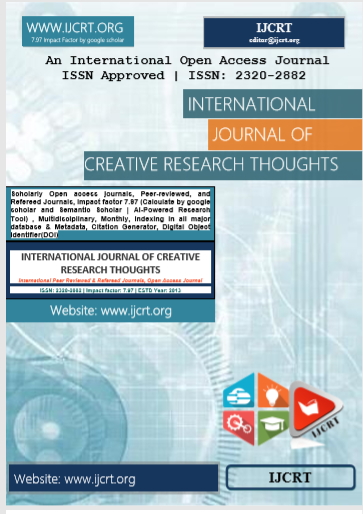
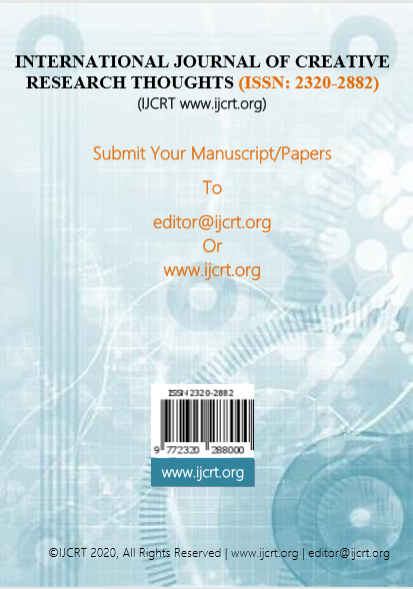
| IJCRT Journal front page | IJCRT Journal Back Page |
Paper Title: STATUS OF INCLUSIVE EDUCATION FOR RURAL GIRLS AT PRIMARY LEVEL IN INDIA: A CRITICAL STUDY IN LIGHT OF SDG 4.5
Author Name(s): Dr. Homa Praveen, Munazza Sami
Published Paper ID: - IJCRT2608019
Register Paper ID - 312305
Publisher Journal Name: IJPUBLICATION, IJCRT
DOI Member ID: 10.6084/m9.doi.one.IJCRT2608019 and DOI :
Author Country : Indian Author, India, 202002 , ALIGARH, 202002 , | Research Area: Social Science All Published Paper URL: http://ijcrt.org/viewfull.php?&p_id=IJCRT2608019 Published Paper PDF: download.php?file=IJCRT2608019 Published Paper PDF: http://www.ijcrt.org/papers/IJCRT2608019.pdf
Your Paper Publication Details:
Title: STATUS OF INCLUSIVE EDUCATION FOR RURAL GIRLS AT PRIMARY LEVEL IN INDIA: A CRITICAL STUDY IN LIGHT OF SDG 4.5
DOI (Digital Object Identifier) :
Pubished in Volume: 14 | Issue: 8 | Year: August 2026
Publisher Name : IJCRT | www.ijcrt.org | ISSN : 2320-2882
Subject Area: Social Science All
Author type: Indian Author
Pubished in Volume: 14
Issue: 8
Pages: a172-a179
Year: August 2026
Downloads: 94
E-ISSN Number: 2320-2882
Abstract
This critical study evaluates the status of inclusive education for rural girls at the primary education level in India (Classes I-V) in direct relation to Sustainable Development Goal 4.5 (SDG 4.5). Utilizing secondary quantitative data from Unified District Information System for Education Plus (UDISE+) reports covering 2021-22 through 2024-25, alongside national educational policy frameworks, this paper analyzes national performance trends across three core indicators: primary level enrollment, Gender Parity Index (GPI), and dropout rates. The empirical analysis reveals a gradual decrease in overall primary enrollment from 12.18 crore in 2021-22 to 10.44 crore in 2024-25, primarily driven by demographic transitions and enhanced student tracking under UDISE+. Concurrently, the Gender Parity Index consistently remained above parity (1.03 to 1.05), reflecting substantial structural progress in girls' educational access. However, dropout rates exhibited temporary fluctuations (peaking at 7.8% before stabilizing near 0.0%-0.3%), underscoring persistent socio-economic, infrastructural, and cultural vulnerabilities in rural areas. The study concludes that achieving complete inclusion under SDG 4.5 requires sustained, targeted interventions, including gender-segregated sanitation, financial incentives, community engagement, and gender-responsive pedagogy.
Licence: creative commons attribution 4.0
License
Creative Commons Attribution 4.0 and The Open Definition

Keywords
Inclusive Education, Rural Girls, Primary Education, SDG 4.5, Gender Parity Index
License
Creative Commons Attribution 4.0 and The Open Definition
Paper Title: Social Life of the Nagas: A Case Study of the Nilamata Purana
Author Name(s): Wasim Akram
Published Paper ID: - IJCRT2608018
Register Paper ID - 312249
Publisher Journal Name: IJPUBLICATION, IJCRT
DOI Member ID: 10.6084/m9.doi.one.IJCRT2608018 and DOI : https://doi.org/10.56975/ijcrt.v14i8.312249
Author Country : Indian Author, India, 180013 , Jammu, 180013 , | Research Area: Social Science All Published Paper URL: http://ijcrt.org/viewfull.php?&p_id=IJCRT2608018 Published Paper PDF: download.php?file=IJCRT2608018 Published Paper PDF: http://www.ijcrt.org/papers/IJCRT2608018.pdf
Your Paper Publication Details:
Title: SOCIAL LIFE OF THE NAGAS: A CASE STUDY OF THE NILAMATA PURANA
DOI (Digital Object Identifier) : https://doi.org/10.56975/ijcrt.v14i8.312249
Pubished in Volume: 14 | Issue: 8 | Year: August 2026
Publisher Name : IJCRT | www.ijcrt.org | ISSN : 2320-2882
Subject Area: Social Science All
Author type: Indian Author
Pubished in Volume: 14
Issue: 8
Pages: a166-a171
Year: August 2026
Downloads: 94
E-ISSN Number: 2320-2882
Abstract
This paper explores the social life of the Nagas as depicted in the Nilamata Purana, focusing on their evolving relationship with humans and their role in shaping the cultural and social foundations of early Kashmir. Rather than viewing the Nagas as purely mythological entities, the study examines their active participation in the region's sacred geography and community development. Through narratives involving figures such as Jalodbhava, Candradeva, and King Nila, the text reveals how the Nagas mediated between divine will and human need, gradually enabling a shift from conflict to coexistence. The paper also investigates the social organization of the Naga community, as evidenced by extensive genealogical records and leadership hierarchies, suggesting a structured and functioning society. Themes of hospitality, spiritual authority, and cosmic regulation emerge throughout the text, reflecting the Nagas' significance beyond myth. The research highlights the Nilamata Purana not only as a religious text but also as a valuable source for understanding the cultural memory and early societal imagination of Kashmir, where the Nagas served as both symbols and agents of social order, environmental guardianship, and ritual continuity.
Licence: creative commons attribution 4.0
License
Creative Commons Attribution 4.0 and The Open Definition
Keywords
Nagas, Nilamata Purana, Early Kashmir, Naga-Human Relations, Mythology
License
Creative Commons Attribution 4.0 and The Open Definition
Paper Title: Exploring the realms of Technoculture and the Cyborg World through Donna Haraway's Essay 'A Cyborg Manifesto'
Author Name(s): DR. TEMJENTULA PONGENER
Published Paper ID: - IJCRT2608017
Register Paper ID - 312263
Publisher Journal Name: IJPUBLICATION, IJCRT
DOI Member ID: 10.6084/m9.doi.one.IJCRT2608017 and DOI :
Author Country : Indian Author, India, 797115 , Chumoukedima, Dimapur, 797115 , | Research Area: Arts All Published Paper URL: http://ijcrt.org/viewfull.php?&p_id=IJCRT2608017 Published Paper PDF: download.php?file=IJCRT2608017 Published Paper PDF: http://www.ijcrt.org/papers/IJCRT2608017.pdf
Your Paper Publication Details:
Title: EXPLORING THE REALMS OF TECHNOCULTURE AND THE CYBORG WORLD THROUGH DONNA HARAWAY'S ESSAY 'A CYBORG MANIFESTO'
DOI (Digital Object Identifier) :
Pubished in Volume: 14 | Issue: 8 | Year: August 2026
Publisher Name : IJCRT | www.ijcrt.org | ISSN : 2320-2882
Subject Area: Arts All
Author type: Indian Author
Pubished in Volume: 14
Issue: 8
Pages: a162-a165
Year: August 2026
Downloads: 78
E-ISSN Number: 2320-2882
Abstract
In Comprehending the essence of Humanity believed to be transpired into the Cyborg world. This paper will establish the social construct of evolution in humans which has been pictured, believed and assimilated in today's world of Technology. By exploring the Cyborg world presented by Donna J. Haraway, in her works such as 'A Cyborg Manifesto', 'Simians, Cyborgs and women' and 'when species meet', these works will elicit the reality of a future we are living in now, wherein we are perceived and identified as Cyborgs. This reality enabled by scientific advancements entail all realms of our existence, such as political, social, religious and cultural, that can be influenced and affected by this approach. My argument gravitates towards the optimistic approaches along with philosophical notions in order to salvage the possibility of a humane Technoculture in today's world and the future. Donna J Haraway's essay is pregnant with hypothetical question of a world of Cyborgs and in the ways it's going to blur the boundaries between man and the machine and man and animal. And hence, essentially breaking these boundaries could be the solution to a humane Technoculture.
Licence: creative commons attribution 4.0
License
Creative Commons Attribution 4.0 and The Open Definition
Keywords
Humanity, Cyborg world, Technology, Optimistic, philosophical, humane, Technoculture, Boundaries.
License
Creative Commons Attribution 4.0 and The Open Definition
Paper Title: EFFECTIVENESS OF A VIDEO-ASSISTED TEACHING PROGRAMME ON KNOWLEDGE REGARDING BASIC LIFE SUPPORT (BLS) AMONG FOURTH-CLASS WORKERS IN A SELECTED HOSPITAL OF RAJASTHAN: A QUASI-EXPERIMENTAL STUDY
Author Name(s): MR. BHARAT SINGH BANSHIWAL, Dr. Manish Sharma
Published Paper ID: - IJCRT2608016
Register Paper ID - 312259
Publisher Journal Name: IJPUBLICATION, IJCRT
DOI Member ID: 10.6084/m9.doi.one.IJCRT2608016 and DOI :
Author Country : Indian Author, India, 452016 , Indore, 452016 , | Research Area: Humanities All Published Paper URL: http://ijcrt.org/viewfull.php?&p_id=IJCRT2608016 Published Paper PDF: download.php?file=IJCRT2608016 Published Paper PDF: http://www.ijcrt.org/papers/IJCRT2608016.pdf
Your Paper Publication Details:
Title: EFFECTIVENESS OF A VIDEO-ASSISTED TEACHING PROGRAMME ON KNOWLEDGE REGARDING BASIC LIFE SUPPORT (BLS) AMONG FOURTH-CLASS WORKERS IN A SELECTED HOSPITAL OF RAJASTHAN: A QUASI-EXPERIMENTAL STUDY
DOI (Digital Object Identifier) :
Pubished in Volume: 14 | Issue: 8 | Year: August 2026
Publisher Name : IJCRT | www.ijcrt.org | ISSN : 2320-2882
Subject Area: Humanities All
Author type: Indian Author
Pubished in Volume: 14
Issue: 8
Pages: a151-a161
Year: August 2026
Downloads: 70
E-ISSN Number: 2320-2882
Abstract
Licence: creative commons attribution 4.0
License
Creative Commons Attribution 4.0 and The Open Definition
Keywords
Keywords: Basic Life Support, Video-Assisted Teaching Programme, Fourth-Class Workers, Knowledge, Hospital Support Staff, Rajasthan
License
Creative Commons Attribution 4.0 and The Open Definition
Paper Title: Effectiveness of a Structured Teaching Programme on Knowledge Regarding Cardiopulmonary Resuscitation Techniques among Fourth-Class Workers in a Selected Hospital of Rajasthan: A Quasi-Experimental Study
Author Name(s): MR. BHARAT SINGH BANSHIWAL, Dr. Manish Sharma
Published Paper ID: - IJCRT2608015
Register Paper ID - 312258
Publisher Journal Name: IJPUBLICATION, IJCRT
DOI Member ID: 10.6084/m9.doi.one.IJCRT2608015 and DOI :
Author Country : Indian Author, India, 452016 , Indore, 452016 , | Research Area: Humanities All Published Paper URL: http://ijcrt.org/viewfull.php?&p_id=IJCRT2608015 Published Paper PDF: download.php?file=IJCRT2608015 Published Paper PDF: http://www.ijcrt.org/papers/IJCRT2608015.pdf
Your Paper Publication Details:
Title: EFFECTIVENESS OF A STRUCTURED TEACHING PROGRAMME ON KNOWLEDGE REGARDING CARDIOPULMONARY RESUSCITATION TECHNIQUES AMONG FOURTH-CLASS WORKERS IN A SELECTED HOSPITAL OF RAJASTHAN: A QUASI-EXPERIMENTAL STUDY
DOI (Digital Object Identifier) :
Pubished in Volume: 14 | Issue: 8 | Year: August 2026
Publisher Name : IJCRT | www.ijcrt.org | ISSN : 2320-2882
Subject Area: Humanities All
Author type: Indian Author
Pubished in Volume: 14
Issue: 8
Pages: a136-a150
Year: August 2026
Downloads: 80
E-ISSN Number: 2320-2882
Abstract
Licence: creative commons attribution 4.0
License
Creative Commons Attribution 4.0 and The Open Definition
Keywords
Keywords: Cardiopulmonary Resuscitation, CPR, Structured Teaching Programme, Fourth-Class Workers, Hospital Support Staff, Knowledge, Rajasthan
License
Creative Commons Attribution 4.0 and The Open Definition
Paper Title: Vaidik Yug Me Stri Adhikaron Ki Aodharna : Samkalin Vimarsh Ke Sandarbh Me Punarmulyankan
Author Name(s): Garima, Dr. Aparna Kumari
Published Paper ID: - IJCRT2608014
Register Paper ID - 312298
Publisher Journal Name: IJPUBLICATION, IJCRT
DOI Member ID: 10.6084/m9.doi.one.IJCRT2608014 and DOI :
Author Country : Indian Author, India, 842001 , Muzaffarpur, 842001 , | Research Area: Arts1 All Published Paper URL: http://ijcrt.org/viewfull.php?&p_id=IJCRT2608014 Published Paper PDF: download.php?file=IJCRT2608014 Published Paper PDF: http://www.ijcrt.org/papers/IJCRT2608014.pdf
Your Paper Publication Details:
Title: VAIDIK YUG ME STRI ADHIKARON KI AODHARNA : SAMKALIN VIMARSH KE SANDARBH ME PUNARMULYANKAN
DOI (Digital Object Identifier) :
Pubished in Volume: 14 | Issue: 8 | Year: August 2026
Publisher Name : IJCRT | www.ijcrt.org | ISSN : 2320-2882
Subject Area: Arts1 All
Author type: Indian Author
Pubished in Volume: 14
Issue: 8
Pages: a129-a135
Year: August 2026
Downloads: 78
E-ISSN Number: 2320-2882
Abstract
Licence: creative commons attribution 4.0
License
Creative Commons Attribution 4.0 and The Open Definition
Paper Title: "A QUASI-EXPERIMENTAL STUDY TO ASSESS THE EFFECTIVENESS OF INFORMATION BOOKLET ON KNOWLEDGE REGARDING HUMAN MILK BANKING AMONG THE POSTNATAL MOTHERS AT SELECTED RURAL AREAS."
Author Name(s): Mr. Rajendra Pitambar lohar
Published Paper ID: - IJCRT2608013
Register Paper ID - 312232
Publisher Journal Name: IJPUBLICATION, IJCRT
DOI Member ID: 10.6084/m9.doi.one.IJCRT2608013 and DOI :
Author Country : Indian Author, India, 425412 , Nandurbar, 425412 , | Research Area: Health Science All Published Paper URL: http://ijcrt.org/viewfull.php?&p_id=IJCRT2608013 Published Paper PDF: download.php?file=IJCRT2608013 Published Paper PDF: http://www.ijcrt.org/papers/IJCRT2608013.pdf
Your Paper Publication Details:
Title: "A QUASI-EXPERIMENTAL STUDY TO ASSESS THE EFFECTIVENESS OF INFORMATION BOOKLET ON KNOWLEDGE REGARDING HUMAN MILK BANKING AMONG THE POSTNATAL MOTHERS AT SELECTED RURAL AREAS."
DOI (Digital Object Identifier) :
Pubished in Volume: 14 | Issue: 8 | Year: August 2026
Publisher Name : IJCRT | www.ijcrt.org | ISSN : 2320-2882
Subject Area: Health Science All
Author type: Indian Author
Pubished in Volume: 14
Issue: 8
Pages: a118-a128
Year: August 2026
Downloads: 79
E-ISSN Number: 2320-2882
Abstract
ABSTRACT INTRODUCTION Breast milk is the perfect food for human infants. It is markedly different from, and uniquely superior to, artificial baby milk. Superiority of human milk is due to its superior nutritive and protective value. It provides total nutrient requirement for the first six months of life. It also prevents malnutrition and allows the child to develop fully. But when there is not enough mother's milk available due to some reasons like mother has insufficient milk glands, has had past breast surgery or is taking medication (eg: chemotherapy for cancer) and has an infection that could spread to her baby through breast feeding. For these babies an alternative must be sought. Breast milk is the main source of food for the baby, which is necessary for its growth and development. every mother looks forwards for a healthy baby. Breastfeeding also allows mother and baby to bond emotionally. WHO Recommended exclusive breastfeeding for first 6 months and continue till two years of age along with weaning. Background of the study: - Breast milk that has been expressed, pasteurized and stored in sterilized conditions is safe and healthy for babies. The milk in the human milk bank is collected from donor mothers on the third day after giving birth, if they fulfil certain safety criteria that have been set by the hospital. The milk bank has one refrigerator, one sterilizer and two pasteurizers. The steel containers are washed and sterilized in the sterilizer. The containers are then sent for collection of milk. The technician washes her hands, and labels the containers. The milk is pasteurized in the pasteurizer for half an hour at the prescribed temperature. A sample is taken and sent to microbiology department for testing for infections. After the report comes the milk is stored in the freezer at -20 degrees C. Milk thus collected can be stored for 3 to 6 months in prescribed conditions. Objectives of the study: - To assess the pretest knowledge regarding Human milk Banking among the postnatal mothers at selected rural area. To assess the effectiveness of information booklet on knowledge regarding human milk banking among the postnatal mothers at selected rural area. To determine the association between post-test knowledge scores & demographic variables among the postnatal mothers at selected rural area. Methodology: - A study was conducted on 60 among postnatal mothers a Quasi- experimental, one-group-pretest-post-test research design at selected area rural areas and the samples for the study were selected by using convenient sampling method. A tool was prepared to assess the effectiveness of informational booklet on knowledge regarding human milk banking among postnatal mothers which was divided into two parts i.e., Part 1 of demographic data and part 2 of structured questionnaire regarding knowledge on human milk bank. The content validity was done by various experts and the reliability of the tool was obtained by using Parallel Form method of reliability. A pilot study was conducted on 06 samples to check the feasibility of the study, and it was found to be feasible to conduct main study. The final data for main study was collected over 60 samples. Result: - in this study, At the time of pre-test, 35% of the postnatal mothers had poor knowledge, 61.67% of the mothers had average knowledge and 3.33% of them had good knowledge regarding human milk banking. Then post-test, no one of the postnatal mothers had poor knowledge, 28.33% of the mothers had average knowledge and 71.67% of them had good knowledge regarding human milk banking. Which, signifies the positive difference between the pretest and post-test. Conclusion: - This Study concludes that informational booklet is helpful to improve knowledge regarding human milk banking among postnatal mothers in selected rural areas.
Licence: creative commons attribution 4.0
License
Creative Commons Attribution 4.0 and The Open Definition
Paper Title: Spiritual Care as a Marker of Effective Pastoral Leadership
Author Name(s): Micky Chantre Laloo
Published Paper ID: - IJCRT2608012
Register Paper ID - 312219
Publisher Journal Name: IJPUBLICATION, IJCRT
DOI Member ID: 10.6084/m9.doi.one.IJCRT2608012 and DOI :
Author Country : Indian Author, India, 793014 , Shillong, 793014 , | Research Area: Others area Published Paper URL: http://ijcrt.org/viewfull.php?&p_id=IJCRT2608012 Published Paper PDF: download.php?file=IJCRT2608012 Published Paper PDF: http://www.ijcrt.org/papers/IJCRT2608012.pdf
Your Paper Publication Details:
Title: SPIRITUAL CARE AS A MARKER OF EFFECTIVE PASTORAL LEADERSHIP
DOI (Digital Object Identifier) :
Pubished in Volume: 14 | Issue: 8 | Year: August 2026
Publisher Name : IJCRT | www.ijcrt.org | ISSN : 2320-2882
Subject Area: Others area
Author type: Indian Author
Pubished in Volume: 14
Issue: 8
Pages: a108-a117
Year: August 2026
Downloads: 84
E-ISSN Number: 2320-2882
Abstract
Spiritual care has always been central to pastoral ministry, yet pastoral leadership today also includes increasing organisational and administrative responsibilities. This study examines whether Spiritual Care and Growth functions as a marker of effective pastoral leadership by exploring the perceptions of pastors and congregants regarding ministry effectiveness. A convergent mixed-method design was used, involving 28 pastors and 336 congregants through structured questionnaires, together with semi-structured interviews with retired senior pastors. The analysis indicates that Spiritual Care and Growth emerged as the strongest indicator of ministry effectiveness. It also received the highest rating from the congregants and was the only leadership dimension in which congregants rated pastors higher than pastors rated themselves. Taken together, the findings suggest that congregants understand pastoral leadership primarily through spiritual care, guidance, pastoral presence and relational involvement rather than through organisational responsibilities alone. The findings further suggest that spiritual care remains central to effective pastoral leadership, while organisational and administrative responsibilities fulfil their purpose when they support the church's pastoral ministry of nurturing, guiding and caring for God's people.
Licence: creative commons attribution 4.0
License
Creative Commons Attribution 4.0 and The Open Definition
Keywords
Pastoral leadership; Spiritual care; Ministry effectiveness; Pastoral ministry; Shepherding; Pastoral presence.
License
Creative Commons Attribution 4.0 and The Open Definition
Paper Title: आध्यात्मिक संगीत का मनुष्य जीवन में महत्व : एक विश्लेषणात्मक अध्ययन
Author Name(s): Shivani Raina, Dr. Sangram Singh
Published Paper ID: - IJCRT2608011
Register Paper ID - 312279
Publisher Journal Name: IJPUBLICATION, IJCRT
DOI Member ID: 10.6084/m9.doi.one.IJCRT2608011 and DOI :
Author Country : Indian Author, India, 147001 , Patiala, 147001 , | Research Area: Arts1 All Published Paper URL: http://ijcrt.org/viewfull.php?&p_id=IJCRT2608011 Published Paper PDF: download.php?file=IJCRT2608011 Published Paper PDF: http://www.ijcrt.org/papers/IJCRT2608011.pdf
Your Paper Publication Details:
Title: आध्यात्मिक संगीत का मनुष्य जीवन में महत्व : एक विश्लेषणात्मक अध्ययन
DOI (Digital Object Identifier) :
Pubished in Volume: 14 | Issue: 8 | Year: August 2026
Publisher Name : IJCRT | www.ijcrt.org | ISSN : 2320-2882
Subject Area: Arts1 All
Author type: Indian Author
Pubished in Volume: 14
Issue: 8
Pages: a103-a107
Year: August 2026
Downloads: 61
E-ISSN Number: 2320-2882
Abstract
आध्यात्मिक संगीत मानव सभ्यता की सबसे प्राचीन और समृद्ध सांस्कृतिक परंपराओं में से एक है, जिसने सदियों से मनुष्य के मानसिक, भावनात्मक, सामाजिक और आध्यात्मिक विकास में महत्त्वपूर्ण भूमिका निभाई है। भारतीय दर्शन में संगीत को केवल मनोरंजन का साधन नहीं माना गया, बल्कि इसे आत्मा और परमात्मा के मध्य संवाद स्थापित करने वाला एक प्रभावशाली माध्यम स्वीकार किया गया है। वैदिक परंपरा में "नाद-ब्रह्म" की अवधारणा इस तथ्य को स्पष्ट करती है कि सम्पूर्ण सृष्टि ध्वनि और स्पंदन पर आधारित है तथा संगीत मनुष्य को उसकी आंतरिक चेतना से जोड़ने की क्षमता रखता है। भजन, कीर्तन, गुरमत संगीत, सूफी संगीत, मंत्रोच्चारण तथा ध्यान-संगीत जैसी विभिन्न आध्यात्मिक संगीत परंपराएँ व्यक्ति के अंतर्मन को शांति, संतुलन और सकारात्मक ऊर्जा प्रदान करती हैं। प्रस्तुत शोध-पत्र में आध्यात्मिक संगीत की अवधारणा, उसकी ऐतिहासिक पृष्ठभूमि, विभिन्न स्वरूपों तथा मानव जीवन पर उसके बहुआयामी प्रभावों का विस्तृत अध्ययन किया गया है। अध्ययन का मुख्य उद्देश्य यह स्पष्ट करना है कि आध्यात्मिक संगीत किस प्रकार व्यक्ति के मानसिक तनाव, चिंता और अवसाद को कम करने में सहायक सिद्ध होता है तथा उसके नैतिक, सामाजिक और आध्यात्मिक मूल्यों के विकास में योगदान देता है। इसके अतिरिक्त, शोध-पत्र में यह भी विश्लेषित किया गया है कि आध्यात्मिक संगीत ध्यान, योग और आत्म-साक्षात्कार की प्रक्रियाओं को किस प्रकार सुदृढ़ करता है। यह अध्ययन वर्णनात्मक एवं विश्लेषणात्मक शोध-पद्धति पर आधारित है, जिसके अंतर्गत प्राचीन धार्मिक ग्रंथों, संगीतशास्त्रीय साहित्य, आधुनिक शोध-पत्रों तथा मनोवैज्ञानिक अध्ययनों का उपयोग किया गया है। विभिन्न विद्वानों के मतों के आधार पर यह निष्कर्ष प्राप्त हुआ है कि आध्यात्मिक संगीत व्यक्ति के मस्तिष्क में सकारात्मक परिवर्तन उत्पन्न करता है, भावनात्मक संतुलन स्थापित करता है तथा जीवन के प्रति सकारात्मक दृष्टिकोण विकसित करने में सहायता प्रदान करता है। इसके अतिरिक्त, यह सामाजिक समरसता, सांस्कृतिक एकता तथा मानवीय मूल्यों के संरक्षण में भी महत्त्वपूर्ण भूमिका निभाता है। आधुनिक युग में बढ़ते भौतिकवाद, प्रतिस्पर्धा, तनाव और मानसिक विकारों के कारण आध्यात्मिक संगीत की प्रासंगिकता और भी अधिक बढ़ गई है। वर्तमान समय में संगीत-चिकित्सा, योग, ध्यान और मानसिक स्वास्थ्य कार्यक्रमों में आध्यात्मिक संगीत का व्यापक रूप से प्रयोग किया जा रहा है। यह न केवल व्यक्ति को आत्मिक शांति प्रदान करता है, बल्कि उसे आत्म-चिंतन, आत्म-अनुभूति और परम चेतना की ओर भी प्रेरित करता है। अतः यह कहा जा सकता है कि आध्यात्मिक संगीत मानव जीवन के सर्वांगीण विकास का एक सशक्त माध्यम है, जो व्यक्ति के मानसिक, सामाजिक और आध्यात्मिक उत्थान में अत्यंत महत्त्वपूर्ण योगदान देता है तथा उसे जीवन के वास्तविक उद्देश्य और आंतरिक सत्य की अनुभूति कराने में सहायता प्रदान करता है।
Licence: creative commons attribution 4.0
License
Creative Commons Attribution 4.0 and The Open Definition
Keywords
आध्यात्मिक संगीत, नाद-ब्रह्म, मानव जीवन, आत्मिक विकास, मानसिक शांति, गुरमत संगीत, ध्यान, संगीत-चिकित्सा, आध्यात्मिक चेतना, आत्म-साक्षात्कार।
License
Creative Commons Attribution 4.0 and The Open Definition
Paper Title: INSTITUTIONALISATION OF FEMALE EDUCATION: A POLICY FRAMEWORK IN INDIA
Author Name(s): Dr. Genevive Syangbo, Dr. Ruth M. Lepcha, Dr. Pem Choden Tenzing
Published Paper ID: - IJCRT2608010
Register Paper ID - 312282
Publisher Journal Name: IJPUBLICATION, IJCRT
DOI Member ID: 10.6084/m9.doi.one.IJCRT2608010 and DOI : https://doi.org/10.56975/ijcrt.v14i8.312282
Author Country : Indian Author, India, 737102 , Tadong, Gangtok, 737102 , | Research Area: Social Science All Published Paper URL: http://ijcrt.org/viewfull.php?&p_id=IJCRT2608010 Published Paper PDF: download.php?file=IJCRT2608010 Published Paper PDF: http://www.ijcrt.org/papers/IJCRT2608010.pdf
Your Paper Publication Details:
Title: INSTITUTIONALISATION OF FEMALE EDUCATION: A POLICY FRAMEWORK IN INDIA
DOI (Digital Object Identifier) : https://doi.org/10.56975/ijcrt.v14i8.312282
Pubished in Volume: 14 | Issue: 8 | Year: August 2026
Publisher Name : IJCRT | www.ijcrt.org | ISSN : 2320-2882
Subject Area: Social Science All
Author type: Indian Author
Pubished in Volume: 14
Issue: 8
Pages: a93-a102
Year: August 2026
Downloads: 89
E-ISSN Number: 2320-2882
Abstract
The "Agenda for Sustainable Development Goals," established by the United Nations Educational, Scientific and Cultural Organisation on 25 September 2015, outlines a series of international objectives aimed at promoting gender equality. The Sustainable Development Goals of 2015 highlighted the issues of gender inequality and the disparities in access to resources, participation, opportunities, the exercise of rights, and access to positions of power, among other factors. Education is identified as one of the critical areas that can significantly advance gender equality. Kofi Annan, the 7th UN Secretary-General and a strong advocate for human rights, aptly stated, "Study after study has taught us that there is no tool for development more effective than the education of girls and the empowerment of women". Hence, female education, which is regarded by the world over as a benchmark to measure the progress of a community, is still progressing gradually or developing incrementally in India. This work seeks to summarise the history of the institutionalisation of female education in India. It examines the major provisions enumerated on female education in the National Policy on Education 1986, 1992 and 2020. This paper has undertaken a significant study of the education policies and strategies adopted in the Sustainable Development Goals by the United Nations Educational, Scientific and Cultural Organisation, 2015. The study analyses the extent to which the National Education Policy, 2020 incorporates the Sustainable Development Goals and how far it contributes to fostering female education in India.
Licence: creative commons attribution 4.0
License
Creative Commons Attribution 4.0 and The Open Definition
Keywords
Female, Education, Policy, Sustainable, Development, Goals, Gender, Gap Equity.
License
Creative Commons Attribution 4.0 and The Open Definition
Call For Paper August 2026
Call For Papers
August 2026
Volume 14 | Issue 8
Last Date :
31-Aug-2026
Submit Manuscript Online Impact Factor: 7.97 Review Results : Within 02-03 Days Paper Publication : Within 02-03 Days
August 2026
Volume 14 | Issue 8
Last Date :
31-Aug-2026
Submit Manuscript Online Impact Factor: 7.97 Review Results : Within 02-03 Days Paper Publication : Within 02-03 Days
Published Issue Details
For Authors
Forms / Downloads
Other IMP Links
Indexing Partner
Research Area
LICENSE





ISSN and 7.97 Impact Factor Details
ISSN: 2320-2882 Impact Factor: 7.97 and ISSN APPROVED Journal Starting Year (ESTD) : 2013


ISSN and 7.97 Impact Factor Details
ISSN: 2320-2882 Impact Factor: 7.97 and ISSN APPROVED Journal Starting Year (ESTD) : 2013
DOI Details
CONFERENCE
CONFERENCE MANAGMENT & PUBLICATION CONFERENCE PROPOSAL
RECENT CONFERENCE

CONFERENCE PROPOSAL CONFERENCE PROCEEDINGS
CONFERENCE PROPOSAL CONFERENCE PROCEEDINGS
For Reviewer /Referral (RMS) Earn 500 per paper
Important Links
NEWS & Conference
Digital Library
IJCRT RMS | Earn 500 Per Paper.

Open Access


LICENSE
Indexing Partner
Scholarly open access journals, Peer-reviewed, and Refereed Journals, Impact factor 7.97 (Calculate by google scholar and Semantic Scholar | AI-Powered Research Tool) , Multidisciplinary, Monthly, Indexing in all major database & Metadata, Citation Generator, Digital Object Identifier(DOI)