Important Details
IJCRT - International Peer Reviewed, Open Access Journal, Multidisciplinary, Monthly, Nominal(Low) Fees for Professional Research Services International Journal of Creative Research Thoughts - IJCRT Peer Review Journal, Refereed Journal, Peer Reviewed Journal , Referred Journal and Indexed Journal, Open access, Online and Print Journal,international Journal Open Access, Accepted by Indian and foreign university ,IJCRT Followed Norms, guidelines, requirement, listing criteria and methodology of score/point also applied from: Scopus , Web of Science , UGC Approved , UGC CARE, UGC-CARE .
UGC Approved Journal No: 49023 (18)
UGC approval Link
https://ijcrt.org/ugc%20approval.jpg
All Policy and Approval
Please Like Our Facebook Page | CrossRef DOI and Hard copy of Certificate Provide if required. | www.IJCRT.org | editor@IJCRT.org | WhatsApp: 7990172303
Publication Details:
- Paper Submission : 31-Mar-2026. Call For Paper (Volume 14 | Issue 3 | Month- March 2026)
- Acceptance/Rejection Notification: Within 02-04 Days.
- Paper Publish: Within 02-04 Days after submitting all documents.
-
Submit Your Paper Any time There No deadline.
-
Publication fees : 1570 INR for Indian author & 59$ for foreign International author.
Please Like Our Facebook Page | CrossRef DOI and Hard copy of Certificate Provide if required.
Licence and Indexing
Indexing In Google Scholar, SSRN, ResearcherID-Publons, Semantic Scholar | AI-Powered Research Tool, Microsoft Academic, Academia.edu, arXiv.org, Research Gate, CiteSeerX, ResearcherID Thomson Reuters, Mendeley : reference manager, DocStoc, ISSUU, Scribd, and many more | High Impact Factor: 7.97 | Digital object identifier (DOI) and Hard Copy of certificate Provided.




























Licence
DOI
ISSN Approved impact factor: 7.97 
Creative Common 
Valid as per new UGC Gazette regulations 

INTERNATIONAL JOURNAL OF CREATIVE RESEARCH THOUGHTS - IJCRT (IJCRT.ORG)
International Peer Reviewed & Refereed Journals, Open Access Journal
IJCRT Peer-Reviewed (Refereed) Journal as Per New UGC Rules.
ISSN Approved Journal No: 2320-2882 | Impact factor: 7.97 | ESTD Year: 2013
Call For Paper - Volume 14 | Issue 3 | Month- March 2026
Scholarly open access journals, Peer-reviewed, and Refereed Journals, Impact factor 7.97 (Calculate by google scholar and Semantic Scholar | AI-Powered Research Tool) , Multidisciplinary, Monthly, Indexing in all major database & Metadata, Citation Generator, Digital Object Identifier(CrossRef DOI)
Contact Us Click Here
WhatsApp Contact Click Here
IJCRT Search Xplore - Search all paper by Paper Name , Author Name, and Title
Volume 13 | Issue 9
Volume 13 | Issue 9 | Month
Downlaod After Publication 1) Table of content index in PDF
2) Table of content index in HTML 2)Table of content index in HTML
3) Front Page 3) Front Page
4) Back Page 4) Back Page
5) Editor Board Member 5)Editor Board Member
6) OLD Style Issue 6) OLD Style Issue
 |
 |
|---|---|
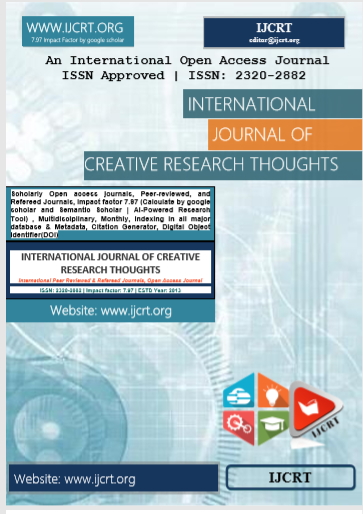
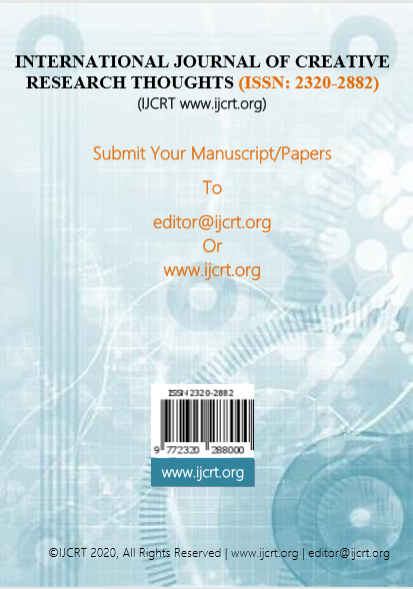
| IJCRT Journal front page | IJCRT Journal Back Page |
Paper Title: "AN EMPIRICAL STUDY ON HR ANALYTICS ADOPTION AND ITS IMPACT ON HR PERFORMANCE"
Publisher Journal Name: IJCRT
Your Paper Publication Details:
Published Paper ID: - IJCRT2509657
Register Paper ID - 294336
Title: "AN EMPIRICAL STUDY ON HR ANALYTICS ADOPTION AND ITS IMPACT ON HR PERFORMANCE"
Author Name(s): Kavitha C, Dr. Cynthia Menezes
Publisher Journal name: IJCRT
Volume: 13
Issue: 9
Pages: f749-f762
Year: September 2025
Downloads: 98
Abstract
In today's world managing employees in organization is not a one-man task. With the evolving business and advancement in technologies managing employees and tracking their performance can be performed online with the help of HR analytic tools. The use of HR analytics has improved employee performance and increased efficiency in business like, improvement of quality of recruitment, talent management, employee productivity and decreasing employee turnover. In this paper we are going to study about HR analytics, its tools, and its application in different organizations. In this paper we study various use of HR Analytics in different organisations and the benefits of the use of HR Analytics. With the help of analytical tools the organisations can recognise the issues like performance, employee turnover and retention employee behaviour, etc by using the data available with the organisation. This research is conducted because of the lack of use of HR in many organisations. The use of HR is undermined in many organisations but in this modern technological world various analytical tools have been developed which are used by huge corporations. In this paper we are going to see such uses of HR Analytics in 5 different organisations and their how the use of HR Analytics helped the organisation as well as the employees in monetary ways and change the business strategy around people - centric way.
Licence: creative commons attribution 4.0
License
Creative Commons Attribution 4.0 and The Open Definition

Keywords
HR Analytics, HR analytics tools, Data Metrics, Employee Attrition, Organizations.
License
Creative Commons Attribution 4.0 and The Open Definition
Paper Title: "A STUDY ON FINANCIAL PERFORMANCE EVALUATION OF HDFC BANK USING DUPONT ANALYSIS".
Publisher Journal Name: IJCRT
Your Paper Publication Details:
Published Paper ID: - IJCRT2509656
Register Paper ID - 294353
Title: "A STUDY ON FINANCIAL PERFORMANCE EVALUATION OF HDFC BANK USING DUPONT ANALYSIS".
Author Name(s): Tasleem Banu, Prof Moula Hussain K
Publisher Journal name: IJCRT
Volume: 13
Issue: 9
Pages: f738-f748
Year: September 2025
Downloads: 106
Abstract
The banking sector plays a vital role in the economic development of a country, and financial performance evaluation is essential for assessing the efficiency, profitability, and sustainability of banks. This study focuses on the financial performance of HDFC Bank, one of India's leading private sector banks, using the DuPont Analysis framework. The DuPont model disaggregates Return on Equity (ROE) into three key components--Net Profit Margin, Asset Turnover, and Equity Multiplier--thereby providing deeper insights into the underlying drivers of profitability. The research is based on secondary data collected from annual reports and financial statements of HDFC Bank over a selected period. Ratios such as ROE, ROA, Net Profit Margin, and Leverage are analyzed to identify trends and evaluate the bank's operational efficiency and financial stability. The findings reveal that HDFC Bank has maintained consistent profitability, strong asset utilization, and efficient leverage management, which together contribute to its robust ROE performance. This study not only highlights the financial strengths of HDFC Bank but also demonstrates the usefulness of DuPont Analysis as a comprehensive tool for stakeholders, investors, and policymakers in evaluating the performance of banking institutions.
Licence: creative commons attribution 4.0
License
Creative Commons Attribution 4.0 and The Open Definition
Keywords
HDFC Bank, Financial Performance, DuPont Analysis, Return on Equity (ROE), Net Profit Margin, Asset Turnover, Equity Multiplier, Profitability Analysis, Banking Sector, Financial Evaluation
License
Creative Commons Attribution 4.0 and The Open Definition
Paper Title: The Embodied Universe: An Analysis of The Portrayal of Women's Character and Emotions In Indian Dance
Publisher Journal Name: IJCRT
Your Paper Publication Details:
Published Paper ID: - IJCRT2509655
Register Paper ID - 294282
Title: THE EMBODIED UNIVERSE: AN ANALYSIS OF THE PORTRAYAL OF WOMEN'S CHARACTER AND EMOTIONS IN INDIAN DANCE
Author Name(s): Ankita Kohli
Publisher Journal name: IJCRT
Volume: 13
Issue: 9
Pages: f732-f737
Year: September 2025
Downloads: 91
Abstract
Indian dance, a vast and intricate tapestry of classical and folk traditions, serves as a profound repository of cultural expression, particularly for the depiction of women's inner lives. This research paper argues that Indian dance is not merely performance but a sophisticated language of emotion (rasa) and narrative (abhinaya), through which the character, agency, and emotional spectrum of women are articulated, celebrated, and preserved. Through an analysis of key classical forms like Bharatanatyam, Odissi, and Kathakali, and folk forms like Lavani and Giddha, this paper will explore how dance narratives move beyond simplistic archetypes to present complex female personas -from the divine and devotional to the heroic and transgressive. It will examine the technical apparatus of dance, including mudras (hand gestures), navarasa (the nine emotions), and the thematic tradition of the Ashta Nayika (eight heroines), as tools for constructing a nuanced emotional architecture for its female subjects. Ultimately, this paper posits that these dance forms have historically provided a sanctioned space for the expression of female subjectivity, desire, and power, making them a vital and dynamic field for understanding the construction of femininity in Indian culture.
Licence: creative commons attribution 4.0
License
Creative Commons Attribution 4.0 and The Open Definition
Keywords
Indian Classical Dance, Rasa Theory, Emotional Expression, Cultural Representation, Women Folklore, Feminity In Dance
License
Creative Commons Attribution 4.0 and The Open Definition
Paper Title: Myth, Mind And Moral Imagination: Literary Representations Of Animal Intelligence In The Ramayana And Remarkably Bright Creatures.
Publisher Journal Name: IJCRT
Your Paper Publication Details:
Published Paper ID: - IJCRT2509654
Register Paper ID - 294250
Title: MYTH, MIND AND MORAL IMAGINATION: LITERARY REPRESENTATIONS OF ANIMAL INTELLIGENCE IN THE RAMAYANA AND REMARKABLY BRIGHT CREATURES.
Author Name(s): Sreeshna Prasad K
Publisher Journal name: IJCRT
Volume: 13
Issue: 9
Pages: f729-f731
Year: September 2025
Downloads: 89
Abstract
This paper analyses how literary representations of animal intelligence and moral imagination in the ancient Indian epic Ramayana and the contemporary novel Remarkably Bright Creatures challenge and complement scientific paradigms of animal cognition. Focusing on characters such as Jatayu in the Ramayana and Marcellus in Shelby Van Pelt's novel, the study explores how these texts portray animals as capable of ethical reasoning, emotional autonomy, and transformative action. While the Ramayana situates animal agency within a mythic and divine framework, Remarkably Bright Creatures offers a secular, modern framework that raises philosophical questions about consciousness and moral choice. The paper argues that literary fictions containing complex nonhuman minds serves as a parallel discourse to scientific inquiry. It can expand our understanding of cognition, sentience, and the ethical boundaries between species.
Licence: creative commons attribution 4.0
License
Creative Commons Attribution 4.0 and The Open Definition
Keywords
Literary Studies, Animal Studies, Cognitive Science
License
Creative Commons Attribution 4.0 and The Open Definition
Paper Title: India's Bancassurance: A Potential Insurance Industry Distribution Network
Publisher Journal Name: IJCRT
Your Paper Publication Details:
Published Paper ID: - IJCRT2509653
Register Paper ID - 286839
Title: INDIA'S BANCASSURANCE: A POTENTIAL INSURANCE INDUSTRY DISTRIBUTION NETWORK
Author Name(s): Vikash, Komal Rani
Publisher Journal name: IJCRT
Volume: 13
Issue: 9
Pages: f722-f728
Year: September 2025
Downloads: 175
Abstract
The purpose of this research is to examine the extent of bancassurance in the Indian setting. It is examined how bancassurance has changed over the last ten years (2007-08 to 2020-21) in the Indian life insurance market. This study is empirical in nature and mostly relies on secondary data. The main markers of promising futures in Indian bancassurance are recognized, including population size, population structure, and literacy rate, banking sector structure, registered insurer in India, insurance penetration, and density. Additionally examined is the percentage of new insurance premiums paid by commercial and governmental life insurers. Additionally, in order to analyze the trends in both private and public life insurance, the compound annual growth rate (CAGR) of new individual insurance premiums is calculated. In order to support Indian bancassurance's future potential, the trend of insurance penetration and density in Asian nations is also examined. Important conclusions confirm the thriving scope of bancassurance in India and point to the necessity of using it as a distribution network for the insurance industry.
Licence: creative commons attribution 4.0
License
Creative Commons Attribution 4.0 and The Open Definition
Keywords
Bancassurance, Life Insurance, Insurance penetration, Insurance density.
License
Creative Commons Attribution 4.0 and The Open Definition
Paper Title: ECONOMIC ETHICS FROM KAUTILYA TO GANDHI: THE DEVELOPMENT OF MORAL ECONOMY IN INDIA
Publisher Journal Name: IJCRT
Your Paper Publication Details:
Published Paper ID: - IJCRT2509652
Register Paper ID - 294368
Title: ECONOMIC ETHICS FROM KAUTILYA TO GANDHI: THE DEVELOPMENT OF MORAL ECONOMY IN INDIA
Author Name(s): Dr. Gulshan Akhtar, Ms. Saima Haque
Publisher Journal name: IJCRT
Volume: 13
Issue: 9
Pages: f715-f721
Year: September 2025
Downloads: 148
Abstract
ABSTRACT Purpose: The purpose of the study is to explore the ethical foundations of economic thought in Indian tradition and their relevance to modern Indian society, and contribute to a broader understanding of moral economy as a viable alternative to purely market-driven models. Methodology: Qualitative, text-based analysis is used. Primary sources & Secondary sources i.e. Arthashastra and selected Gandhian writings are studied in depth to identify normative economic prescriptions and moral constraints. Findings: Kautilya and Gandhi represent two poles of the Indian moral economy. Kautilya's ideal is a 'powerful state ensuring economic welfare', whereas Gandhi's is a 'self-regulating society of moral individuals. Yet both agree that a society's prosperity must be aligned with ethical duties and human dignity. This structured comparison helps us to see how moral underpinnings shift from a top-down vision to a grassroots one, even as the goal social welfare and ethical order remains. This historical trajectory shows that Indian thought has consistently emphasised that economic systems should be based on ethical principles, social welfare, human dignity and sustainable development. This study shed light on the enduring objectives of duty-bound wealth creation, distributive justice and moral management, and highlight the Indian moral-economy over the centuries and its relevance in the present times. Research Limitations / Implications: The reliance on text analysis and translation variations limits empirical validation. Future research may test the applicability of these ethico-economic frameworks through fieldwork in corporate social responsibility initiatives and pave the way for policy experiments based on India's intellectual heritage.
Licence: creative commons attribution 4.0
License
Creative Commons Attribution 4.0 and The Open Definition
Keywords
Moral economy; Kautilya; Gandhi; Swadeshi and Arthashastra
License
Creative Commons Attribution 4.0 and The Open Definition
Paper Title: Krushi Me Navachar Ki Bhumika : Purvibhundhelkhand Pathar (Chatishgadh Rajya ) Ke Vishesh Sandharbh Me
Publisher Journal Name: IJCRT
Your Paper Publication Details:
Published Paper ID: - IJCRT2509651
Register Paper ID - 294161
Title: KRUSHI ME NAVACHAR KI BHUMIKA : PURVIBHUNDHELKHAND PATHAR (CHATISHGADH RAJYA ) KE VISHESH SANDHARBH ME
Author Name(s): Omkar Kushwaha, Dr. D.D. Kashyap
Publisher Journal name: IJCRT
Volume: 13
Issue: 9
Pages: f709-f714
Year: September 2025
Downloads: 108
Abstract
Krushi Me Navachar Ki Bhumika : Purvibhundhelkhand Pathar (Chatishgadh Rajya ) Ke Vishesh Sandharbh Me
Licence: creative commons attribution 4.0
License
Creative Commons Attribution 4.0 and The Open Definition
Keywords
Krushi Me Navachar Ki Bhumika : Purvibhundhelkhand Pathar (Chatishgadh Rajya ) Ke Vishesh Sandharbh Me
License
Creative Commons Attribution 4.0 and The Open Definition
Paper Title: Clothing Culture With Specific Reference To Apparel Sector In Andhra Pradesh
Publisher Journal Name: IJCRT
Your Paper Publication Details:
Published Paper ID: - IJCRT2509650
Register Paper ID - 294251
Title: CLOTHING CULTURE WITH SPECIFIC REFERENCE TO APPAREL SECTOR IN ANDHRA PRADESH
Author Name(s): GODA POOJA, Dr. Mini Amit Arrawatia
Publisher Journal name: IJCRT
Volume: 13
Issue: 9
Pages: f698-f708
Year: September 2025
Downloads: 138
Abstract
This study examines the cultural dimensions of consumer behavior in the apparel sector of Andhra Pradesh, India, with a particular emphasis on brand engagement and clothing preferences. Drawing on a structured bilingual survey and supported by statistical techniques such as Principal Component Analysis (PCA), regression modeling, and cluster analysis, the research identifies key drivers influencing purchase decisions--namely cultural symbolism, fabric comfort, emotional resonance, and generational identity. Findings indicate that ethnic wear retains strong cultural and emotional relevance, particularly among female and older demographics, while younger consumers exhibit a hybridized approach, integrating traditional attire with global fashion influences. Brands such as Fabindia and Ramraj are perceived as cultural custodians, offering more than products--they convey heritage, identity, and continuity. Simultaneously, emerging private labels are gaining consumer trust by blending affordability with culturally adaptive design. The study positions branding not merely as a commercial tool but as a mechanism of cultural expression and identity formation. By integrating empirical rigor with cultural insight, it contributes to a deeper understanding of how apparel branding in India functions as a dynamic interface between tradition, aspiration, and market behavior.
Licence: creative commons attribution 4.0
License
Creative Commons Attribution 4.0 and The Open Definition
Keywords
Clothing culture, Brand culture, Apparel sector, Consumer behavior, Cultural branding
License
Creative Commons Attribution 4.0 and The Open Definition
Paper Title: The Role Of Music Therapy Especially Raga Music In Suicide Prevention
Publisher Journal Name: IJCRT
Your Paper Publication Details:
Published Paper ID: - IJCRT2509649
Register Paper ID - 293688
Title: THE ROLE OF MUSIC THERAPY ESPECIALLY RAGA MUSIC IN SUICIDE PREVENTION
Author Name(s): Dr. Sudokshina Manna Chatterjee
Publisher Journal name: IJCRT
Volume: 13
Issue: 9
Pages: f693-f697
Year: September 2025
Downloads: 126
Abstract
Abstract Background: Suicide is a leading cause of death globally and a serious public health concern in India, particularly among youth. Conventional treatments such as counseling, psychiatry, and medication are essential but often inaccessible due to stigma, lack of awareness, and limited resources. In this context, culturally rooted interventions like Raga Music Therapy present a promising complementary approach. Aim: To explore the role of Indian classical raga music as a therapeutic tool in suicide prevention by examining its psychological, emotional, and cultural impact. Method: This paper reviews causes of suicide in India--including psychological, social, economic, biological, and cultural factors--and evaluates the application of raga music therapy through four approaches: receptive (listening), recreational (performing), compositional (creating), and improvisational (exploring). Therapeutic effects of specific ragas such as Ahir Bhairav, Darbari Kanada, Yaman, and Todi are analyzed in relation to stress reduction, emotional regulation, and resilience building. Results: Raga therapy influences the limbic system, fostering emotional catharsis, physiological relaxation, cognitive reframing, and spiritual connection. Clinical and community-based applications demonstrate potential for reducing anxiety, depression, and suicidal ideation. Research from AIIMS and other studies supports its effectiveness in lowering stress, improving mood, and aiding emotional healing. Conclusion: While not a replacement for medical treatment, raga music therapy offers a culturally accepted, non-stigmatizing, and accessible means of suicide prevention. Integrating it into clinical practice, community programs, and digital platforms can nurture hope, resilience, and mental well-being in Indian society.
Licence: creative commons attribution 4.0
License
Creative Commons Attribution 4.0 and The Open Definition
Keywords
Keywords - Suicide Prevention, Raga Music Therapy, Mental Health,Emotional Well-being.
License
Creative Commons Attribution 4.0 and The Open Definition
Paper Title: Mahila Suraksha Ki Chunautiya Ev Zimdari Ek Samajik Vishleshan
Publisher Journal Name: IJCRT
Your Paper Publication Details:
Published Paper ID: - IJCRT2509648
Register Paper ID - 294145
Title: MAHILA SURAKSHA KI CHUNAUTIYA EV ZIMDARI EK SAMAJIK VISHLESHAN
Author Name(s): Dr. Hemlata sanguri, Amita Verma
Publisher Journal name: IJCRT
Volume: 13
Issue: 9
Pages: f684-f692
Year: September 2025
Downloads: 100
Abstract
यह शोध पत्र महिलाओं की सुरक्षा के ज्वलंत मुद्दे की पड़ताल करता है, और समाज में उनकी भेद्यता को बढ़ाने वाले विभिन्न पहलुओं पर ध्यान केंद्रित करता है। मौजूदा ढाँचों और पहलों के व्यापक विश्लेषण के माध्यम से, यह अध्ययन सुरक्षा के वर्तमान दृष्टिकोणों में प्रमुख चुनौतियों और कमियों की पहचान करता है । यह सार्वजनिक और निजी दोनों स्थानों पर महिलाओं की सुरक्षा को बढ़ाने के उद्देश्य से प्रौद्योगिकी-संचालित उपकरणों और सामुदायिक सहभागिता रणनीतियों सहित नवीन समाधानों का प्रस्ताव करता है । यह शोध महिलाओं के लिए एक सुरक्षित वातावरण को बढ़ावा देने में अंतःविषय सहयोग और नीति विकास के महत्व पर प्रकाश डालता है । यह शोध पत्र महिलाओं को सशक्त बनाने और लैंगिक समानता को बढ़ावा देने के लिए निरंतर प्रयासों की आवश्यकता को रेखांकित करते हैं, जो अधिक सुरक्षित और समतामूलक समाज में योगदान देगा ।
Licence: creative commons attribution 4.0
License
Creative Commons Attribution 4.0 and The Open Definition
Keywords
महिला सुरक्षा, चुनौतियां, कानूनी प्रावधान, घरेलू हिंसा
License
Creative Commons Attribution 4.0 and The Open Definition
Paper Title: Digitalization in Cooperative Banking for Enhanced Service Delivery: A Case of TNSCB
Publisher Journal Name: IJCRT
Your Paper Publication Details:
Published Paper ID: - IJCRT2509647
Register Paper ID - 293925
Title: DIGITALIZATION IN COOPERATIVE BANKING FOR ENHANCED SERVICE DELIVERY: A CASE OF TNSCB
Author Name(s): DR.B.TAMILMANI
Publisher Journal name: IJCRT
Volume: 13
Issue: 9
Pages: f667-f683
Year: September 2025
Downloads: 107
Abstract
The Tamil Nadu State Apex Cooperative Bank (TNSC Bank), established in 1905, serving as the central institution for the cooperative banking sector in Tamil Nadu. It plays a crucial role in advancing the cooperative movement by providing inclusive financial support to Primary Cooperatives. TNSCB has been instrumental in the state's economic progress for over a century and it the first State Cooperative Bank to celebrate a centenary. It holds a banking license from the Reserve Bank of India and is listed under the Second Schedule of the RBI Act, qualifying it as a Scheduled Cooperative Bank. It is also a member of the Deposit Insurance and Credit Guarantee Corporation (DICGC), ensuring deposit protection under the DICGC Act. The TNSCB has demonstrated a consistent commitment to digital transformation and infrastructure development over the past 15 years. From 2010 to 2024, the bank invested a total of INR260.98 lakhs in Information and Communication Technology (ICT), including hardware and software upgrades. This steady increase in ICT investment, particularly notable in 2016 (INR30.85 lakhs) and 2019 (INR33.24 lakhs), reflects the bank's strategic focus on enhancing operational efficiency, digital banking capabilities, and service delivery. In parallel, TNSCB has also expanded its physical infrastructure, investing INR80.39 lakhs in buildings and related facilities to modernizing physical spaces, possibly to support digital operations and customer service. The combined investment of INR341.37 lakhs over the period underscores the bank's balanced approach to both digital and physical growth. This dual investment strategy positions TNSCB as a forward-looking institution, aligning with national priorities for financial inclusion, digital banking, and cooperative sector modernization. It has adopted a range of digital initiatives aimed at elevating service quality and streamlining its operations namely Core Banking Solutions (CBS), Mobile Banking, Internet Banking, Digital Payment Solutions, Customer Relationship Management (CRM), Financial Inclusion Initiatives, Data Analytics, E-Governance, and Reconciliation.
Licence: creative commons attribution 4.0
License
Creative Commons Attribution 4.0 and The Open Definition
Keywords
Digitalization, State Cooperative Bank, Digital Banking, Enhance Services Delivery.
License
Creative Commons Attribution 4.0 and The Open Definition
Paper Title: Women in the Silk Route: Agents of Production, Trade, and Cultural Exchange
Publisher Journal Name: IJCRT
Your Paper Publication Details:
Published Paper ID: - IJCRT2509646
Register Paper ID - 293570
Title: WOMEN IN THE SILK ROUTE: AGENTS OF PRODUCTION, TRADE, AND CULTURAL EXCHANGE
Author Name(s): Dr. Neha Kumari
Publisher Journal name: IJCRT
Volume: 13
Issue: 9
Pages: f659-f666
Year: September 2025
Downloads: 95
Abstract
The Silk Route, extending across Asia, the Middle East, and into Europe, stands as one of the most influential transcontinental networks of communication, trade, and cultural interaction in premodern history. Traditionally, scholarship has emphasized the exchange of luxury commodities such as silk, spices, gems, precious metals, and the transmission of religious and philosophical ideas. However, the integral contributions of women within this vast system have often remained marginalized or overlooked. This article seeks to foreground women's multifaceted roles in shaping the Silk Route economy and its cultural landscape.1 Women were not only the primary producers of silk and textiles-commodities that gave the network its very name-but also significant participants in artisanal crafts, agriculture, and domestic industries that supported long-distance trade. In many regions, they engaged directly in market activities, local trading, and even long-distance caravans, challenging the assumption that commerce was a male-dominated sphere. Beyond economic contributions, women served as vital cultural transmitters: their clothing styles and artistic expressions influenced cross-cultural fashions; their marriages forged political and diplomatic alliances across empires and nomadic societies; and their patronage of religious institutions enabled the spread of Buddhism, Christianity, and Islam along the routes.2 Despite social restrictions imposed by patriarchal structures, women consistently exercised agency, adaptability, and influence in maintaining and expanding this global web of interaction. A gender-inclusive study of the Silk Route thus provides a more comprehensive understanding of how international trade, diplomacy, and intercultural exchanges were sustained. By situating women at the center of analysis, this research not only recovers hidden histories but also reshapes the narrative of one of the world's earliest systems of globalization.
Licence: creative commons attribution 4.0
License
Creative Commons Attribution 4.0 and The Open Definition
Keywords
Silk Route, Women agency, Textile production, Cross-cultural exchange, Gender & trade
License
Creative Commons Attribution 4.0 and The Open Definition
Paper Title: BALLADS AND TALES IN MAITHILI LITERATURE
Publisher Journal Name: IJCRT
Your Paper Publication Details:
Published Paper ID: - IJCRT2509645
Register Paper ID - 294345
Title: BALLADS AND TALES IN MAITHILI LITERATURE
Author Name(s): Dr. Bijayendra Jha
Publisher Journal name: IJCRT
Volume: 13
Issue: 9
Pages: f652-f658
Year: September 2025
Downloads: 138
Abstract
These are the most prominent folk narratives in Maithili, detailing the heroic deeds of specific caste or community heroes and are central to their cultural identity and worship. Maithili literature boasts a rich collection of traditional ballads, or lok-gathas, that tell the stories of community heroes and are often performed as examples including the legendary Lorika, Salahesa, Dina-Bhadri, Kumar Brijabhana etc. Other narrative works and literary tales are found in collections like the Bihula-ka katha, Gopichand-ka katha, Ajura-ka katha etc. These ballads & Tales are sung in a specific tune and it relates the ancient culture, which is the root identity of Mithila. In this article, these topics are described in a symbolic way.
Licence: creative commons attribution 4.0
License
Creative Commons Attribution 4.0 and The Open Definition
Keywords
Adventure, Arony, Carol, Gatha, Katha, Love, Legend, Melodious Prevalent, Peculiar, Pathetic, Romance, Supernatural, Tradition, Verse.
License
Creative Commons Attribution 4.0 and The Open Definition
Paper Title: A STUDY ON FIDUCIARY DUTIES AND LIABILITIES OF DIRECTORS UNDER COMPANIES ACT WITH RECENT CASE LAWS
Publisher Journal Name: IJCRT
Your Paper Publication Details:
Published Paper ID: - IJCRT2509644
Register Paper ID - 294310
Title: A STUDY ON FIDUCIARY DUTIES AND LIABILITIES OF DIRECTORS UNDER COMPANIES ACT WITH RECENT CASE LAWS
Author Name(s): Manoranjith A, Muthuraj M, Vijay Anand K
Publisher Journal name: IJCRT
Volume: 13
Issue: 9
Pages: f642-f651
Year: September 2025
Downloads: 163
Abstract
Directors are crucial to corporate governance, acting on behalf of shareholders and ensuring compliance with laws. They have fiduciary duties of loyalty, care, and good faith, which are essential for ethical management. The legal definition of a director is broad, and judicial interpretations have expanded its applicability across various contexts. The codification of directors' duties in statutory law reflects a shift from common law principles to a more structured legal framework. This summary captures the essential elements of the document regarding the roles, responsibilities, and legal definitions of directors within the corporate governance framework in India.
Licence: creative commons attribution 4.0
License
Creative Commons Attribution 4.0 and The Open Definition
Keywords
Company Directors, fiduciary duties, liability of directors, companies Act
License
Creative Commons Attribution 4.0 and The Open Definition
Paper Title: Role of Yoga in the Management of Heart Rate Variability: A Narrative Review
Publisher Journal Name: IJCRT
Your Paper Publication Details:
Published Paper ID: - IJCRT2509643
Register Paper ID - 294319
Title: ROLE OF YOGA IN THE MANAGEMENT OF HEART RATE VARIABILITY: A NARRATIVE REVIEW
Author Name(s): Abhimanyu Kumar, Anuja Rawat
Publisher Journal name: IJCRT
Volume: 13
Issue: 9
Pages: f627-f641
Year: September 2025
Downloads: 97
Abstract
Abstract: Introduction: Heart rate variability (HRV) is a technique to assess cardiac autonomic rhythm non-invasively. It is a proxy for autonomic regulation and gives much psychophysiological information about holistic health. Having a higher HRV is a sign of sound cardiovascular health. According to WHO reports, 32% of global deaths occur due to malfunctioning of the cardiovascular system, which is the result of arrhythmic cardiac autonomic modulation. Many studies have suggested that yoga has the potential to increase HRV and alter HRV parameters towards parasympathetic activation, which has an immense positive effect on the mind and cardiac health. Aim: The aim of this study is to investigate the existing scientific literature to explore the role of yoga in the management of Heart rate variability. Methods: For this purpose, an online search on three specific databases, PubMed, Scopus, and Science Direct, was conducted using the keywords Yoga, Pranayama, Asana, Dhyan, meditation, "Heart rate variability", "RR interval," HRV and "autonomic nervous system" etc. Search was limited to years ranging from 2014 to October 2023 with all inclusion criteria. Filter was applied as English language and human subject. Result: From all three databases, 3549 papers were recorded; after duplicates were removed and screened, only 11 RCT papers were included in this review based on the inclusion criteria. Studies suggested that yoga positively affected HRV and risk factors for cardiovascular disease across various populations. Conclusion: This review suggests that yoga is significantly useful in cardiac autonomic modulation towards parasympathetic dominance, which increases HRV and sympathovagal tone.
Licence: creative commons attribution 4.0
License
Creative Commons Attribution 4.0 and The Open Definition
Keywords
Keywords: Heart rate variability, HRV, Cardiac Health, and Yoga.
License
Creative Commons Attribution 4.0 and The Open Definition
Paper Title: Crypto Vault: Loss Advisory & Investment Guidance
Publisher Journal Name: IJCRT
Your Paper Publication Details:
Published Paper ID: - IJCRT2509642
Register Paper ID - 293522
Title: CRYPTO VAULT: LOSS ADVISORY & INVESTMENT GUIDANCE
Author Name(s): Subramanian S, Kaarthikeyan AV, Dr. Yamuna Devi N
Publisher Journal name: IJCRT
Volume: 13
Issue: 9
Pages: f617-f626
Year: September 2025
Downloads: 141
Abstract
This paper introduces Crypto Vault, an advisory tool designed to assist novice cryptocurrency investors in managing losses and making informed investment decisions. By integrating technical indicators such as the Relative Strength Index (RSI) and Moving Average Convergence Divergence (MACD), machine learning based forecasting, and the detection of emotional investing, the tool provides personalized guidance and strategic recovery plans. Unlike existing platforms that offer raw market data, Crypto Vault focuses on interpreting this data to generate actionable insights, including loss thresholds, rebalancing recommendations, and mood based coaching notifications. The system architecture leverages a modern technology stack, including Next.js, Fast API, to deliver a robust and responsive user experience. This work ad dresses a critical gap in the market by providing a holistic support system that accounts for both the technical and psychological challenges of cryptocurrency investing.
Licence: creative commons attribution 4.0
License
Creative Commons Attribution 4.0 and The Open Definition
Keywords
cryptocurrency, investment guidance, loss advisory, machine learning, sentiment analysis, behavioral finance, Robo-advisor, LSTM, emotional investing
License
Creative Commons Attribution 4.0 and The Open Definition
Paper Title: SkillShift Model: Advancing Innovation And Creativity In K-12 Learners With A Scalable Framework For 21st-Century Competencies
Publisher Journal Name: IJCRT
Your Paper Publication Details:
Published Paper ID: - IJCRT2509641
Register Paper ID - 294255
Title: SKILLSHIFT MODEL: ADVANCING INNOVATION AND CREATIVITY IN K-12 LEARNERS WITH A SCALABLE FRAMEWORK FOR 21ST-CENTURY COMPETENCIES
Author Name(s): Dr. Ritu Uppal
Publisher Journal name: IJCRT
Volume: 13
Issue: 9
Pages: f611-f616
Year: September 2025
Downloads: 97
Abstract
The SkillShift Model represents an innovative, scalable intervention targeting the development of 21st-century skills--innovation, creativity, curiosity, risk-taking, and collaboration--among K-12 learners. Implemented in partnership with Harvard Business Publishing, the model delivered a structured two-day curriculum to grades 8 and 9 students at D. Y Patil Dyan Shakti, Akurdi, Pune, blending digital tools and project-based learning. Analysis of pre- and post-test scores and detailed student feedback demonstrates significant skill enhancement, high engagement, and promising potential for broader educational transformation. The findings support international trends emphasizing future-ready competencies in K-12 education.
Licence: creative commons attribution 4.0
License
Creative Commons Attribution 4.0 and The Open Definition
Keywords
SkillShift Model, 21st-century skills, K-12learners, innovation, creativity, project-based learning, future-ready competencies
License
Creative Commons Attribution 4.0 and The Open Definition
Paper Title: A STUDY TO ASSESS THE EFFECTIVENESS OF PLANNED TEACHING PROGRAM ON KNOWLEDGE REGARDING CRASH CART MANAGEMENT AMONG STAFF NURSES IN A SELECTED HOSPITAL, INDORE,M.P
Publisher Journal Name: IJCRT
Your Paper Publication Details:
Published Paper ID: - IJCRT2509640
Register Paper ID - 294362
Title: A STUDY TO ASSESS THE EFFECTIVENESS OF PLANNED TEACHING PROGRAM ON KNOWLEDGE REGARDING CRASH CART MANAGEMENT AMONG STAFF NURSES IN A SELECTED HOSPITAL, INDORE,M.P
Author Name(s): Ms Chingangbam Anju chanu, Dr Manoj Prajapati
Publisher Journal name: IJCRT
Volume: 13
Issue: 9
Pages: f601-f610
Year: September 2025
Downloads: 113
Abstract
Licence: creative commons attribution 4.0
License
Creative Commons Attribution 4.0 and The Open Definition
Keywords
Effectiveness, Knowledge, crash card management
License
Creative Commons Attribution 4.0 and The Open Definition
Paper Title: Pazhan Thamizharin Panpattu Kalaigal
Publisher Journal Name: IJCRT
Your Paper Publication Details:
Published Paper ID: - IJCRT2509639
Register Paper ID - 294295
Title: PAZHAN THAMIZHARIN PANPATTU KALAIGAL
Author Name(s): Dr P Priya
Publisher Journal name: IJCRT
Volume: 13
Issue: 9
Pages: f595-f600
Year: September 2025
Downloads: 90
Abstract
Pazhan Thamizharin Panpattu Kalaigal
Licence: creative commons attribution 4.0
License
Creative Commons Attribution 4.0 and The Open Definition
Keywords
Pazhan Thamizharin Panpattu Kalaigal
License
Creative Commons Attribution 4.0 and The Open Definition
Paper Title: The Eternal Journey Of Learning: From Ancient Nalanda To Global Education In The Digital Age
Publisher Journal Name: IJCRT
Your Paper Publication Details:
Published Paper ID: - IJCRT2509638
Register Paper ID - 294334
Title: THE ETERNAL JOURNEY OF LEARNING: FROM ANCIENT NALANDA TO GLOBAL EDUCATION IN THE DIGITAL AGE
Author Name(s): Jawale Chetan S, Jangle Lalita G.
Publisher Journal name: IJCRT
Volume: 13
Issue: 9
Pages: f591-f594
Year: September 2025
Downloads: 107
Abstract
The evolution of education from ancient learning hubs, such as the monastic university of Nalanda, to the digitally connected and globalized educational environment of the twenty-first century is examined in this article. This paper demonstrates a recurrent conflict between the forces of scalability, accessibility, and technology and localized, immersive, and residential models of knowledge transmission. The democratization of knowledge made possible by the printing press and the recent paradigm shift toward individualized, on-demand learning made possible by digital technologies are just two examples of the fundamental changes in pedagogy, curriculum, and the very goal of education that are revealed by a comparative analysis. The fundamental human and social purposes of education promoting critical thinking, advancing human development, and acting as a vehicle for social progress remain unaltered in spite of these changes. The article concludes by discussing the challenges and ethical considerations posed by digital education and outlining potential pathways for the future of learning, emphasizing the need for equity, engagement, and intentional design.
Licence: creative commons attribution 4.0
License
Creative Commons Attribution 4.0 and The Open Definition
Keywords
Education history, Nalanda University, printing press, digital education, educational technology, learning theory, educational equity.
License
Creative Commons Attribution 4.0 and The Open Definition
All Published Paper Details Search Through Above Search Option.
About IJCRT
The International Journal of Creative Research Thoughts (IJCRT) aims to explore advances in research pertaining to applied, theoretical and experimental Technological studies. The goal is to promote scientific information interchange between researchers, developers, engineers, students, and practitioners working in and around the world.
Indexing In Google Scholar, ResearcherID Thomson Reuters, Mendeley : reference manager, Academia.edu, arXiv.org, Research Gate, CiteSeerX, DocStoc, ISSUU, Scribd, and many more International Journal of Creative Research Thoughts (IJCRT) ISSN: 2320-2882 | Impact Factor: 7.97 | 7.97 impact factor and ISSN Approved. Provide DOI and Hard copy of Certificate. Low Open Access Processing Charges. 1500 INR for Indian author & 55$ for foreign International author. Call For Paper (Volume 14 | Issue 3 | Month- March 2026)
Call For Paper March 2026
Call For Papers
March 2026
Volume 14 | Issue 3
Last Date :
31-Mar-2026
Submit Manuscript Online Impact Factor: 7.97 Review Results : Within 02-03 Days Paper Publication : Within 02-03 Days
March 2026
Volume 14 | Issue 3
Last Date :
31-Mar-2026
Submit Manuscript Online Impact Factor: 7.97 Review Results : Within 02-03 Days Paper Publication : Within 02-03 Days
Published Issue Details
For Authors
Forms / Downloads
Other IMP Links
Indexing Partner
Research Area
LICENSE





ISSN and 7.97 Impact Factor Details
ISSN: 2320-2882 Impact Factor: 7.97 and ISSN APPROVED Journal Starting Year (ESTD) : 2013


ISSN and 7.97 Impact Factor Details
ISSN: 2320-2882 Impact Factor: 7.97 and ISSN APPROVED Journal Starting Year (ESTD) : 2013
DOI Details
CONFERENCE
CONFERENCE MANAGMENT & PUBLICATION CONFERENCE PROPOSAL
RECENT CONFERENCE

CONFERENCE PROPOSAL CONFERENCE PROCEEDINGS
CONFERENCE PROPOSAL CONFERENCE PROCEEDINGS
For Reviewer /Referral (RMS) Earn 500 per paper
Important Links
NEWS & Conference
Digital Library
IJCRT RMS | Earn 500 Per Paper.

Open Access


LICENSE
Indexing Partner
Scholarly open access journals, Peer-reviewed, and Refereed Journals, Impact factor 7.97 (Calculate by google scholar and Semantic Scholar | AI-Powered Research Tool) , Multidisciplinary, Monthly, Indexing in all major database & Metadata, Citation Generator, Digital Object Identifier(DOI)