Important Details
IJCRT - International Peer Reviewed, Open Access Journal, Multidisciplinary, Monthly, Nominal(Low) Fees for Professional Research Services International Journal of Creative Research Thoughts - IJCRT Peer Review Journal, Refereed Journal, Peer Reviewed Journal , Referred Journal and Indexed Journal, Open access, Online and Print Journal,international Journal Open Access, Accepted by Indian and foreign university ,IJCRT Followed Norms, guidelines, requirement, listing criteria and methodology of score/point also applied from: Scopus , Web of Science , UGC Approved , UGC CARE, UGC-CARE .
UGC Approved Journal No: 49023 (18)
UGC approval Link
https://ijcrt.org/ugc%20approval.jpg
All Policy and Approval
Please Like Our Facebook Page | CrossRef DOI and Hard copy of Certificate Provide if required. | www.IJCRT.org | editor@IJCRT.org | IJCRT WhatsApp +91 94294 58311
Publication Details:
- Paper Submission : 30-Sep-2026. Call For Paper (Volume 14 | Issue 9 | Month- September 2026)
- Acceptance/Rejection Notification: Within 02-04 Days.
- Paper Publish: Within 02-04 Days after submitting all documents.
-
Submit Your Paper Any time There No deadline.
-
Publication fees : 1570 INR for Indian author & 59$ for foreign International author.
Please Like Our Facebook Page | CrossRef DOI and Hard copy of Certificate Provide if required.
Licence and Indexing
Indexing In Google Scholar, SSRN, ResearcherID-Publons, Semantic Scholar | AI-Powered Research Tool, Microsoft Academic, Academia.edu, arXiv.org, Research Gate, CiteSeerX, ResearcherID Thomson Reuters, Mendeley : reference manager, DocStoc, ISSUU, Scribd, and many more | High Impact Factor: 7.97 | Digital object identifier (DOI) and Hard Copy of certificate Provided.




























Licence
DOI
ISSN Approved impact factor: 7.97 
Creative Common 
Valid as per new UGC Gazette regulations 

INTERNATIONAL JOURNAL OF CREATIVE RESEARCH THOUGHTS - IJCRT (IJCRT.ORG)
International Peer Reviewed & Refereed Journals, Open Access Journal
IJCRT Peer-Reviewed (Refereed) Journal as Per New UGC Rules.
ISSN Approved Journal No: 2320-2882 | Impact factor: 7.97 | ESTD Year: 2013
Call For Paper - Volume 14 | Issue 9 | Month- September 2026
Scholarly open access journals, Peer-reviewed, and Refereed Journals, Impact factor 7.97 (Calculate by google scholar and Semantic Scholar | AI-Powered Research Tool) , Multidisciplinary, Monthly, Indexing in all major database & Metadata, Citation Generator, Digital Object Identifier(CrossRef DOI)
IJCRT WhatsApp Contact
IJCRT Search Xplore - Search all paper by Paper Name , Author Name, and Title
Volume 13 | Issue 12
Volume 13 | Issue 12 | Month
Downlaod After Publication 1) Table of content index in PDF
2) Table of content index in HTML 2)Table of content index in HTML
3) Front Page 3) Front Page
4) Back Page 4) Back Page
5) Editor Board Member 5)Editor Board Member
6) OLD Style Issue 6) OLD Style Issue
 |
 |
|---|---|
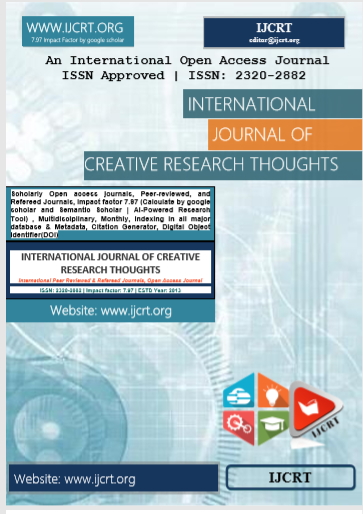
| IJCRT Journal front page | IJCRT Journal Back Page |
Paper Title: A Comparative Study of Gender of the Santal Community, Six Blocks under Kharagpur Subdivision in Paschim Midnapore District, West Bengal.
Publisher Journal Name: IJCRT
Your Paper Publication Details:
Published Paper ID: - IJCRT25A1311
Register Paper ID - 299696
Title: A COMPARATIVE STUDY OF GENDER OF THE SANTAL COMMUNITY, SIX BLOCKS UNDER KHARAGPUR SUBDIVISION IN PASCHIM MIDNAPORE DISTRICT, WEST BENGAL.
Author Name(s): Bipulkanti Bhunia
Publisher Journal name: IJCRT
Volume: 13
Issue: 12
Pages: i827-i841
Year: December 2025
Downloads: 157
Abstract
The Santal community another major Scheduled Tribe group in Indian subcontinent, is significantly facing considerable educational and socio-economic challenge. Against this backdrop, a thorough examination of gender disparities in the current education system of the Santal community in the Kharagpur sub-division of Paschim Midnapur district in West Bengal is necessary. The main objective of this study is to observed and analyze the current educational status, gender disparity, and the impact of education on the socio-economic status of Santal community in six blocks of Kharagpur sub-division. This study used a non-probability sampling method. Primary data was collected through questioner and group discussion, and secondary data was collected from government website, report and relevant research paper. Microsoft excel software and ArcGIS 10.8 software were used as research tools. Research indicates that the current education scenario of the Santal Tribe in the six (Dantan-I; Dantan-II; Debra; Kesiary; Narayangrah & Mohanpur) blocks of Kharagpur Sub-division is for behind the general cast and the impact of gender inequality in education is directly affecting their socio-economic condition. In term of gender, female is comparatively ahead of men in the field of education. The findings of this research suggest that interventions such as the kanya Shree project, addressing language discrimination, implementing culturally relevant curriculum, and promoting education and improved living standards will make an essential contribution to the sustainable socio-economic development of the Santal community in the study area.
Licence: creative commons attribution 4.0
License
Creative Commons Attribution 4.0 and The Open Definition

Keywords
Education, Scenario, Gender Disparities, Santal, Tribe, Community.
License
Creative Commons Attribution 4.0 and The Open Definition
Paper Title: Synergistic Gain in Gender Equality and Economic Dimension of Women Empowerment
Publisher Journal Name: IJCRT
Your Paper Publication Details:
Published Paper ID: - IJCRT25A1310
Register Paper ID - 299665
Title: SYNERGISTIC GAIN IN GENDER EQUALITY AND ECONOMIC DIMENSION OF WOMEN EMPOWERMENT
Author Name(s): Dr. H.N Singh
Publisher Journal name: IJCRT
Volume: 13
Issue: 12
Pages: i817-i826
Year: December 2025
Downloads: 150
Abstract
The capital, in it's all the forms, is the fundamental element of life on this planet and the economics of it is the fundamental principle. It is the possession and independency of individual, in terms of capital, is the key to have life standards, identity, honour, equality and finally the power in decision-making spectrum at every level of his/her formal and informal life pattern and social structure. Unfortunately, the women lagged nearly in all respect to participate and represent their potential for the development of self, their family, community belonging and the nation as a whole. This communication attempts to address: what is women's empowerment? What is the gender equality? why and how should we empower women first towards economic and financial independency under achieving gender equality? Further, attempt has been made to understand how this gender inequality came into picture as a norm in Indian Social Fabric under good faith but now it has become the basic hurdle for women empowerment in 21st century. Along with these, the concept of Synergistic Effect has been introduced for the empowered human resource working force and related vibrant work-force culture at the workplace, to attain the desired efficacy in production quality and quantity, happiness index in satisfaction and fullness of having positive vibes in every situation in day to day life.
Licence: creative commons attribution 4.0
License
Creative Commons Attribution 4.0 and The Open Definition
Keywords
Economic Dimension, Women Empowerment, Gender Equality, Synergistic Effect.
License
Creative Commons Attribution 4.0 and The Open Definition
Paper Title: A study to evaluate the effectiveness of educational interventions on knowledge, attitude, and expressed practice regarding snake bite management among people residing in selected areas of Daman.
Publisher Journal Name: IJCRT
Your Paper Publication Details:
Published Paper ID: - IJCRT25A1309
Register Paper ID - 298994
Title: A STUDY TO EVALUATE THE EFFECTIVENESS OF EDUCATIONAL INTERVENTIONS ON KNOWLEDGE, ATTITUDE, AND EXPRESSED PRACTICE REGARDING SNAKE BITE MANAGEMENT AMONG PEOPLE RESIDING IN SELECTED AREAS OF DAMAN.
Author Name(s): Ms Kajal N Purabiya, Ms Nikita Patel
Publisher Journal name: IJCRT
Volume: 13
Issue: 12
Pages: i792-i816
Year: December 2025
Downloads: 156
Abstract
Snakebite is a significant public health concern in rural and coastal regions like Daman, where frequent human-snake interactions result in morbidity and mortality. Public health education on snakebite prevention, first aid, and timely hospital referral is essential in addressing this neglected tropical issue. Improving community knowledge and expressed practices through educational interventions can significantly reduce snakebite-related harm. Aim of the study is to improve knowledge, improve positive attitude and enhancing expressed practice by providing educational interventions on snakebite management. A Quasi-experimental research design with one group pre-test and post-test approach, purposive sampling was used to select the Moti daman and Dabhel areas of Daman, with 238 sample. The study Shows that educational intervention significantly improved participants' knowledge, attitude, and expressed practice regarding snake bite management among 238 participants. The intervention significantly improved knowledge (mean difference = 5.57, z = 13.127, p < 0.001), attitude (mean difference = 4.43, z = 8.136, p < 0.001), and expressed practice (mean difference =1.85.z =12.398). The findings suggest that educational interventions are effective in enhancing knowledge, attitude, and expressed practice regarding snake bite management. The study concludes that educational interventions are effective in improving knowledge, shaping positive attitudes, and improving practices regarding snakebite management.
Licence: creative commons attribution 4.0
License
Creative Commons Attribution 4.0 and The Open Definition
Keywords
Effectiveness, Knowledge, attitude, expressed practice, Educational Intervention, snakebite management.
License
Creative Commons Attribution 4.0 and The Open Definition
Paper Title: Non-Invasive Optical Biosensing: A Hybrid NIRS-PPG Approach for Blood Parameter Estimation
Publisher Journal Name: IJCRT
Your Paper Publication Details:
Published Paper ID: - IJCRT25A1308
Register Paper ID - 299707
Title: NON-INVASIVE OPTICAL BIOSENSING: A HYBRID NIRS-PPG APPROACH FOR BLOOD PARAMETER ESTIMATION
Author Name(s): Swapnil K. Shelke, Dr. Deepak S. Dhote
Publisher Journal name: IJCRT
Volume: 13
Issue: 12
Pages: i783-i791
Year: December 2025
Downloads: 131
Abstract
Haemoglobin, oxygen, platelets, red and white blood cells, and plasma are some important parameters of blood. As haemoglobin carries oxygen from the lungs to the body and returns carbon dioxide to the lungs, haemoglobin and oxygen saturation are very important. Their levels are important for the diagnosis of number of diseases. Haemoglobin concentration is currently determined via invasive blood sample, which is unsuitable for real-time patient monitoring during crises due to its inconvenience and analysis delays. In this study, we have used Photoplethysmography (PPG) and Near-infrared spectroscopy (NIRS) to measure blood haemoglobin and Oxygen saturation level non-invasively. Here we have developed multi wavelength photometric system containing LED's of different wavelength (550, 660, 810, 940 nm) and photo detector. Signal from the sensor system is given to the microcontroller for the further processing and displays using LCD display. In this study we take 25 volunteers of different age group that are suggested for Complete blood count or Haemoglobin test by the doctor or medical practitioner. Proposed non-invasive haemoglobin measurement have significant positive linear association with a correlation coefficient of r is 0.9318 (? <0.0001) with mean bias of 0.5280 g/dL and limits of agreement (95%) ranging from -0.6391 to +1.6951 g/dL as compared to invasive standard laboratory method. In case of Oxygen saturation correlation values of r is 0.6123 (? <0.0001) with mean bias of 0.3200% with 95% LoA ranging from -1.440% to +2.0840%.
Licence: creative commons attribution 4.0
License
Creative Commons Attribution 4.0 and The Open Definition
Keywords
Haemoglobin, oxygen saturation, non-invasive, Near-infrared spectroscopy, photophethysmography
License
Creative Commons Attribution 4.0 and The Open Definition
Paper Title: The Impact of Physical Education on Academic Achievement, Attention, and Cognitive Skills in Students.
Publisher Journal Name: IJCRT
Your Paper Publication Details:
Published Paper ID: - IJCRT25A1307
Register Paper ID - 299733
Title: THE IMPACT OF PHYSICAL EDUCATION ON ACADEMIC ACHIEVEMENT, ATTENTION, AND COGNITIVE SKILLS IN STUDENTS.
Author Name(s): GURUPRASAD D S
Publisher Journal name: IJCRT
Volume: 13
Issue: 12
Pages: i780-i782
Year: December 2025
Downloads: 176
Abstract
The present study investigates the impact of physical education (PE) on students' academic achievement, attention span, and cognitive skills. While physical education has traditionally focused on physical fitness, recent research highlights its significant role in enhancing cognitive functioning and learning outcomes. This study examines how regular participation in structured physical education programs influences concentration, memory, classroom behavior, and overall academic performance. A mixed-method research design was employed involving middle and high school students. Data were collected using questionnaires, cognitive tests, and academic records. The findings reveal that students who regularly participate in physical education demonstrate better academic achievement, improved attention span, and enhanced cognitive abilities compared to less physically active students. The study emphasizes the importance of integrating physical education as a core component of the school curriculum for holistic student development.
Licence: creative commons attribution 4.0
License
Creative Commons Attribution 4.0 and The Open Definition
Keywords
Physical Education, Academic Achievement, Cognitive Skills, Attention Span, Physical Activity, Student Development and Learning and Exercise
License
Creative Commons Attribution 4.0 and The Open Definition
Paper Title: Effect of self instructional module on knowledge regarding antenatal care among primigravida mothers coming to selected hospital of wardha city
Publisher Journal Name: IJCRT
Your Paper Publication Details:
Published Paper ID: - IJCRT25A1306
Register Paper ID - 299728
Title: EFFECT OF SELF INSTRUCTIONAL MODULE ON KNOWLEDGE REGARDING ANTENATAL CARE AMONG PRIMIGRAVIDA MOTHERS COMING TO SELECTED HOSPITAL OF WARDHA CITY
Author Name(s): Ms. Nancy Anil Dhule, Ms. Divya Vidhvanskar, Ms. Priyanka Mahendra Wadurkar
Publisher Journal name: IJCRT
Volume: 13
Issue: 12
Pages: i774-i779
Year: December 2025
Downloads: 130
Abstract
The study was conducted to assess the knowledge of primigravida mothers regarding antenatal care and to evaluate the effect of self-Instructional Module among control and experimental groups. The objectives included assessing pre- and post-test knowledge, comparing the effect of self-Instructional Module, and finding The findings show that in pretest scores, 3% having poor knowledge, 64% subjects having average knowledge, 27% of subjects having good knowledge and 6% having very good level of knowledge. However in post test scores 53% of subjects having excellent knowledge, 31% having very good knowledge, 14% having good knowledge and 2% of subjects having average knowledge. Hence it was statistically interpreted that post- test knowledge score is higher than the pretest knowledge score. Mean standard deviation and mean percentage values were compared and paired't' test was applied at 5% level of significance. The calculated 't' values are much higher than the tabulated value at 5% level of significance for overall knowledge score of primigravida mothers , which is statistically acceptable level of significance. Hence it is statistically interpreted that self-instructional module on overall knowledge regarding antenatal care among primigravida mothers was effective. Thus, the H1 is accepted.
Licence: creative commons attribution 4.0
License
Creative Commons Attribution 4.0 and The Open Definition
Paper Title: Forecasting Analysis of Energy Consumption and Emissions in India (2021-2047)
Publisher Journal Name: IJCRT
Your Paper Publication Details:
Published Paper ID: - IJCRT25A1305
Register Paper ID - 299657
Title: FORECASTING ANALYSIS OF ENERGY CONSUMPTION AND EMISSIONS IN INDIA (2021-2047)
Author Name(s): SATRAJIT DUTTA
Publisher Journal name: IJCRT
Volume: 13
Issue: 12
Pages: i754-i773
Year: December 2025
Downloads: 172
Abstract
Energy sector related emissions is considered as mainly responsible for anthropogenic climate change in the World and in India as well. The study considered energy consumption for both direct consumption and for its use in the electricity generation also in case of both the total economy and three highly polluting sectors - Industry, Transport and Residential. It used Holt-Winters non-seasonal smoothing method to forecast the energy consumption and emissions for the period 2021-2047. Policy guided measures caused increase in non-fossil fuel consumption at the national level and is projected to increase in coming years. The share of non-fossil fuels is going to increase in Industrial sector due to increased use of biofuels and wastes, while that of fossil fuels is going to decrease in both direct and indirect use. Fuel efficiency of vehicle engines, gradual increase in urban metro rail services would cause decline in energy consumption in Transport sector but the share of fossil fuel would remain high. Due to increased urbanisation, mobility and higher electricity access would raise the projected share of fossil fuel in residential energy consumption. The study suggests increased coverage of Performance Achieve and Trade to include micro, small and medium enterprises with adequate financial assistance for higher research and development purpose to increase energy efficiency through technological improvement. Promotion of EVs with filling up the inadequacy in the related infrastructure, mass rapid transportation and increased fleet of public buses (EVs or CNG-run) for expanding urban areas with expansion of electrified rail networks. Measures like coverage of all types of houses under building code, standard and labels for sustainable consumption, etc. are useful to contain future residential sector emissions.
Licence: creative commons attribution 4.0
License
Creative Commons Attribution 4.0 and The Open Definition
Keywords
Key Words: Forecasting, energy consumption, fossil fuel, non-fossil fuel, emissions
License
Creative Commons Attribution 4.0 and The Open Definition
Paper Title: From Theory to Practice: Integrating Jan van Dijk's Approaches in Modern Special Education
Publisher Journal Name: IJCRT
Your Paper Publication Details:
Published Paper ID: - IJCRT25A1304
Register Paper ID - 299406
Title: FROM THEORY TO PRACTICE: INTEGRATING JAN VAN DIJK'S APPROACHES IN MODERN SPECIAL EDUCATION
Author Name(s): Dr. Ashish Kumar Gupta, Prof. Vijay Shankar Sharma
Publisher Journal name: IJCRT
Volume: 13
Issue: 12
Pages: i749-i753
Year: December 2025
Downloads: 176
Abstract
The education of children with deaf-blindness and multiple disabilities presents unique challenges that often exceed the scope of conventional teaching methods. Standardised assessment and instruction frequently fail to capture the abilities, communication potential, and learning needs of children with profound sensory impairments. Dr. Jan van Dijk, a pioneer in special education, introduced innovative approaches emphasising child-guided assessment, co-active movement, emotional resonance, and tactile communication. His methods highlight the importance of attachment, rhythm, and shared experiences in fostering communication, emotional security, and cognitive development. This paper examines Van Dijk's theoretical contributions and explores their practical application in contemporary special education. Key strategies include observing and responding to the child's initiative, engaging in co-active movement to establish trust, and using tactile and rhythmic communication to support expressive and receptive skills. Structured routines and predictable interactions further enhance emotional regulation and learning opportunities. The study situates Van Dijk's approaches within modern inclusive education, demonstrating their relevance for individualised instruction, accessibility, and multi-sensory learning environments. Applications alongside assistive technologies, family-centred interventions, and therapeutic practices underscore the adaptability of his methods to diverse educational settings. By integrating theory with practice, this research highlights the enduring impact of Van Dijk's work and advocates for pedagogical models that centre the child's experience. His approaches not only broaden learning possibilities for children with deaf-blindness but also contribute to the evolution of inclusive education, emphasising empathy, attunement, and meaningful interaction as central components of effective teaching.
Licence: creative commons attribution 4.0
License
Creative Commons Attribution 4.0 and The Open Definition
Keywords
Jan van Dijk, child-guided assessment, special education, deaf-blindness, inclusive learning, co-active movement, emotional resonance
License
Creative Commons Attribution 4.0 and The Open Definition
Paper Title: Exploring the Medicinal Potential and Pharmacological Profile of Asaroon (Asarum europaeum): A Comprehensive Review
Publisher Journal Name: IJCRT
Your Paper Publication Details:
Published Paper ID: - IJCRT25A1303
Register Paper ID - 299530
Title: EXPLORING THE MEDICINAL POTENTIAL AND PHARMACOLOGICAL PROFILE OF ASAROON (ASARUM EUROPAEUM): A COMPREHENSIVE REVIEW
Author Name(s): Reshma parween, Dr. MD Nazamuddin, Mohd Asif
Publisher Journal name: IJCRT
Volume: 13
Issue: 12
Pages: i739-i748
Year: December 2025
Downloads: 234
Abstract
Asaroon (Asarum europaeum), a well-recognized herb in the Unani system of medicine and a member of the Aristolochiaceae family, is native to regions of Eastern and Southern Europe. Traditionally, it has been used in Unani practice for managing a wide range of health conditions, including respiratory and gastrointestinal disorders, neurological conditions, liver-related ailments, genitourinary issues, snake bites, vector-borne diseases, and as a preventive measure during epidemics. This comprehensive review evaluates the pharmacological potential of A. europaeum, covering its classification, distribution, therapeutic uses, phytochemistry, and pharmacology. Experimental investigations have demonstrated its antimicrobial activity, antitumor activity, antioxidant activity, nephroprotective activity, anticancer properties, antisecretory and antiulcer activities, and neuroprotective activity.
Licence: creative commons attribution 4.0
License
Creative Commons Attribution 4.0 and The Open Definition
Keywords
Asarum europaeum, Asaroon, pharmacological studies, phytochemical, Unani medicine, GTCH.
License
Creative Commons Attribution 4.0 and The Open Definition
Paper Title: Review on Sustained Release Tablets
Publisher Journal Name: IJCRT
Your Paper Publication Details:
Published Paper ID: - IJCRT25A1302
Register Paper ID - 297565
Title: REVIEW ON SUSTAINED RELEASE TABLETS
Author Name(s): Swati Prakash Jamathe, Kajal Ruprao Ade, Dr. Sachin W. Lohe
Publisher Journal name: IJCRT
Volume: 13
Issue: 12
Pages: i728-i738
Year: December 2025
Downloads: 157
Abstract
Sustained release (sr) tablets are innovative oral dosage forms designed to deliver a drug at a predetermined rate for a prolonged period, maintaining constant therapeutic drug level in blood stream. The main objective of developing sustained release formulation is to enhanced patient compliance by reducing dosing frequency minimizing side effects and improving the efficacy of drug therapy. These tablets are formulated using various polymer such as hydroxypropyl methylcellulose (HMPC) ethyl cellulose and carbopol which control the drug release rate through diffusion or erosion mechanisms. The design approaches include matrix system, reservoir system and osmotic- controlled release systems. The release behavior of the drug depends on physiochemical properties like solubility, particle size and type of polymer used. Sustained release tablets are particularly useful for chronic conditions and pain management where long term therapy is essential. This drug delivery system not only maintain steady plasma drug concentration but also reduces fluctuation associated with conventional dosage forms. Therefore, sustained release technology represents a significant advancement in modern pharmaceutical formulation and drug delivery science.
Licence: creative commons attribution 4.0
License
Creative Commons Attribution 4.0 and The Open Definition
Keywords
Sustained release tablet, Controlled drug delivery, matrix system, polymers Prolonged action, oral dosage form, patient compliance.
License
Creative Commons Attribution 4.0 and The Open Definition
Paper Title: The North East Indian Migrants in Chennai in the Contemporary Context of Global Migration: Challenges and Prospects
Publisher Journal Name: IJCRT
Your Paper Publication Details:
Published Paper ID: - IJCRT25A1301
Register Paper ID - 299703
Title: THE NORTH EAST INDIAN MIGRANTS IN CHENNAI IN THE CONTEMPORARY CONTEXT OF GLOBAL MIGRATION: CHALLENGES AND PROSPECTS
Author Name(s): Wapangtoshi
Publisher Journal name: IJCRT
Volume: 13
Issue: 12
Pages: i722-i727
Year: December 2025
Downloads: 146
Abstract
This study examines the experiences of North East Indian migrants in Chennai within the broader contemporary context of global migration. Migration has become a universal phenomenon in recent years. Millions of people all over the world move out of their normal place of residence to seek their fortune elsewhere (Joseph, 1988). Industrialization and economic development go side by side with the growth and expansion of the urban areas. Migrants tend to shift from regions of lower economic avenues to those of higher economic avenues (Prabir C. Bhattacharya, 2000). Some of the factors of migration from the context of North East India basically are education, livelihood, job opportunities, and better life. Most of the migrants from the region particularly the uneducated or less educated or skilled ones voluntarily leave their place in search of better economic opportunities and work in various companies, building projects, shopping malls and hospitality industries (Walotemjen, 2018). The state of Tamil Nadu reported 12.39 million migrants in the 2011 Census, while it was only 3.95 million in the 2001 Census. The State added the highest number of migrants (8.47 million) among all states in India, registering a growth rate of 213.7 per cent (Rabiul Ansary, 2018). Therefore, there are large numbers of North East Indian migrants in the state of Tamil Nadu, particularly in Chennai Metropolitan Area. Migration normally leads to higher income, savings and remittances with positive implication for human development and poverty reduction. But some migrants also face hardships in availing basic necessities of life like housing, education and health facilities. Human migration being an international phenomenon has voluminous study both at the international and national levels. Considering these facts, the paper focuses on the study of the North East Indian migrants in Chennai and its challenges as well as prospects.
Licence: creative commons attribution 4.0
License
Creative Commons Attribution 4.0 and The Open Definition
Keywords
Global Migration, North East Indian Migrants in Chennai Metropolitan Area, Tamil Nadu State Government.
License
Creative Commons Attribution 4.0 and The Open Definition
Paper Title: Automated Medicine Reminder and Dispensing System
Publisher Journal Name: IJCRT
Your Paper Publication Details:
Published Paper ID: - IJCRT2512999
Register Paper ID - 299694
Title: AUTOMATED MEDICINE REMINDER AND DISPENSING SYSTEM
Author Name(s): Chavhan Vishal Dnyaneshwar, Rai Shalini Dhirendra, Lavkush Santosh Jadhav
Publisher Journal name: IJCRT
Volume: 13
Issue: 12
Pages: i717-i721
Year: December 2025
Downloads: 142
Abstract
This project aims to develop a medication reminder and automated dispensing system tailored for senior citizens and hospital patients. The goal is to help users manage complex medication schedules and improve adherence to treatment plans. The system will incorporate various hardware and software components. Hardware may include user-friendly interfaces, such as digital pillboxes with compartments for medications, and notification systems with visual alerts and audible reminders. On the software side, an intuitive app will allow users or caregivers to input medication information, track dosages, and schedule reminders. It will send alerts when medication is due and confirm when doses are taken, aiding in accurate adherence. Additionally, the system may include reporting features for caregivers and healthcare professionals to monitor compliance and enhance patient care. By integrating these components, the system aims to empower users to manage their health better, reduce medication errors, and improve treatment outcomes.
Licence: creative commons attribution 4.0
License
Creative Commons Attribution 4.0 and The Open Definition
Keywords
Automated Medicine Dispenser, Microcontroller, PillPal Application.
License
Creative Commons Attribution 4.0 and The Open Definition
Paper Title: Evaluating the Feasibility of Replacing Human Workforce with Physical Artificial Intelligence.
Publisher Journal Name: IJCRT
Your Paper Publication Details:
Published Paper ID: - IJCRT2512998
Register Paper ID - 299114
Title: EVALUATING THE FEASIBILITY OF REPLACING HUMAN WORKFORCE WITH PHYSICAL ARTIFICIAL INTELLIGENCE.
Author Name(s): Firuz
Publisher Journal name: IJCRT
Volume: 13
Issue: 12
Pages: i711-i716
Year: December 2025
Downloads: 144
Abstract
Background. The following study evaluates both the feasibility of replacing human workforce with Physical Artificial Intelligence (PAI), a term that has been developing rapidly over the past several years. Materials and Methods. We designed and utilised a "Feasibility Index" in order to accurately determine how possible it is to replace human workforce with PAI. In the Feasibility Index Formula, we would combine several crucial factors such as productivity gain, cost efficiency, reliability (R), quality (Q), safety (S), ethical/social acceptance (E) and technological maturity (T). We also analysed multiple published data and, in order to derive the required input values, conducted a custom public survey in regards to PAI in various roles, such as Robotaxis, Manipulators, Humanoids. Results. The results indicate Feasibility Index (FI) of 0, which is largely caused by low scores in adaptability (A=0) and social acceptance (E=0). Although Physical Artificial Intelligence shows significant advantages in cost efficiency (score of 2.75) and provides productivity gain (score of 1.30) for repetitive tasks, these scores are nullified due to the current technical immaturity and societal disapproval of Physical Artificial Intelligence. Conclusion. The obtained results strongly suggest that the widespread replacement of the human workforce is not currently feasible due to a low Feasibility Index, but it would be strongly beneficial and thus would need an extended period of time before it is accepted by the society, as it was the case with the adoption of the internet.
Licence: creative commons attribution 4.0
License
Creative Commons Attribution 4.0 and The Open Definition
Keywords
Key Words. Physical Artificial Intelligence, Workforce Automation, Feasibility Index, Social Acceptance, Robotic Adaptability.
License
Creative Commons Attribution 4.0 and The Open Definition
Paper Title: A Study To Assess The Impact Of Social Networking Sites On Academic Performance Of College Going Students In Selected Areas Of Navsari District With A View To Develop An Informational Leaflet.
Publisher Journal Name: IJCRT
Your Paper Publication Details:
Published Paper ID: - IJCRT2512997
Register Paper ID - 299686
Title: A STUDY TO ASSESS THE IMPACT OF SOCIAL NETWORKING SITES ON ACADEMIC PERFORMANCE OF COLLEGE GOING STUDENTS IN SELECTED AREAS OF NAVSARI DISTRICT WITH A VIEW TO DEVELOP AN INFORMATIONAL LEAFLET.
Author Name(s): Ms. Komal Patel, Ms. Prinee Tandel, Ms. Jyoti Patel
Publisher Journal name: IJCRT
Volume: 13
Issue: 12
Pages: i700-i710
Year: December 2025
Downloads: 127
Abstract
Introduction: Social Networking Sites (SNS) have become a significant part of daily life, especially among youth and college students due to easy Smartphone and internet availability. They support online learning, sharing study materials, and academic collaboration, yet excessive use can cause distraction, reduced study time, and poor academic performance. Continuous scrolling may disturb sleep, concentration and productivity. Hence, assessing the influence of SNS on academic achievement becomes important. Therefore, this study aims to evaluate the impact of SNS on academic performance of college going students in selected areas of Navsari district, and develop an informational leaflet for healthy and balanced use. Methodology: A Non-experimental quantitative descriptive design was used. Random Sampling Technique was used to select 200 college students from various colleges fall in inclusion criteria. A structured demographic questionnaire and a 25-item Likert scale on Social Networking Sites usage and academic performance was used for data collection. Data Analysis was done by using descriptive inferential statistics. Results: Data were analyzed using descriptive and inferential statistics. Data analysis showed a moderate impact of Social Networking Sites on academic performance. Chi-square (36.89, p = 0.0054) indicated a significant association, and correlation (r = -0.503) revealed a moderate negative relationship, with higher usage linked to lower performance. Conclusion: The study concluded that while Social Networking Sites can support academic activities, excessive use may hinder performance. An informational leaflet was developed to promote mindful usage, emphasizing awareness, self-regulation, and time management among college students.
Licence: creative commons attribution 4.0
License
Creative Commons Attribution 4.0 and The Open Definition
Keywords
KEYWORDS: Social Networking Sites, Academic Performance, College Students, Impact, Informational Leaflet, Usage Pattern, SGPA.
License
Creative Commons Attribution 4.0 and The Open Definition
Paper Title: SHAKESPEARE IN INDIAN CINEMA
Publisher Journal Name: IJCRT
Your Paper Publication Details:
Published Paper ID: - IJCRT2512996
Register Paper ID - 299658
Title: SHAKESPEARE IN INDIAN CINEMA
Author Name(s): Dipali D. Devani
Publisher Journal name: IJCRT
Volume: 13
Issue: 12
Pages: i692-i699
Year: December 2025
Downloads: 154
Abstract
Shakespeare today is not confined to any particular nation or culture having truly attained the stature of one of the most important names in World Literature. Cinema, a relatively new art, but capturing the place of a parallel 'text' (in the academic sense) in the twenty-first century, has always been inspired by Shakespeare. This paper is an attempt to study Shakespeare's influence and the adaptation of his plays in mainstream Indian (Hindi) cinema. It aims at studying the plot of selected Hindi films and trace how they have been shaped by Shakespearean plays. The paper would focus upon the three major Shakespearean tragedies adapted by the veteran filmmaker Vishal Bhardwaj in his movies respectively: Maqbool (released in 2004; based on Shakespeare's Macbeth), Omkara (released in 2006; based on Shakespeare's Othello), Haider (released in 2014; based on Shakespeare's Hamlet). These movies achieved great success in India and what made these Elizabethan plays to attract large number of audience in the mainstream (Hindi) Cinema could be an interesting study.
Licence: creative commons attribution 4.0
License
Creative Commons Attribution 4.0 and The Open Definition
Keywords
World Literature, Influence Study, Adaptation, Mainstream (Hindi) Cinema
License
Creative Commons Attribution 4.0 and The Open Definition
Paper Title: Filmmaking in the Age of AI: Innovations from Pre-Production to Distribution
Publisher Journal Name: IJCRT
Your Paper Publication Details:
Published Paper ID: - IJCRT2512995
Register Paper ID - 299673
Title: FILMMAKING IN THE AGE OF AI: INNOVATIONS FROM PRE-PRODUCTION TO DISTRIBUTION
Author Name(s): Riya Sikdar
Publisher Journal name: IJCRT
Volume: 13
Issue: 12
Pages: i681-i691
Year: December 2025
Downloads: 187
Abstract
In recent years, the pervasiveness of Artificial Intelligence (AI) has led to revolutionary changes in the filmmaking industry. In this context, the present study examines the potential for AI to innovate at various stages of the filmmaking process. This study specifically focuses on the role of AI in transforming the Pre-production, Production, Post-production, and Audience Analysis and Marketing stages, along with brief assessments of different AI tools used in these stages. The findings highlight that AI has enormous implications for the filmmaking process. AI-driven tools provide several facilities for script writing and pre-visualization. AI can be a useful tool for preparing realistic budgets and mitigate economic risks. In addition, AI technologies enhance cinematography by using automated moving camera systems and AI-driven drones. In post-production, tedious tasks, such as CGI integration, animation making, voice recording, audio correction, color correction, and color grading, have become much easier with various AI tools and techniques. AI transforms the overall film marketing and distribution process with the help of social networking conversation analysis and large AI-based viewer data-driven personalized marketing techniques. This paper presents case studies of several films to demonstrate AI's impact on the contemporary filmmaking industry. It also discusses AI's limitations and challenges in filmmaking, emphasizing ethical and creative constraints. Undoubtedly, AI opens up opportunities for innovations in filmmaking; however, several regulations must be introduced to ensure artistic integrity as well as preserve jobs in the film industry.
Licence: creative commons attribution 4.0
License
Creative Commons Attribution 4.0 and The Open Definition
Keywords
Filmmaking, Artificial Intelligence, Pre-production, Post-production, Film Marketing, Ethical Challenges
License
Creative Commons Attribution 4.0 and The Open Definition
Paper Title: "Determinants of Hedge Fund Performance in India: An Empirical Study Using Correlation and Regression Analysis"
Publisher Journal Name: IJCRT
Your Paper Publication Details:
Published Paper ID: - IJCRT2512994
Register Paper ID - 299612
Title: "DETERMINANTS OF HEDGE FUND PERFORMANCE IN INDIA: AN EMPIRICAL STUDY USING CORRELATION AND REGRESSION ANALYSIS"
Author Name(s): Mr. Muthuraju M, Dr. Cynthia Menezes
Publisher Journal name: IJCRT
Volume: 13
Issue: 12
Pages: i672-i680
Year: December 2025
Downloads: 129
Abstract
Abstract This study examines the determinants of hedge fund performance in India with special reference to Category III Alternative Investment Funds (AIFs). Using a sample of 50 hedge funds over a 5-year period (2020-2024), the research analyses the impact of fund size, expense ratio, leverage, and portfolio turnover on risk-adjusted returns (Sharpe ratio). Pearson correlation and multiple linear regression are used. The results show that fund size and leverage have a positive and significant relationship with hedge fund performance, while higher expense ratios are negatively associated with returns. Portfolio turnover shows an insignificant relationship. The findings provide useful implications for fund managers, investors, and regulators in the Indian alternative investment space.
Licence: creative commons attribution 4.0
License
Creative Commons Attribution 4.0 and The Open Definition
Keywords
Hedge Fund Performance, Sharpe Ratio, Correlation and Multiple Linear Regression.
License
Creative Commons Attribution 4.0 and The Open Definition
Paper Title: EMOTIONAL BURNOUT AMONG SOCIAL WORK STUDENTS IN CLINICAL FIELD WORK SETTING - INSIGHTS FROM AN UNEXPLORED PHENOMENON.
Publisher Journal Name: IJCRT
Your Paper Publication Details:
Published Paper ID: - IJCRT2512993
Register Paper ID - 299517
Title: EMOTIONAL BURNOUT AMONG SOCIAL WORK STUDENTS IN CLINICAL FIELD WORK SETTING - INSIGHTS FROM AN UNEXPLORED PHENOMENON.
Author Name(s): Dhanalakshmi, Dr. Muthusami Kumaran
Publisher Journal name: IJCRT
Volume: 13
Issue: 12
Pages: i660-i671
Year: December 2025
Downloads: 135
Abstract
Abstract Social work education, in general demands intensive academic engagement coupled with emotionally challenging field work experiences, particularly within medical and psychiatric settings. This study explores the nature, prevalence, and determinants of emotional burnout among postgraduate social work students undergoing clinical fieldwork training in Chennai. This study used a qualitative research design and data were collected from 30 female MSW students through semi-structured interviews and focus group discussions. Major findings of the study revealed higher levels of emotional exhaustion, anxiety, intrusive thoughts, physical decline, absenteeism, and reduced academic performance among the respondents. Key stressors include exposure to trauma and critical incidents, inadequate supervision, role ambiguity, and personal vulnerabilities. Students also reported changes in identity expression, diminished self-esteem, and difficulty in managing their emotions during the field work hours and the impact continued even after signing out the clinical agency. This study highlights significant gaps in institutional support systems within social work training programs.
Licence: creative commons attribution 4.0
License
Creative Commons Attribution 4.0 and The Open Definition
Keywords
Emotional exhaustion, Emotional burnout, Personal vulnerabilities etc.
License
Creative Commons Attribution 4.0 and The Open Definition
Paper Title: How Minimum is the Minimum Standard of Protection Under TRIPS
Publisher Journal Name: IJCRT
Your Paper Publication Details:
Published Paper ID: - IJCRT2512992
Register Paper ID - 299540
Title: HOW MINIMUM IS THE MINIMUM STANDARD OF PROTECTION UNDER TRIPS
Author Name(s): Priyanka Gehlot, Maniratnam Bhati
Publisher Journal name: IJCRT
Volume: 13
Issue: 12
Pages: i650-i659
Year: December 2025
Downloads: 135
Abstract
The TRIPS Agreement plays a foundational role in shaping modern intellectual property law across the world. At its core, TRIPS establishes a baseline of protections that all WTO Member States must implement within their domestic legal systems. These are minimum standards, meaning that countries cannot offer weaker IP protection than what TRIPS mandates, but they are free to adopt stronger protections if they choose, provided this does not conflict with the obligations of the treaty. Under TRIPS, the minimum standards cover several key dimensions: the subject matter to be protected, the exact rights conferred to IP holders, permissible exceptions to these rights, and the minimum duration of protection in each category. For example, patents must be made available for any invention in all fields of technology and protected for at least 20 years from the filing date. Copyright protection must align with the substantive provisions of the Berne Convention, often translated in practice into terms of at least 50 years. Trademarks must be registrable and renewable, and rights holders must have effective remedies against infringement. Importantly, while TRIPS sets these floors, it also acknowledges that legal traditions and developmental priorities differ across countries. Thus, it allows flexibility in implementation-Member States determine how to embed these minimum standards in their laws, balancing public interest and economic welfare with the core obligations of the agreement. This balance ensures that the minimum standards are meaningful but not rigidly uniform, recognizing the diverse legal and social contexts of WTO Members.
Licence: creative commons attribution 4.0
License
Creative Commons Attribution 4.0 and The Open Definition
Keywords
TRIPS, minimum standards, intellectual property protection, WTO Member obligations, flexibility, implementation, patents, copyright, trademarks.
License
Creative Commons Attribution 4.0 and The Open Definition
Paper Title: A Study on Stylistic Approach to Teaching Poetry
Publisher Journal Name: IJCRT
Your Paper Publication Details:
Published Paper ID: - IJCRT2512991
Register Paper ID - 299484
Title: A STUDY ON STYLISTIC APPROACH TO TEACHING POETRY
Author Name(s): Dr Panchanan Tripathy
Publisher Journal name: IJCRT
Volume: 13
Issue: 12
Pages: i643-i649
Year: December 2025
Downloads: 139
Abstract
The stylistic approach to teaching of poetry takes on linguistic analysis to simplify poems, focusing on how conscious language choices--such as deviation, foregrounding, and parallelism--construct meaning and effect. Unlike subjective or historical methods, it treats poetry as a linguistic artifact, enabling students to objectively explore features like metaphor, syntax shifts, register changes, and irony through close reading. This method fosters analytical skills in vocabulary, grammar, and discourse, particularly benefiting ESL learners by bridging familiar language rules with poetic innovation. It promotes student autonomy via interactive tasks, such as tracing lexical patterns or contrasting representational dialogue, shifting from teacher-led interpretation to collaborative discovery Pedagogical language activities begin with oral readings for rhythm, progressing to annotations of cohesion and parody, enhancing engagement and deeper cognitive process. Overall, it transforms poetry from intimidating to accessible, equipping learners for nuanced textual analysis
Licence: creative commons attribution 4.0
License
Creative Commons Attribution 4.0 and The Open Definition
Keywords
ELT, ESL,&, metaphor, autonomy, linguistic, method, approach & Technique, pedagogical, parallelism, language, discovery, theory, dialogue, collaborative, foregrounding
License
Creative Commons Attribution 4.0 and The Open Definition
All Published Paper Details Search Through Above Search Option.
About IJCRT
The International Journal of Creative Research Thoughts (IJCRT) aims to explore advances in research pertaining to applied, theoretical and experimental Technological studies. The goal is to promote scientific information interchange between researchers, developers, engineers, students, and practitioners working in and around the world.
Indexing In Google Scholar, ResearcherID Thomson Reuters, Mendeley : reference manager, Academia.edu, arXiv.org, Research Gate, CiteSeerX, DocStoc, ISSUU, Scribd, and many more International Journal of Creative Research Thoughts (IJCRT) ISSN: 2320-2882 | Impact Factor: 7.97 | 7.97 impact factor and ISSN Approved. Provide DOI and Hard copy of Certificate. Low Open Access Processing Charges. 1500 INR for Indian author & 55$ for foreign International author. Call For Paper (Volume 14 | Issue 9 | Month- September 2026)
Call For Paper September 2026
Call For Papers
September 2026
Volume 14 | Issue 9
Last Date :
30-Sep-2026
Submit Manuscript Online Impact Factor: 7.97 Review Results : Within 02-03 Days Paper Publication : Within 02-03 Days
September 2026
Volume 14 | Issue 9
Last Date :
30-Sep-2026
Submit Manuscript Online Impact Factor: 7.97 Review Results : Within 02-03 Days Paper Publication : Within 02-03 Days
Published Issue Details
For Authors
Forms / Downloads
Other IMP Links
Indexing Partner
Research Area
LICENSE





ISSN and 7.97 Impact Factor Details
ISSN: 2320-2882 Impact Factor: 7.97 and ISSN APPROVED Journal Starting Year (ESTD) : 2013


ISSN and 7.97 Impact Factor Details
ISSN: 2320-2882 Impact Factor: 7.97 and ISSN APPROVED Journal Starting Year (ESTD) : 2013
DOI Details
CONFERENCE
CONFERENCE MANAGMENT & PUBLICATION CONFERENCE PROPOSAL
RECENT CONFERENCE

CONFERENCE PROPOSAL CONFERENCE PROCEEDINGS
CONFERENCE PROPOSAL CONFERENCE PROCEEDINGS
For Reviewer /Referral (RMS) Earn 500 per paper
Important Links
NEWS & Conference
Digital Library
IJCRT RMS | Earn 500 Per Paper.

Open Access


LICENSE
Indexing Partner
Scholarly open access journals, Peer-reviewed, and Refereed Journals, Impact factor 7.97 (Calculate by google scholar and Semantic Scholar | AI-Powered Research Tool) , Multidisciplinary, Monthly, Indexing in all major database & Metadata, Citation Generator, Digital Object Identifier(DOI)