Important Details
IJCRT - International Peer Reviewed, Open Access Journal, Multidisciplinary, Monthly, Nominal(Low) Fees for Professional Research Services International Journal of Creative Research Thoughts - IJCRT Peer Review Journal, Refereed Journal, Peer Reviewed Journal , Referred Journal and Indexed Journal, Open access, Online and Print Journal,international Journal Open Access, Accepted by Indian and foreign university ,IJCRT Followed Norms, guidelines, requirement, listing criteria and methodology of score/point also applied from: Scopus , Web of Science , UGC Approved , UGC CARE, UGC-CARE .
UGC Approved Journal No: 49023 (18)
UGC approval Link
https://ijcrt.org/ugc%20approval.jpg
All Policy and Approval
Please Like Our Facebook Page | CrossRef DOI and Hard copy of Certificate Provide if required. | www.IJCRT.org | editor@IJCRT.org | WhatsApp: 7990172303
Publication Details:
- Paper Submission : 31-Mar-2026. Call For Paper (Volume 14 | Issue 3 | Month- March 2026)
- Acceptance/Rejection Notification: Within 02-04 Days.
- Paper Publish: Within 02-04 Days after submitting all documents.
-
Submit Your Paper Any time There No deadline.
-
Publication fees : 1570 INR for Indian author & 59$ for foreign International author.
Please Like Our Facebook Page | CrossRef DOI and Hard copy of Certificate Provide if required.
Licence and Indexing
Indexing In Google Scholar, SSRN, ResearcherID-Publons, Semantic Scholar | AI-Powered Research Tool, Microsoft Academic, Academia.edu, arXiv.org, Research Gate, CiteSeerX, ResearcherID Thomson Reuters, Mendeley : reference manager, DocStoc, ISSUU, Scribd, and many more | High Impact Factor: 7.97 | Digital object identifier (DOI) and Hard Copy of certificate Provided.




























Licence
DOI
ISSN Approved impact factor: 7.97 
Creative Common 
Valid as per new UGC Gazette regulations 

INTERNATIONAL JOURNAL OF CREATIVE RESEARCH THOUGHTS - IJCRT (IJCRT.ORG)
International Peer Reviewed & Refereed Journals, Open Access Journal
IJCRT Peer-Reviewed (Refereed) Journal as Per New UGC Rules.
ISSN Approved Journal No: 2320-2882 | Impact factor: 7.97 | ESTD Year: 2013
Call For Paper - Volume 14 | Issue 3 | Month- March 2026
Scholarly open access journals, Peer-reviewed, and Refereed Journals, Impact factor 7.97 (Calculate by google scholar and Semantic Scholar | AI-Powered Research Tool) , Multidisciplinary, Monthly, Indexing in all major database & Metadata, Citation Generator, Digital Object Identifier(CrossRef DOI)
Contact Us Click Here
WhatsApp Contact Click Here
IJCRT Search Xplore - Search all paper by Paper Name , Author Name, and Title
Volume 12 | Issue 12
Volume 12 | Issue 12 | Month
Downlaod After Publication 1) Table of content index in PDF
2) Table of content index in HTML 2)Table of content index in HTML
3) Front Page 3) Front Page
4) Back Page 4) Back Page
5) Editor Board Member 5)Editor Board Member
6) OLD Style Issue 6) OLD Style Issue
 |
 |
|---|---|
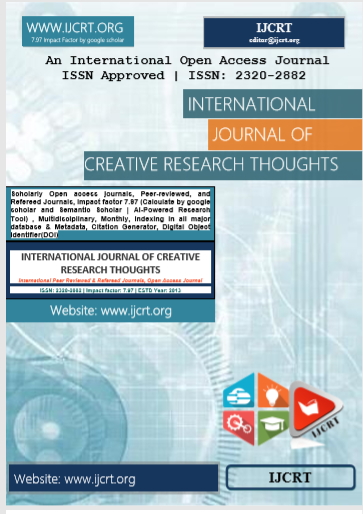
| IJCRT Journal front page | IJCRT Journal Back Page |
Paper Title: REVIEWING MEDHYA DRAVYA: AYURVEDA'S APPROACH TO ENHANCE THE INTELLECTUAL POWER
Publisher Journal Name: IJCRT
Your Paper Publication Details:
Published Paper ID: - IJCRT2412538
Register Paper ID - 273715
Title: REVIEWING MEDHYA DRAVYA: AYURVEDA'S APPROACH TO ENHANCE THE INTELLECTUAL POWER
Author Name(s): Dr. Risheecha, Dr. Shah Foram Vipulkumar, Dr. (Prof.) Chandan Singh
Publisher Journal name: IJCRT
Volume: 12
Issue: 12
Pages: e952-e960
Year: December 2024
Downloads: 160
Abstract
Ayurveda has two main aims - one is to maintain the health of a healthy individual and the second is to treat a diseased person. Rasayana Chikitsa has a significant role in meeting Ayurveda's first goal. Rasayana Chikitsa is also a part of Ashtanga Ayurveda which presents its importance. Rasayana is any herb, food, or activity that confers youthfulness and cures diseases. If taken properly, the Rasayana prevents early aging and keeps you young and active both physically and mentally. Rasayana primarily refers to nourishment on all scales, from the macro to the micro-cellular level. All Rasayanas are nutrition promotores in general but there are certain target-specific Rasayana Medhya Rasayana for the brain, Hridya Rasayana for the heart, Chakshusya Rasayana for the eye, etc. It accelerates the formation of new Dhatus and retards aging. This way, it comprehends our body's vital energy and boosts immunity. A good intellectual power acts as a catalyst in all aspects of life. Ayurveda provides a list of herbs known for nootropic activity and their multi-dimensional utility in various conditions. Yashtimadhu, Guduchi, Shankhapushpi, and Mandookparni are the four Medhya Rasayana that Acharya Charaka briefly explained. It is said that Shankhapushpi is the best among all Medhya Rasayana Dravya. These drugs enhance one's capacity for acquiring knowledge (Dhi), retention (Dhriti), and memory (Smriti). Medhya Rasayana medications are used to promote health and prevent and treat mental illnesses in people of all ages. Recently there has been a tremendous urge to explore medicinal plants globally for improving cognitive function owing to their less adverse effects. Throughout the Nighantu period, more cognitive enhancers were occasionally introduced to classical literature under the label Smritikara Dravya and in folk practice.
Licence: creative commons attribution 4.0
License
Creative Commons Attribution 4.0 and The Open Definition

Keywords
Medhya Rasayana, Memory, Nootropics, Intellectual power, Medha, Dhi, Dhriti, Smriti.
License
Creative Commons Attribution 4.0 and The Open Definition
Paper Title: Diabetes Prediction Using Support Vector Machine
Publisher Journal Name: IJCRT
Your Paper Publication Details:
Published Paper ID: - IJCRT2412537
Register Paper ID - 274173
Title: DIABETES PREDICTION USING SUPPORT VECTOR MACHINE
Author Name(s): Kalakshi Jadhav, Dr. Reena Gunjan
Publisher Journal name: IJCRT
Volume: 12
Issue: 12
Pages: e947-e951
Year: December 2024
Downloads: 155
Abstract
Diabetes, a major global source of morbidity, must be identified early in order to be effectively managed and complications avoided. In this work, we propose a machine learning method for diabetes prediction that makes use of a Support Vector Machine (SVM) model. We carried out comprehensive preparation using a publically accessible dataset, which included choosing pertinent properties, addressing missing values, and normalizing features. Several kernels (linear, polynomial, and RBF) were used to optimize the SVM model, and performance was enhanced through hyperparameter adjustment. The model's effectiveness was validated using evaluation measures such as accuracy, precision, recall, F1-score, and ROC-AUC, which achieved [certain performance criteria]. Our results demonstrate the potential of SVM in clinical decision support systems for the diagnosis of diabetes. In order to improve model resilience, future research will examine sophisticated feature engineering approaches and broaden the dataset to include a variety of populations.
Licence: creative commons attribution 4.0
License
Creative Commons Attribution 4.0 and The Open Definition
Keywords
Diabetes Prediction, Support Vector Machine (SVM), Pima Indians Diabetes Dataset, Machine Learning, Radial Basis Function (RBF) Kernel, Hyperparameter Tuning, Accuracy, Precision, Recall, F1-Score, ROC-AUC, Data Preprocessing, Feature Selection, Healthcare Analytics, Early Diagnosis
License
Creative Commons Attribution 4.0 and The Open Definition
Paper Title: IMPORTANCE AND EFFECTIVENESS OF NUTRITIONAL EDUCATION IN NEP 2020
Publisher Journal Name: IJCRT
Your Paper Publication Details:
Published Paper ID: - IJCRT2412536
Register Paper ID - 273924
Title: IMPORTANCE AND EFFECTIVENESS OF NUTRITIONAL EDUCATION IN NEP 2020
Author Name(s): Shivaraja, Dr. Samata B Deshmane
Publisher Journal name: IJCRT
Volume: 12
Issue: 12
Pages: e938-e946
Year: December 2024
Downloads: 366
Abstract
The National Education Policy (NEP) 2020 emphasizes holistic education, recognizing the critical role of nutritional education in supporting students' physical, cognitive, and emotional development. Nutritional education aligns with NEP's goals of fostering lifelong healthy habits, improving academic performance, and reducing health disparities in India. Integrating nutritional knowledge into school curriculums helps students understand the importance of a balanced diet, promoting both personal and community well-being. NEP 2020 also enhances this focus by advocating experiential learning methods, such as school kitchen gardens and improved mid-day meal programs, to reinforce practical knowledge. While the policy sets a strong foundation for nutritional education, its effectiveness will depend on addressing challenges like resource limitations, cultural diversity, and monitoring outcomes. In conclusion, NEP 2020's approach to nutritional education holds promise for developing healthier, more informed citizens, contributing to India's vision of a balanced, inclusive, and skill-oriented education system.
Licence: creative commons attribution 4.0
License
Creative Commons Attribution 4.0 and The Open Definition
Keywords
Nutrition, Education, NEP-2020, Importance, Effectiveness
License
Creative Commons Attribution 4.0 and The Open Definition
Paper Title: A CRITICAL EXAMINATION OF THE BHARATIYA NYAYA SANHITA'S (BNS) PROVISIONS ON RAPE: A GENDERED PERSPECTIVE
Publisher Journal Name: IJCRT
Your Paper Publication Details:
Published Paper ID: - IJCRT2412535
Register Paper ID - 274165
Title: A CRITICAL EXAMINATION OF THE BHARATIYA NYAYA SANHITA'S (BNS) PROVISIONS ON RAPE: A GENDERED PERSPECTIVE
Author Name(s): Sandhya Devi S
Publisher Journal name: IJCRT
Volume: 12
Issue: 12
Pages: e931-e937
Year: December 2024
Downloads: 211
Abstract
The Bharatiya Nyaya Sanhita (BNS), India's new criminal code, has introduced major changes in the country's criminal laws. The provisions related to rape in BNS have been structured to protect female sexual assault victims. This has raised a concern about the gender-biased approach of this code. This research paper critically examines Bharatiya Nyaya Sanhita's provisions on rape from a gendered perspective, analysing whether the legal framework perpetuates gender bias and excludes male and non-binary victims of sexual violence. This paper calls for a shift in India's legal framework on rape to be gender-neutral for a more inclusive legal approach that ensures justice and support for all, regardless of their gender.
Licence: creative commons attribution 4.0
License
Creative Commons Attribution 4.0 and The Open Definition
Keywords
gender-neutral, sexual violence, rape laws, BNS.
License
Creative Commons Attribution 4.0 and The Open Definition
Paper Title: Stabilization of Black Cotton soil Using Sugarcane Baggage Ash
Publisher Journal Name: IJCRT
Your Paper Publication Details:
Published Paper ID: - IJCRT2412534
Register Paper ID - 274142
Title: STABILIZATION OF BLACK COTTON SOIL USING SUGARCANE BAGGAGE ASH
Author Name(s): Rakshita J Hebali, Dr Shivamanth Angadi, Sukanya GANI, Prem Patil, Supreet Kaluti
Publisher Journal name: IJCRT
Volume: 12
Issue: 12
Pages: e926-e930
Year: December 2024
Downloads: 161
Abstract
Black cotton soil, characterized by its high swelling and shrinkage properties, poses significant challenges to construction and infrastructure development. Stabilizing this soil is crucial for improving its engineering properties and ensuring structural durability. This study explores the use of sugarcane bagasse ash (SCBA), an agricultural waste by-product, as a sustainable stabilizing agent for black cotton soil. SCBA, rich in silica and alumina, reacts with soil particles to enhance strength and reduce plasticity. Laboratory tests were conducted to evaluate the effects of varying SCBA percentages on soil properties, including Atterberg limits, compaction characteristics, unconfined compressive strength (UCS).The results show a significant improvement in soil strength, reduced swelling potential, and enhanced load-bearing capacity with the optimal SCBA content. This approach not only improves soil performance but also promotes waste recycling and environmental sustainability. The findings demonstrate the potential of SCBA as a cost-effective and eco-friendly material for soil stabilization.
Licence: creative commons attribution 4.0
License
Creative Commons Attribution 4.0 and The Open Definition
Keywords
Atterberg Limits, Compaction
License
Creative Commons Attribution 4.0 and The Open Definition
Paper Title: AI Powered Navigator for Personalized and Accessible Healthcare Solutions - VITA Healthcare Pilot
Publisher Journal Name: IJCRT
Your Paper Publication Details:
Published Paper ID: - IJCRT2412533
Register Paper ID - 273880
Title: AI POWERED NAVIGATOR FOR PERSONALIZED AND ACCESSIBLE HEALTHCARE SOLUTIONS - VITA HEALTHCARE PILOT
Author Name(s): Rachitha B R, Sreedevi S, Dhruthi N, Nanditha N Raj, Punya A M
Publisher Journal name: IJCRT
Volume: 12
Issue: 12
Pages: e919-e925
Year: December 2024
Downloads: 132
Abstract
This paper introduces the VITA Healthcare Pilot, an innovative AI-powered platform designed to revolutionize personalized healthcare services. Utilizing the advanced capabilities of Google Generative AI (GenAI), the system offers a comprehensive suite of functionalities, including real-time symptom analysis, health monitoring, medication management, and emergency navigation. By integrating cutting-edge artificial intelligence with user-centric design principles, the VITA Healthcare Pilot aims to address critical gaps in healthcare delivery. This study explores the platform's architecture, methodology, and experimental outcomes, highlighting its transformative potential to enhance accessibility, patient engagement, and the efficiency of healthcare systems. Additionally, the paper discusses future enhancements such as telemedicine integration, wearable device support, and blockchain-enabled data security to further expand its impact
Licence: creative commons attribution 4.0
License
Creative Commons Attribution 4.0 and The Open Definition
Keywords
AI in Healthcare, Generative AI, Symptom Analysis, Health Monitoring, Emergency Navigation
License
Creative Commons Attribution 4.0 and The Open Definition
Paper Title: RIGHT TO PRIVACY - A STUDY (USA AND INDIA)
Publisher Journal Name: IJCRT
Your Paper Publication Details:
Published Paper ID: - IJCRT2412532
Register Paper ID - 274176
Title: RIGHT TO PRIVACY - A STUDY (USA AND INDIA)
Author Name(s): UMANG
Publisher Journal name: IJCRT
Volume: 12
Issue: 12
Pages: e911-e918
Year: December 2024
Downloads: 199
Abstract
This paper provides a comparative analysis of the right to privacy in India and the United States, examining the legal and constitutional frameworks in both countries, and evaluating their alignment with international human rights standards, particularly those outlined in the Universal Declaration of Human Rights (UDHR). Privacy is recognized as a fundamental human right that safeguards personal liberties and protects individuals from unwarranted intrusion into their private lives. While both India and the U.S. offer legal protections for privacy through constitutional provisions and legislation, the scope and effectiveness of these protections vary significantly, especially in the digital age. In India, the right to privacy is enshrined under Article 21 of the Constitution, with landmark rulings like Puttaswamy v. Union of India (2017) affirming its fundamental status. Additionally, India is in the process of implementing the Personal Data Protection Bill to regulate data privacy. In contrast, the U.S. relies on the Fourth Amendment and sectoral laws like the Privacy Act and the Electronic Communications Privacy Act, but challenges remain, particularly concerning the balance between privacy and national security, especially in the post-9/11 context. The paper highlights key differences, such as the U.S.'s lack of comprehensive federal data protection laws compared to European standards, and India's struggle with surveillance programs like Aadhaar. Both countries face significant challenges in ensuring privacy in the digital era, where surveillance, data breaches, and technological advancements complicate privacy protection. The paper concludes by proposing stronger privacy regulations, better oversight of surveillance activities, and enhanced international cooperation to address the global nature of data flows and privacy concerns in the digital age.
Licence: creative commons attribution 4.0
License
Creative Commons Attribution 4.0 and The Open Definition
Paper Title: "Investigate the LC50 values and toxic effect of Glyphosate on the fresh water fish, Labeo rohita in in Sarju River of Gonda, Uttar Pradesh"
Publisher Journal Name: IJCRT
Your Paper Publication Details:
Published Paper ID: - IJCRT2412531
Register Paper ID - 274045
Title: "INVESTIGATE THE LC50 VALUES AND TOXIC EFFECT OF GLYPHOSATE ON THE FRESH WATER FISH, LABEO ROHITA IN IN SARJU RIVER OF GONDA, UTTAR PRADESH"
Author Name(s): Praphulla Narayan Singh, Dr. Ashish Vishwakarma, Laxmi Prasad Gupta
Publisher Journal name: IJCRT
Volume: 12
Issue: 12
Pages: e905-e910
Year: December 2024
Downloads: 157
Abstract
The present study was undertaken to evaluate the toxicity and effects of a commercial formulation of the herbicide, Glyphosate on liver enzyme system in the freshwater air breathing fish Labeo rohita. The 24, 48, 72 and 96 h LC50 of Glyphosate, calculated by Direct interpolation Method, were determined to be 0.018ml/liter, 0.015 ml/liter, 0.012 ml/liter and 0.009 ml/liter respectively. In addition to concentration and time dependent decrease in mortality rate, stress signs in the form of behavioural changes were also observed in response to the test chemical.
Licence: creative commons attribution 4.0
License
Creative Commons Attribution 4.0 and The Open Definition
Keywords
Glyphosate, toxicity, Labeo rohita, oxidative stress, environmental pollution, LC50.
License
Creative Commons Attribution 4.0 and The Open Definition
Paper Title: ALOE VERA IN COSMETIC PRODUCTS: STRIKING A BALANCE BETWEEN BEAUTY AND SAFETY OF CONSUMER THROUGH COSMETOVIGILANCE.
Publisher Journal Name: IJCRT
Your Paper Publication Details:
Published Paper ID: - IJCRT2412530
Register Paper ID - 274224
Title: ALOE VERA IN COSMETIC PRODUCTS: STRIKING A BALANCE BETWEEN BEAUTY AND SAFETY OF CONSUMER THROUGH COSMETOVIGILANCE.
Author Name(s): Sahani Sapana Ramashray, Firdous Abdulrahman Khan, Moisali Sayyed
Publisher Journal name: IJCRT
Volume: 12
Issue: 12
Pages: e889-e904
Year: December 2024
Downloads: 166
Abstract
While the use of aloes has been useful in making beauty and cosmetic products more attractive, ingredients to check unwanted prices on abuse could be managed through a concept of cosmetovigilance. Aloe Vera: You have probably heard in some natural cosmetic formulas because of its multifunctional actions, Aloe vera has earned a place ingredient that is already parament for moisture and hydration to hydrate or oriented from home care consumers as it acts moisturizing, anti-inflammatory, healing; This abstract examines the optimization given by Aloe Vera as an adjuvant for cosmetic efficacy and opens accessible approaches to unsafe considerations of cosmetovigilance. However, the challenges for Aloe Vera continue to be its efficacy and safety for all who are now exposed to many hair care products one-handed: mimicking the excellent skin-care world. Although its natural ingredients are fantastic for maintaining skin hydration, counteracting the signs of aging, and treating acne; if used long term can have side effects which may include allergic reactions or your own body getting too good at moisturising itself... over-moisturisation. To maintain the benefits of Aloe Vera in cosmetics, while preventing risks from overshadowing consumer safety, it becomes indispensable follow-up by cosmetovigilance practices. Such an overview in the current review is essential to highlight balancing strategies i.e., cosmetic benefits provided by Aloe Vera should be balanced with strict safety evaluations which are necessary for safeguarding consumer health and maintaining the integrity of a product. Incorporation of thorough safety assessments; and consumer feedback during the Product Development Lifecycle would promote the overall reliance on safe Aloe Vera-based cosmetics. This will attempt to synchronize the beauty benefits that are obtained from Aloe Vera with proper use while building trust amongst consumers and responsible cosmetic innovation.
Licence: creative commons attribution 4.0
License
Creative Commons Attribution 4.0 and The Open Definition
Keywords
Cosmetovigilance , moisturizer, anti inflammatory aleovera
License
Creative Commons Attribution 4.0 and The Open Definition
Paper Title: Rule Based Sarcasm Detection
Publisher Journal Name: IJCRT
Your Paper Publication Details:
Published Paper ID: - IJCRT2412529
Register Paper ID - 274183
Title: RULE BASED SARCASM DETECTION
Author Name(s): Yash Nimbalkar, Dr. Yuvraj Nikam
Publisher Journal name: IJCRT
Volume: 12
Issue: 12
Pages: e883-e888
Year: December 2024
Downloads: 148
Abstract
The practicality of rule-based techniques for text sarcasm detection is investigated in this study. Although the discipline has recently been dominated by deep learning techniques, rule-based approaches provide explainability and can work well in some applications. In order to detect sarcastic words, we suggest an improved rule-based framework that makes use of sentiment analysis, linguistic patterns, and contextual clues. Our approach combines a thorough set of guidelines drawn from sardonic expression analysis and linguistic theory. We test our method on benchmark datasets and show that it is effective at detecting sarcasm, especially when explainability is important or training data is limited.
Licence: creative commons attribution 4.0
License
Creative Commons Attribution 4.0 and The Open Definition
Keywords
Sarcasm Detection, Natural Language Processing (NLP), Sentiment Analysis, Machine Learning, Deep Learning, Rule-Based Systems
License
Creative Commons Attribution 4.0 and The Open Definition
Paper Title: Framework and Methodology for Investigating Inclusive Education Policies For Children with Special Needs in Government Schools of Dausa
Publisher Journal Name: IJCRT
Your Paper Publication Details:
Published Paper ID: - IJCRT2412528
Register Paper ID - 274168
Title: FRAMEWORK AND METHODOLOGY FOR INVESTIGATING INCLUSIVE EDUCATION POLICIES FOR CHILDREN WITH SPECIAL NEEDS IN GOVERNMENT SCHOOLS OF DAUSA
Author Name(s): NILESH KUMAR GUPTA, PROF. (DR.) RITA ARORA
Publisher Journal name: IJCRT
Volume: 12
Issue: 12
Pages: e878-e882
Year: December 2024
Downloads: 136
Abstract
This study aims to explore the policies and status of Children with Special Needs (CWSN) within inclusive classrooms in government schools in Dausa, Rajasthan. Grounded in a qualitative methodology, the research adopts a phenomenological approach to uncover the lived experiences of parents and teachers. Semi-structured interviews, supplemented by document reviews and classroom observations, provide a nuanced understanding of the practical realities of inclusive education. Key areas of focus include stakeholder awareness of policies, challenges in implementation, perceived impacts on CWSN, and actionable suggestions for improvement. Ethical rigor, contextual sensitivity, and methodological reliability ensure the study's findings contribute meaningfully to enhancing inclusive education practices. The insights derived aim to inform policy development, teacher training programs, and support mechanisms for CWSN.
Licence: creative commons attribution 4.0
License
Creative Commons Attribution 4.0 and The Open Definition
Paper Title: A comparison of the inverted type and non-inverted type equations of state for some binary solids
Publisher Journal Name: IJCRT
Your Paper Publication Details:
Published Paper ID: - IJCRT2412527
Register Paper ID - 273331
Title: A COMPARISON OF THE INVERTED TYPE AND NON-INVERTED TYPE EQUATIONS OF STATE FOR SOME BINARY SOLIDS
Author Name(s): A. Solanki, P.K. Singh
Publisher Journal name: IJCRT
Volume: 12
Issue: 12
Pages: e871-e877
Year: December 2024
Downloads: 141
Abstract
We have presented a comparison of the results for different types of solids determined using the inverted type equation of state and the non-inverted type of equation of state. We have presented a discussion emphasizing that the Kholiya equation of state represents a satisfactory formulation for determining volumes at different values of pressure and temperature. On the other hand, non-inverted Holzapfel adapted polynomial of second order equation of state yields more accurate results for pressure and bulk modulus of solids up to extremely high pressures. A comparison of the results obtained for NaCl NaF, Lif, MgO, CaF2 and SiC for a very wide range of pressures has been presented. The pressure dependences of bulk modulus are also computed and the results are discussed in the limit of infinite pressure and extreme compression.
Licence: creative commons attribution 4.0
License
Creative Commons Attribution 4.0 and The Open Definition
Keywords
Equations of state, Bulk modulus, Binary solids, P-V-T relationship, Pressure derivatives of bulk modulus, Infinite pressure behaviour.
License
Creative Commons Attribution 4.0 and The Open Definition
Paper Title: STUDY ON ZOOPLANKTON DIVERSITY OF TIGHRA RESERVOIR DISTRICT GWALIOR, MADHYA PRADESH
Publisher Journal Name: IJCRT
Your Paper Publication Details:
Published Paper ID: - IJCRT2412526
Register Paper ID - 274037
Title: STUDY ON ZOOPLANKTON DIVERSITY OF TIGHRA RESERVOIR DISTRICT GWALIOR, MADHYA PRADESH
Author Name(s): Priti Soni, Preeti Upadhyay
Publisher Journal name: IJCRT
Volume: 12
Issue: 12
Pages: e864-e870
Year: December 2024
Downloads: 142
Abstract
Licence: creative commons attribution 4.0
License
Creative Commons Attribution 4.0 and The Open Definition
Keywords
Zooplankton, Season, Diversity, Density, Tighra reservoir, micro-organism
License
Creative Commons Attribution 4.0 and The Open Definition
Paper Title: WEATHER DATA VISUALIZATION USING JAVASCRIPT
Publisher Journal Name: IJCRT
Your Paper Publication Details:
Published Paper ID: - IJCRT2412525
Register Paper ID - 273543
Title: WEATHER DATA VISUALIZATION USING JAVASCRIPT
Author Name(s): VIMAL M, KRUTHIKA V T, ROHITH K, SANTHOSKUMAR S
Publisher Journal name: IJCRT
Volume: 12
Issue: 12
Pages: e860-e863
Year: December 2024
Downloads: 150
Abstract
Weather data visualization is a project brings weather data to life through interactive JavaScript visualizations. By using tools le React.js and Node.js, we create engaging maps and charts that let users explore real-time weather patterns compare trends over-time and even visualize wind flow in motion. These visualizations turn complex weather data into intuitive, interactive experiences, making it easier to understand and analyze the ever-changing conditions around us. The project aims to bridge the gap between raw weather data and actionable insights, offering a scalable and customizable solution for meteorological analysis.
Licence: creative commons attribution 4.0
License
Creative Commons Attribution 4.0 and The Open Definition
Keywords
Weather data visualization, Interactive visualizations, React.js, Node.js, Real-time weather patterns, Maps and charts, Wind flow visualization, Intuitive experiences, Meteorological analysis, Actionable insights, Scalable solution. Customizable solution, Trends over time.
License
Creative Commons Attribution 4.0 and The Open Definition
Paper Title: An experimental study to assess the effectiveness of communication board on the communication process among patients with mechanical ventilation at selected hospitals of the city'.
Publisher Journal Name: IJCRT
Your Paper Publication Details:
Published Paper ID: - IJCRT2412524
Register Paper ID - 274195
Title: AN EXPERIMENTAL STUDY TO ASSESS THE EFFECTIVENESS OF COMMUNICATION BOARD ON THE COMMUNICATION PROCESS AMONG PATIENTS WITH MECHANICAL VENTILATION AT SELECTED HOSPITALS OF THE CITY'.
Author Name(s): Ms. Priya S. Bhamodre, Ms. Sneha Tadulwar, Dr. Jitendra Belokar, Ms. Shraddha Gaikwad
Publisher Journal name: IJCRT
Volume: 12
Issue: 12
Pages: e846-e859
Year: December 2024
Downloads: 147
Abstract
Every individual wants to share his/her feelings, thoughts and views to feel comfortable and to satisfy himself/herself. So for this, they interact with one another and share their feelings, thoughts and views through the process of communication. Communication is always been a fundamental need of human beings. Good communication likewise improves the standard of care delivering to patients illness was never being an isolated life event. Patients react differently to illness. Individual behaviour and emotional reaction depend on the nature of the illness and the patient attitude towards it. Patients who were supported with mechanical ventilator create undue stress, uncertainty fear and anxiety among the patients. STATEMENT OF THE PROBLEM "An experimental study to assess the effectiveness of communication board on the communication process among patients with mechanical ventilation at selected hospitals of the city'. OBJECTIVES 1.To assess the level of communication before and after use of communication board among the control and experimental group of patient with mechanical ventilator.2.To determine the effectiveness of the communication board on the communication process by comparing the communication process between the control and the experimental group of patients with mechanical ventilator. 3.To determine the association between selected demographic variables and the level of communication among the control and experimental group of patients with mechanical ventilator. METHODOLOGY A post test only quasi-experimental research design was undertaken to assess the effectiveness of communication board on communication process among patients with mechanical ventilation. The study was conducted among mechanically ventilated patient at selected hospitals of the city. 60 patients were selected by using Non-probability purposive sampling technique i.e. 30 in each group. Pre-test was conducted to assess the communication using communication board. Then the two groups were given interventions respectively. On the 8th day, post test was conducted for both groups. The data was analysed for frequency, percentage, mean and standard deviation. Paired t test was done for finding out the effectiveness of the interventions. Independent t test was done to compare both the interventions. RESULTS OF THE STUDY RESULT The Mean, standard deviation and mean difference values are compared and student's paired 't' test is applied at 5% level of significance. The tabulated value for n=172-1 i.e., 171 degrees of freedom was 1.96. The calculated 't' value i.e., 9.48 are much higher than the tabulated value at 5% level of significance for overall knowledge score of patients which is statistically acceptable level of significance. Hence, it is statistically interpreted that the communication board on the communication process among patients with mechanical ventilation. was effective Key Words: Communication, Communication board, Mechanical ventilator
Licence: creative commons attribution 4.0
License
Creative Commons Attribution 4.0 and The Open Definition
Keywords
Communication, Communication board, Mechanical ventilator
License
Creative Commons Attribution 4.0 and The Open Definition
Paper Title: Personalized Nutritional Recommendation System By Using Machine Learning & wearable Sensors: A Review
Publisher Journal Name: IJCRT
Your Paper Publication Details:
Published Paper ID: - IJCRT2412523
Register Paper ID - 274180
Title: PERSONALIZED NUTRITIONAL RECOMMENDATION SYSTEM BY USING MACHINE LEARNING & WEARABLE SENSORS: A REVIEW
Author Name(s): Siddharth Nikam, Dr. Reena Gunjan
Publisher Journal name: IJCRT
Volume: 12
Issue: 12
Pages: e840-e845
Year: December 2024
Downloads: 197
Abstract
The Personalized Nutritional Recommendation System is an innovative approach that combines machine learning algorithms with wearable sensors to deliver real-time, tailored dietary guidance. This system uses health metrics such as heart rate, activity levels, and other physiological data collected by wearable devices to adapt recommendations to individual needs dynamically. By leveraging advanced machine learning techniques, the system improves user engagement, promotes healthier dietary choices, and enhances overall well-being. Despite challenges such as data variability and privacy concerns, the integration of robust data preprocessing methods and secure frameworks ensures reliability and user trust. This paper explores the design, implementation, and impact of this system, highlighting its potential to transform personalized health management and provide adaptive nutritional solutions.
Licence: creative commons attribution 4.0
License
Creative Commons Attribution 4.0 and The Open Definition
Keywords
Personalized Nutrition, Machine Learning, Wearable Sensors, Data Privacy
License
Creative Commons Attribution 4.0 and The Open Definition
Paper Title: PermitPro : Leave Management System
Publisher Journal Name: IJCRT
Your Paper Publication Details:
Published Paper ID: - IJCRT2412522
Register Paper ID - 274194
Title: PERMITPRO : LEAVE MANAGEMENT SYSTEM
Author Name(s): Dr. Adarsh T.K, Bishal Guha, Nitish Trigun, Sahil Pokhrel, Shubhendu Singh
Publisher Journal name: IJCRT
Volume: 12
Issue: 12
Pages: e834-e839
Year: December 2024
Downloads: 142
Abstract
In educational institutions, leave management is a recurring administrative challenge. This paper introduces PermitPro, a mobile Leave Management System (LMS) developed using Flutter and Firebase, designed to streamline the process for students, Class Teachers, and Heads of Departments (HODs). The system employs Google Sign-In for secure authentication, with role-based access ensuring users navigate customized dashboards tailored to their needs. Features include comprehensive profile management, leave request submission with supporting documents, and approval workflows. PermitPro leverages Firebase Firestore for real-time data storage and Firebase Storage for handling image uploads. The app's intuitive interface, coupled with modular role-specific functionality, addresses common inefficiencies in traditional systems. Preliminary testing demonstrates improved process efficiency and user satisfaction. Future enhancements, such as real-time notifications and attendance integration, are proposed to further optimize functionality.
Licence: creative commons attribution 4.0
License
Creative Commons Attribution 4.0 and The Open Definition
Keywords
Leave Management System, PermitPro, Flutter Application, Leave Approval/Rejection
License
Creative Commons Attribution 4.0 and The Open Definition
Paper Title: A Comparative Analysis of Formal and Informal Sector Employment in India
Publisher Journal Name: IJCRT
Your Paper Publication Details:
Published Paper ID: - IJCRT2412521
Register Paper ID - 274158
Title: A COMPARATIVE ANALYSIS OF FORMAL AND INFORMAL SECTOR EMPLOYMENT IN INDIA
Author Name(s): Ankita Mishra, Atika Khatoon
Publisher Journal name: IJCRT
Volume: 12
Issue: 12
Pages: e823-e833
Year: December 2024
Downloads: 237
Abstract
This study presents a detailed comparative examination of India's formal and informal sector employment, focusing on the wage gap and economic contributions. As explained in the tables, we use NSSO, PLFS, Economic census, and ASUSE surveys for this study. The study also investigates the interplay between demographic factors, regional disparities, and policy interventions in shaping employment trends. The study aims to present a clear and analytical scenario of formal and informal sectors of the workforce. This analysis helps to understand the broader discourse on labour economics in emerging economies, offering recommendations for fostering sustainable and equitable employment opportunities in India.
Licence: creative commons attribution 4.0
License
Creative Commons Attribution 4.0 and The Open Definition
Keywords
Employment, wage gap, demography, regional disparity, workforce, etc.
License
Creative Commons Attribution 4.0 and The Open Definition
Paper Title: EFFECTIVENESS OF MUSCLE ENERGY TECHNIQUE ALONG WITH KINESIO TAPING IN TREATING SACROILIAC JOINT DYSFUNCTION
Publisher Journal Name: IJCRT
Your Paper Publication Details:
Published Paper ID: - IJCRT2412520
Register Paper ID - 273637
Title: EFFECTIVENESS OF MUSCLE ENERGY TECHNIQUE ALONG WITH KINESIO TAPING IN TREATING SACROILIAC JOINT DYSFUNCTION
Author Name(s): PRIYA M
Publisher Journal name: IJCRT
Volume: 12
Issue: 12
Pages: e810-e822
Year: December 2024
Downloads: 164
Abstract
ABSTRACT Background : Sacroiliac joint dysfunction is a condition in which the joint is locked, Partially dislocated (or) subluxated in a non-anatomical position due to hyper mobility (or) hypo mobility within the joint. The biomechanics of the SI joint are complex.SI joint motion is affected by motion of the spine, ilium, pubic symphysis, and hip. The sacrum becomes dysfunctional between the two iliac bones either unilaterally or bilaterally. Aim: The aim of the study to find out the effectiveness of muscle energy technique along with kinesio taping in treating sacroiliac joint dysfunction. Methods: A total number of 15 subjects who met inclusion and exclusion criteria were recruited. Prior to the treatment, pre test were conducted with Numerical pain rating scale for pain, Oswestry disability index for functional ability.After a brief demonstration about muscle energy technique with kinesio taping, subjects were treated with the same period of 4 weeks. The post test were onducted for subjects by Numerical pain rating scale for pain, oswestry disability index for functional ability.Pre and post results were recorded and analyzed.Results: Result show that muscle energy technique along with kinesio taping was effective to improve pain and disability in sacroiliac joint. Muscle energy technique along with kinesio taping shows significant different in pre and post test value before and after application.Conclusion: The study was concluded that muscle energy technique along with kinesio taping was significant improvement on pain and disability in sacroiliac joint.
Licence: creative commons attribution 4.0
License
Creative Commons Attribution 4.0 and The Open Definition
Keywords
Kinesio Taping., Muscle Energy Technique., NPRS., Sacroiliac Joint
License
Creative Commons Attribution 4.0 and The Open Definition
Paper Title: Sustainable Precision Agriculture Techniques using Artificial Intelligence
Publisher Journal Name: IJCRT
Your Paper Publication Details:
Published Paper ID: - IJCRT2412519
Register Paper ID - 274134
Title: SUSTAINABLE PRECISION AGRICULTURE TECHNIQUES USING ARTIFICIAL INTELLIGENCE
Author Name(s): Rahul Vijaykumar Nalage, Dr. Dipti Patil
Publisher Journal name: IJCRT
Volume: 12
Issue: 12
Pages: e802-e809
Year: December 2024
Downloads: 151
Abstract
This study presents Precision agriculture, augmented by artificial intelligence (AI), is transforming farming practices by enabling data-driven and sustainable solutions to meet global food demands. AI technologies, including machine learning, computer vision, and Internet of Things integration, allow for precise crop management, optimized resource usage, and early detection of diseases and pests. These advancements reduce environmental impacts by minimizing water, fertilizer, and pesticide use while boosting productivity and profitability. By addressing challenges like climate change and resource scarcity, AI-driven precision agriculture represents a vital approach to achieving sustainable agricultural practices worldwide. This work initially analyses Artificial Intelligent technologies used in Smart Sustainable Agriculture (SSA). This paper examines the state of research and development in Precision agriculture, pays attention to the current form of machine learning and deep learning algorithms as a starting point for SSA to achieve goal of sustainability.
Licence: creative commons attribution 4.0
License
Creative Commons Attribution 4.0 and The Open Definition
Keywords
Artificial Intelligence, Machine Learning, Deep Learning, Sustainable Farming, Precision Agriculture.
License
Creative Commons Attribution 4.0 and The Open Definition
All Published Paper Details Search Through Above Search Option.
About IJCRT
The International Journal of Creative Research Thoughts (IJCRT) aims to explore advances in research pertaining to applied, theoretical and experimental Technological studies. The goal is to promote scientific information interchange between researchers, developers, engineers, students, and practitioners working in and around the world.
Indexing In Google Scholar, ResearcherID Thomson Reuters, Mendeley : reference manager, Academia.edu, arXiv.org, Research Gate, CiteSeerX, DocStoc, ISSUU, Scribd, and many more International Journal of Creative Research Thoughts (IJCRT) ISSN: 2320-2882 | Impact Factor: 7.97 | 7.97 impact factor and ISSN Approved. Provide DOI and Hard copy of Certificate. Low Open Access Processing Charges. 1500 INR for Indian author & 55$ for foreign International author. Call For Paper (Volume 14 | Issue 3 | Month- March 2026)
Call For Paper March 2026
Call For Papers
March 2026
Volume 14 | Issue 3
Last Date :
31-Mar-2026
Submit Manuscript Online Impact Factor: 7.97 Review Results : Within 02-03 Days Paper Publication : Within 02-03 Days
March 2026
Volume 14 | Issue 3
Last Date :
31-Mar-2026
Submit Manuscript Online Impact Factor: 7.97 Review Results : Within 02-03 Days Paper Publication : Within 02-03 Days
Published Issue Details
For Authors
Forms / Downloads
Other IMP Links
Indexing Partner
Research Area
LICENSE





ISSN and 7.97 Impact Factor Details
ISSN: 2320-2882 Impact Factor: 7.97 and ISSN APPROVED Journal Starting Year (ESTD) : 2013


ISSN and 7.97 Impact Factor Details
ISSN: 2320-2882 Impact Factor: 7.97 and ISSN APPROVED Journal Starting Year (ESTD) : 2013
DOI Details
CONFERENCE
CONFERENCE MANAGMENT & PUBLICATION CONFERENCE PROPOSAL
RECENT CONFERENCE

CONFERENCE PROPOSAL CONFERENCE PROCEEDINGS
CONFERENCE PROPOSAL CONFERENCE PROCEEDINGS
For Reviewer /Referral (RMS) Earn 500 per paper
Important Links
NEWS & Conference
Digital Library
IJCRT RMS | Earn 500 Per Paper.

Open Access


LICENSE
Indexing Partner
Scholarly open access journals, Peer-reviewed, and Refereed Journals, Impact factor 7.97 (Calculate by google scholar and Semantic Scholar | AI-Powered Research Tool) , Multidisciplinary, Monthly, Indexing in all major database & Metadata, Citation Generator, Digital Object Identifier(DOI)