Important Details
IJCRT - International Peer Reviewed, Open Access Journal, Multidisciplinary, Monthly, Nominal(Low) Fees for Professional Research Services International Journal of Creative Research Thoughts - IJCRT Peer Review Journal, Refereed Journal, Peer Reviewed Journal , Referred Journal and Indexed Journal, Open access, Online and Print Journal,international Journal Open Access, Accepted by Indian and foreign university ,IJCRT Followed Norms, guidelines, requirement, listing criteria and methodology of score/point also applied from: Scopus , Web of Science , UGC Approved , UGC CARE, UGC-CARE .
UGC Approved Journal No: 49023 (18)
UGC approval Link
https://ijcrt.org/ugc%20approval.jpg
All Policy and Approval
Please Like Our Facebook Page | CrossRef DOI and Hard copy of Certificate Provide if required. | www.IJCRT.org | editor@IJCRT.org | IJCRT WhatsApp +91 94294 58311
Publication Details:
- Paper Submission : 31-Aug-2026. Call For Paper (Volume 14 | Issue 8 | Month- August 2026)
- Acceptance/Rejection Notification: Within 02-04 Days.
- Paper Publish: Within 02-04 Days after submitting all documents.
-
Submit Your Paper Any time There No deadline.
-
Publication fees : 1570 INR for Indian author & 59$ for foreign International author.
Please Like Our Facebook Page | CrossRef DOI and Hard copy of Certificate Provide if required.
Licence and Indexing
Indexing In Google Scholar, SSRN, ResearcherID-Publons, Semantic Scholar | AI-Powered Research Tool, Microsoft Academic, Academia.edu, arXiv.org, Research Gate, CiteSeerX, ResearcherID Thomson Reuters, Mendeley : reference manager, DocStoc, ISSUU, Scribd, and many more | High Impact Factor: 7.97 | Digital object identifier (DOI) and Hard Copy of certificate Provided.




























Licence
DOI
ISSN Approved impact factor: 7.97 
Creative Common 
Valid as per new UGC Gazette regulations 

INTERNATIONAL JOURNAL OF CREATIVE RESEARCH THOUGHTS - IJCRT (IJCRT.ORG)
International Peer Reviewed & Refereed Journals, Open Access Journal
IJCRT Peer-Reviewed (Refereed) Journal as Per New UGC Rules.
ISSN Approved Journal No: 2320-2882 | Impact factor: 7.97 | ESTD Year: 2013
Call For Paper - Volume 14 | Issue 8 | Month- August 2026
Scholarly open access journals, Peer-reviewed, and Refereed Journals, Impact factor 7.97 (Calculate by google scholar and Semantic Scholar | AI-Powered Research Tool) , Multidisciplinary, Monthly, Indexing in all major database & Metadata, Citation Generator, Digital Object Identifier(CrossRef DOI)
IJCRT WhatsApp Contact
IJCRT Search Xplore - Search all paper by Paper Name , Author Name, and Title
Volume 13 | Issue 10
Volume 13 | Issue 10 | Month
Downlaod After Publication 1) Table of content index in PDF
2) Table of content index in HTML 2)Table of content index in HTML
3) Front Page 3) Front Page
4) Back Page 4) Back Page
5) Editor Board Member 5)Editor Board Member
6) OLD Style Issue 6) OLD Style Issue
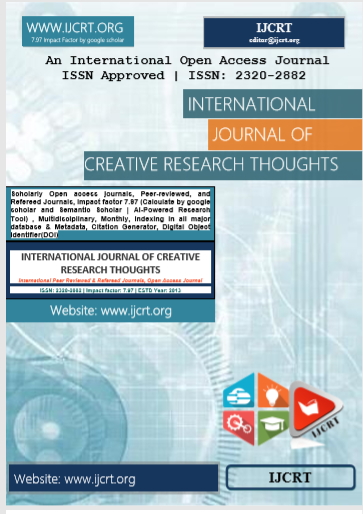 |
 |
|---|---|
| IJCRT Journal front page | IJCRT Journal Back Page |
Paper Title: Alkali-Activated Materials For Low-Carbon Construction: A Review
Publisher Journal Name: IJCRT
Your Paper Publication Details:
Published Paper ID: - IJCRT2510731
Register Paper ID - 295796
Title: ALKALI-ACTIVATED MATERIALS FOR LOW-CARBON CONSTRUCTION: A REVIEW
Author Name(s): Ahmad Isar Makhdoomi, Amit Prasad, Prakash Kumar, Shabnam Purty, Prabhat Kumar
Publisher Journal name: IJCRT
Volume: 13
Issue: 10
Pages: g240-g247
Year: October 2025
Downloads: 160
Abstract
The construction industry accounts for nearly 8 % of global anthropogenic CO? emissions, primarily due to the production of Ordinary Portland Cement (OPC). To achieve carbon-neutral construction, alternative binders with low embodied energy and carbon footprints are being widely studied. Alkali-activated materials (AAMs)--including alkali-activated slag (AAS), fly ash geopolymers, and hybrid binders--are among the most promising candidates. This review provides a comprehensive synthesis of recent research on AAMs for low-carbon construction, addressing material chemistry, processing, performance, life-cycle assessment, and industrial implementation. Key findings indicate that AAMs can reduce embodied CO? by 40-80 % relative to OPC, while achieving comparable mechanical and durability performance under optimized curing. However, challenges remain regarding activator sustainability, precursor variability, and standardization. Future research priorities include development of one-part systems, ambient-curing formulations, and harmonized life-cycle assessment methodologies.
Licence: creative commons attribution 4.0
License
Creative Commons Attribution 4.0 and The Open Definition

Keywords
Alkali-activated materials, geopolymer, low-carbon construction, sustainability, life-cycle assessment, circular economy.
License
Creative Commons Attribution 4.0 and The Open Definition
Paper Title: Youth Power and Leadership: The Ideals of Birsa Munda
Publisher Journal Name: IJCRT
Your Paper Publication Details:
Published Paper ID: - IJCRT2510730
Register Paper ID - 295785
Title: YOUTH POWER AND LEADERSHIP: THE IDEALS OF BIRSA MUNDA
Author Name(s): Dr. Rashmi Nagwanshi
Publisher Journal name: IJCRT
Volume: 13
Issue: 10
Pages: g236-g239
Year: October 2025
Downloads: 152
Abstract
Many national leaders shaped the course of history through their courage, leadership, and vision during India's freedom struggle. Among these great personalities, Birsa Munda holds a special place as a revolutionary who awakened the tribal society. This research study analyzes the life, work, and ideas of Birsa Munda in the context of youth power and leadership. His ideals continue to inspire today's youth by providing the energy essential for social change, self-respect, and nation-building.
Licence: creative commons attribution 4.0
License
Creative Commons Attribution 4.0 and The Open Definition
Keywords
History, leadership, Freedom struggle, awake tribal society, social change, national building
License
Creative Commons Attribution 4.0 and The Open Definition
Paper Title: A Reviw On :Chromium Deficiency And Its Emerging Role In The Pathogenesis Of Type 2 Diabetes Mallitus
Publisher Journal Name: IJCRT
Your Paper Publication Details:
Published Paper ID: - IJCRT2510729
Register Paper ID - 295605
Title: A REVIW ON :CHROMIUM DEFICIENCY AND ITS EMERGING ROLE IN THE PATHOGENESIS OF TYPE 2 DIABETES MALLITUS
Author Name(s): Gholap Apeksha Santosh, Gaikar Mayur, Gangurde Mayuri Pravin, Kote Sayali Nilesh, Kadam Vaishnavi Madan
Publisher Journal name: IJCRT
Volume: 13
Issue: 10
Pages: g226-g235
Year: October 2025
Downloads: 154
Abstract
Licence: creative commons attribution 4.0
License
Creative Commons Attribution 4.0 and The Open Definition
Keywords
Chromium deficiency, Glycemic control ,Trivalent chromium, Chromium supplementation , Insulin sensitivity, Glucose metabolism , Type 2 Diabetes Mallitus
License
Creative Commons Attribution 4.0 and The Open Definition
Paper Title: Use of Library Resources and Services in Vignan's Foundation for Science, Technology & Research Deemed UniversityHyderabad: a study
Publisher Journal Name: IJCRT
Your Paper Publication Details:
Published Paper ID: - IJCRT2510728
Register Paper ID - 295795
Title: USE OF LIBRARY RESOURCES AND SERVICES IN VIGNAN'S FOUNDATION FOR SCIENCE, TECHNOLOGY & RESEARCH DEEMED UNIVERSITYHYDERABAD: A STUDY
Author Name(s): Dr Banothu Champla
Publisher Journal name: IJCRT
Volume: 13
Issue: 10
Pages: g211-g225
Year: October 2025
Downloads: 135
Abstract
In this paper I studied collection development, staff position, working hours, library automation, usage of library and information resources and services of vignan's foundation for science. Technology and research deemed university.Vignan's University's library plays a crucial role in supporting the academic and research endeavours of its students and faculty, offering a comprehensive array of resources and services. I found in this study the vignan's foundation for science. Technology and research deemed university library maintain good library collection development resources, services (electronic & print), and library expressed their opinion about library working hours, physical facility, library information resources and services excellent and good.
Licence: creative commons attribution 4.0
License
Creative Commons Attribution 4.0 and The Open Definition
Keywords
collection development in library, Library resources and services, Library physical facilities, Library working hours, library automation, staff position Reprographic Services, Digital library access.
License
Creative Commons Attribution 4.0 and The Open Definition
Paper Title: Information Overload in Present Times: A study
Publisher Journal Name: IJCRT
Your Paper Publication Details:
Published Paper ID: - IJCRT2510727
Register Paper ID - 295767
Title: INFORMATION OVERLOAD IN PRESENT TIMES: A STUDY
Author Name(s): SAIKAT SOREN
Publisher Journal name: IJCRT
Volume: 13
Issue: 10
Pages: g206-g210
Year: October 2025
Downloads: 142
Abstract
Abstract: Internet today coupled to high-tech telecommunication technology, thanks to the private players in the telecom industry and rapid infrastructural development has resulted in generation of huge amount of firsthand information, which has become a blessing to the mankind. Information has become a basic need of present times. But as over eating causes obesity and causes both physical and mental damage to a person, likewise abundance of information also gives rise to concepts like information overload, information obesity and information anxiety. Though there is no universally accepted definition of Information Overload., this paper studies the various aspects of information overload along with its concept, causes, symptoms, consequence and remedies of information overload.
Licence: creative commons attribution 4.0
License
Creative Commons Attribution 4.0 and The Open Definition
Keywords
Keywords: Information, Information Overload, Overload, Information Obesity, Information anxiety
License
Creative Commons Attribution 4.0 and The Open Definition
Paper Title: Shramik utpravaas ka bhugolik adhyayan : sidhi jille k sihawal tehsil ke visesh sandarbh mein
Publisher Journal Name: IJCRT
Your Paper Publication Details:
Published Paper ID: - IJCRT2510726
Register Paper ID - 295766
Title: SHRAMIK UTPRAVAAS KA BHUGOLIK ADHYAYAN : SIDHI JILLE K SIHAWAL TEHSIL KE VISESH SANDARBH MEIN
Author Name(s): Prajapati Rakesh Kumar, Singh R.P
Publisher Journal name: IJCRT
Volume: 13
Issue: 10
Pages: g199-g205
Year: October 2025
Downloads: 154
Abstract
Shramik utpravaas ka bhugolik adhyayan : sidhi jille k sihawal tehsil ke visesh sandarbh mein
Licence: creative commons attribution 4.0
License
Creative Commons Attribution 4.0 and The Open Definition
Keywords
Shramik utpravaas ka bhugolik adhyayan : sidhi jille k sihawal tehsil ke visesh sandarbh mein
License
Creative Commons Attribution 4.0 and The Open Definition
Paper Title: Academic Procrastination among School Students in relation to their Academic Stress, Peer Pressure and Parental Pressure
Publisher Journal Name: IJCRT
Your Paper Publication Details:
Published Paper ID: - IJCRT2510725
Register Paper ID - 295421
Title: ACADEMIC PROCRASTINATION AMONG SCHOOL STUDENTS IN RELATION TO THEIR ACADEMIC STRESS, PEER PRESSURE AND PARENTAL PRESSURE
Author Name(s): Kavita Ladwal, Dr. Madhuri Hooda
Publisher Journal name: IJCRT
Volume: 13
Issue: 10
Pages: g188-g198
Year: October 2025
Downloads: 129
Abstract
Licence: creative commons attribution 4.0
License
Creative Commons Attribution 4.0 and The Open Definition
Keywords
Academic Procrastination, Academic Stress, Peer Pressure and Parental Pressure
License
Creative Commons Attribution 4.0 and The Open Definition
Paper Title: Survey on Price Sensitivity and Brand Loyalty in The Purchase of Ghee and Butter
Publisher Journal Name: IJCRT
Your Paper Publication Details:
Published Paper ID: - IJCRT2510724
Register Paper ID - 295765
Title: SURVEY ON PRICE SENSITIVITY AND BRAND LOYALTY IN THE PURCHASE OF GHEE AND BUTTER
Author Name(s): A.K.Makwana, Rathva Yuvrajsinh
Publisher Journal name: IJCRT
Volume: 13
Issue: 10
Pages: g184-g187
Year: October 2025
Downloads: 143
Abstract
This study on "Price Sensitivity and Brand Loyalty in the Purchase of Ghee and Butter" looks at how people react to changes in price and brand features when buying these dairy products. A survey of 57 people from various age and income groups was done using a Google Form. The results show that price influences buying decisions, but many consumers remain loyal to well-known cooperative brands like Amul and Mother Dairy due to their quality and purity. People with higher incomes are less affected by price changes, while those who are more price-sensitive tend to switch brands or buy smaller packs when prices rise. The study shows that good quality, fair pricing, and a strong brand image help companies keep customers loyal in the dairy market.
Licence: creative commons attribution 4.0
License
Creative Commons Attribution 4.0 and The Open Definition
Keywords
Price Sensitivity, Brand Loyalty, Consumer Behavior, Ghee, Butter, Dairy Marketing
License
Creative Commons Attribution 4.0 and The Open Definition
Paper Title: Critical Review on Different Shodhana in Sharad Ritu with Special Reference to Modalities and Swasthya Paricharya
Publisher Journal Name: IJCRT
Your Paper Publication Details:
Published Paper ID: - IJCRT2510723
Register Paper ID - 295746
Title: CRITICAL REVIEW ON DIFFERENT SHODHANA IN SHARAD RITU WITH SPECIAL REFERENCE TO MODALITIES AND SWASTHYA PARICHARYA
Author Name(s): Vd.Sneha Rajesh Jadhav, Vd. Alakananda Damodar Kulkarni
Publisher Journal name: IJCRT
Volume: 13
Issue: 10
Pages: g179-g183
Year: October 2025
Downloads: 169
Abstract
Sharad Ritu (autumn season) is characterized by an increase in environmental heat, dryness, and reduced humidity after the heavy rainfall of Varsha Ritu. These changes aggravate Pitta Dosha, especially in Rakta Dhatu, leading to disorders like hyperacidity, urticaria, skin eruptions, and hypertension. Ayurveda recommends Shodhana therapies such as Virechana and Raktamokshana during this period to purify Pitta and Rakta, thereby preventing seasonal and psychosomatic diseases. This review explores the rationale, environmental and psychosocial context, Ayurvedic pathology (Samprapti), and modern relevance of different Shodhana modalities and Swasthya Paricharya during Sharad Ritu.
Licence: creative commons attribution 4.0
License
Creative Commons Attribution 4.0 and The Open Definition
Keywords
Shodhana Chikitsa, Shrad Ritu, Ritu Paricharya, Swasthya Paricharya, Seasonal Detoxification, Panchakarma, Virechana Karma, Pitta Prakopa, Dosha Shamana, Ritucharya according to Ayurveda
License
Creative Commons Attribution 4.0 and The Open Definition
Paper Title: EXPLORING THE EVALUATION LANDSCAPE OF TOPICALAND SYSTEMIC ANTIFUNGAL
Publisher Journal Name: IJCRT
Your Paper Publication Details:
Published Paper ID: - IJCRT2510722
Register Paper ID - 295524
Title: EXPLORING THE EVALUATION LANDSCAPE OF TOPICALAND SYSTEMIC ANTIFUNGAL
Author Name(s): Miss.Ashwini Ramchandra Pagar, Mr. Vikas Kunde, Miss. Vishakha Prashant Patil, Miss. Smital Sachin Gondakar, Miss. Shruti Sanjay Joshi
Publisher Journal name: IJCRT
Volume: 13
Issue: 10
Pages: g166-g178
Year: October 2025
Downloads: 157
Abstract
Fungal infections pose a significant global health threat, particularly among immunocompromised individuals such as cancer patients, organ transplant recipients, and those with HIV/ m, AIDS. Despite advancements, current antifungal therapies face challenges including poor solubility, limited bioavailability, side effects, and rising drug resistance. This review provides a comprehensive overview of the evaluation parameters used in assessing antifungal formulation, focusing on their physicochemical, microbiological, and in vivo characteristics. Key quality control parameters such as appearance, pH, viscosity, spreadability, rheology, and drug content uniformity are discussed alongside advance analytical technique like HPLC, FTIR, DSC, and UV-Vis spectrophotometry. Microbiological assays including zone of inhibition, minimum inhibitory concentration (MIC), and time kill studies are also examined, along with in vitro drug release testing using Franz Diffusion, Dialysis, and Dissolution methods. In vivo evaluations such as skin irritation and therapeutic efficacy tests further ensure safety and performance. Emerging technologies such as nanoparticle, liposomal, and hydrogel based delivery system are explored for improving drug stability, targeting, and patient compliance. The review emphasize the importance of comprehensive evaluation in developing effective, safe, and stable antifungal formulations, highlighting future perspectives involving AI-driven formulation design and eco-friendly materials.
Licence: creative commons attribution 4.0
License
Creative Commons Attribution 4.0 and The Open Definition
Keywords
Fungal infection, antifungal medication, stability studies, drug delivery system, physicochemical evaluation, chemical analysis, liposomes, nanoparticles, in vitro and in vivo testing microbiological evaluation
License
Creative Commons Attribution 4.0 and The Open Definition
Paper Title: Forgotten Sisters: Rewriting Women into Indian Art History
Publisher Journal Name: IJCRT
Your Paper Publication Details:
Published Paper ID: - IJCRT2510721
Register Paper ID - 295583
Title: FORGOTTEN SISTERS: REWRITING WOMEN INTO INDIAN ART HISTORY
Author Name(s): KHUSHI RAWAT
Publisher Journal name: IJCRT
Volume: 13
Issue: 10
Pages: g155-g165
Year: October 2025
Downloads: 177
Abstract
"It's a man's world"- a phrase even if problematic from the beginning, has a seed of truth to it. In the realm of achievements and discoveries mostly the result of man, do the accomplishments of women receive equal celebration oftentimes? The massive accolades received by man, the books not only of his accomplishments but of his existence, outweigh the scale by an exponentially larger number than those by women. The paper seeks to bring to the foreground a couple of such women, borrowing from the premise of Virginia Woolf's monumental text 'A Room of One's Own', in which she talks about the differentiation of the sexes. Judith, the hypothetical sister of Shakespeare, she imagines as equally capable and aspiring, but raising the question of whether she might've survived the patriarchal system of society. Would she've been just as famous as her brother? Woolf seriously doubts it herself. This observation can be extended to the Indian artistic world. The subcontinent celebrates renowned male artists such as Raja Ravi Varma and Abanindranath Tagore, names so prominent that even those distantly familiar with art history cannot escape their presence. They are rightly credited with shaping Indian art and making history in ways that would have been vastly different without them. Yet, what about their sisters? Does anyone even faintly remember their names, their artistic practices, or whether they were allowed the same creative pursuits at all? Unlike Judith, they were not fiction, but reality, real women whose existence and contributions were ignored and erased over the years.
Licence: creative commons attribution 4.0
License
Creative Commons Attribution 4.0 and The Open Definition
Keywords
Indian women artists, Indian art history, feminist critique
License
Creative Commons Attribution 4.0 and The Open Definition
Paper Title: The Clan (Kur) And Sub Clan System Of The Karbi Tribe In NortheastIndia : Structure, Function, And Cultural Significance
Publisher Journal Name: IJCRT
Your Paper Publication Details:
Published Paper ID: - IJCRT2510720
Register Paper ID - 295755
Title: THE CLAN (KUR) AND SUB CLAN SYSTEM OF THE KARBI TRIBE IN NORTHEASTINDIA : STRUCTURE, FUNCTION, AND CULTURAL SIGNIFICANCE
Author Name(s): Aprilly Timungpi
Publisher Journal name: IJCRT
Volume: 13
Issue: 10
Pages: g148-g154
Year: October 2025
Downloads: 338
Abstract
The Karbi tribe of Northeast India represents a unique socio-cultural system rooted in an intricate clan and sub-clan organization. These paper explores the structural composition, social function, and cultural implications of the Karbi clan and sub-clan system, specifically within the institution of marriage , governance, and traditional beliefs. It attempts to explore the enduring relevance of these indigenous institutions in maintaining identity and social cohesion amid modern influences.
Licence: creative commons attribution 4.0
License
Creative Commons Attribution 4.0 and The Open Definition
Keywords
Karbi, tribe, clan system, sub-clan, Kur, kur-so, exogamy, Northeast India, indigenous ,etc.
License
Creative Commons Attribution 4.0 and The Open Definition
Paper Title: 3D PRINTING ON PHARMACEUTICAL DOSAGE FORM
Publisher Journal Name: IJCRT
Your Paper Publication Details:
Published Paper ID: - IJCRT2510719
Register Paper ID - 295658
Title: 3D PRINTING ON PHARMACEUTICAL DOSAGE FORM
Author Name(s): Dnyaneshwari Bandu Waghmode
Publisher Journal name: IJCRT
Volume: 13
Issue: 10
Pages: g135-g147
Year: October 2025
Downloads: 133
Abstract
The emergence of 3D printing (additive manufacturing) has transformed many sectors transparently, including pharmaceuticals where it can provide a precise method for producing complex and patient-specific dosage forms. This has great promise in personalized medicine, drug delivery tailoring, and improving patient adherence. Of all 3D printing technology, for example FDM, SLA and SLS etc., each of which has its own strengths and limitations, they have gained popularity in pharmaceutical research due to their utilization benefits. FDM is particularly accessible and affordable, while SLA if known for its.and SLS are capable of complex geometries with no additional supporting structures. Materials science has developed rapidly and is still developing, particularly in terms of biocompatible polymers, nanocomposite materials, as well as biodegradable materials, thus broadening the application field of 3D printing to drug formulation and implant design [1]. However, there are processes of optimization to be followed, ways to adhere in the regulations and materials and methods routines. Both academia and regulatory agencies need to work together to create a set of safety guidelines and guidelines capable of effectively integrate this new technology in the conventional production of pharmaceuticals. Overall, 3D printing holds significant promise to transform patient-centred treatment, promote customized therapies, and advance the future of pharmaceutical innovation.
Licence: creative commons attribution 4.0
License
Creative Commons Attribution 4.0 and The Open Definition
Keywords
3D printing, additive manufacturing, personalized medicine, drug delivery, Fused Deposition Modelling (FDM), Stereolithography (SLA), Selective Laser Sintering (SLS), pharmaceutical dosage forms, regulatory challenges, patient compliance.
License
Creative Commons Attribution 4.0 and The Open Definition
Paper Title: RP-HPLC METHOD DEVELOPMENT AND VALIDATION FOR CONCURRENT ESTIMATION OF PANTOPRAZOLE AND LEVOSULPIRIDE
Publisher Journal Name: IJCRT
Your Paper Publication Details:
Published Paper ID: - IJCRT2510718
Register Paper ID - 295598
Title: RP-HPLC METHOD DEVELOPMENT AND VALIDATION FOR CONCURRENT ESTIMATION OF PANTOPRAZOLE AND LEVOSULPIRIDE
Author Name(s): Lakshmipuram Mahesh Babu, M Divya
Publisher Journal name: IJCRT
Volume: 13
Issue: 10
Pages: g129-g134
Year: October 2025
Downloads: 153
Abstract
Licence: creative commons attribution 4.0
License
Creative Commons Attribution 4.0 and The Open Definition
Keywords
Pantoprazole, Levosulpiride, Method Validation.
License
Creative Commons Attribution 4.0 and The Open Definition
Paper Title: "Ex Parte Decrees and Principles of Natural Justice"
Publisher Journal Name: IJCRT
Your Paper Publication Details:
Published Paper ID: - IJCRT2510717
Register Paper ID - 295744
Title: "EX PARTE DECREES AND PRINCIPLES OF NATURAL JUSTICE"
Author Name(s): Sakshi deepak wagh
Publisher Journal name: IJCRT
Volume: 13
Issue: 10
Pages: g116-g128
Year: October 2025
Downloads: 175
Abstract
The jurisprudence surrounding ex parte decrees in Indian civil law reveals a complex interplay between judicial efficiency and procedural fairness. Ex parte decrees pronounced in the absence of a defendant who, despite sufficient service of summons, fails to appear--serve a pivotal function by enabling courts to avoid unnecessary delays and ensure timely justice. However, this power is far from absolute; it exists as a necessary exception to the overarching principle that every litigant must be provided an opportunity to be heard. The grant of ex parte relief, though generally valid and enforceable as any other decree, presents fundamental questions about compliance with the principles of natural justice--particularly the right to a fair hearing (audi alteram partem) and freedom from bias (nemo judex in causa sua). While expedient decision-making prevents miscarriage of justice in urgent cases or where one party adopts delaying tactics, there remains an intrinsic risk of arbitrary adjudication or denial of justice for the absent party. Recognizing this, the CPC has embedded procedural safeguards, such as mandatory proof of adequate notice, judicial scrutiny at the time of granting ex parte decrees, and avenues for challenging or setting aside such decrees on limited but substantive grounds (improper service or sufficient cause for non-appearance). Contemporary judicial practice has also evolved robust remedial frameworks, empowering defendants to contest ex parte decrees through applications under Order IX Rule 13 and appellate mechanisms, thereby reconciling the flexibility of the ex parte process with the requirement of fairness and transparency. The Indian judiciary, through landmark judgments, continually reiterates that while ex parte decrees address judicial urgency, their use must remain exceptional, proportionate, and always subject to review to prevent their misuse or abuse as tools of harassment or unfair advantage. This research explores the statutory, doctrinal, and comparative dynamics of ex parte decrees, critically examining procedural safeguards, judicial trends, and leading case law to illuminate best practices for balancing judicial efficiency with the indispensable imperatives of natural justice.
Licence: creative commons attribution 4.0
License
Creative Commons Attribution 4.0 and The Open Definition
Keywords
Ex Parte Decree, Natural Justice, Code of Civil Procedure (CPC), Audi Alteram Partem, Nemo Judex in Causa Sua, Order IX Rule 6, Setting Aside Ex Parte Decree, Judicial Efficiency, Procedural Safeguards, Fair Hearing
License
Creative Commons Attribution 4.0 and The Open Definition
Paper Title: Personal AI-TAX Advisor:(India Specific)
Publisher Journal Name: IJCRT
Your Paper Publication Details:
Published Paper ID: - IJCRT2510716
Register Paper ID - 295632
Title: PERSONAL AI-TAX ADVISOR:(INDIA SPECIFIC)
Author Name(s): Dr.Sonia.H.Bajaj, Sankalp Jumde, Soham Tare, Vikrant Dhage, Sayali Kude
Publisher Journal name: IJCRT
Volume: 13
Issue: 10
Pages: g99-g115
Year: October 2025
Downloads: 205
Abstract
The complexity and frequent updates of Indian tax regulations often create challenges for young professionals in managing accurate and timely tax compliance[4]. This research presents AI-Tax Advisor, an intelligent web-based system designed to simplify tax computation and planning. Unlike prior studies that explore AI in taxation primarily from a theoretical standpoint[1][2][3], this work demonstrates a fully functional implementation that integrates rule-based reasoning, machine learning models, and human-in-the-loop validation within a Flask framework. The system automatically parses Form 16 documents, computes tax liabilities, and generates detailed PDF reports through an intuitive interface. Experimental results show that the proposed solution achieves over 90% accuracy in data extraction while reducing computation time by nearly 60% compared to manual methods. Furthermore, the advisor offers personalized insights, enabling users to achieve an average 12-15% annual tax savings. This research highlights the practical potential of AI in modernizing and democratizing personal tax management in India.
Licence: creative commons attribution 4.0
License
Creative Commons Attribution 4.0 and The Open Definition
Keywords
Indian Income Tax System, Web based - AI Tax Advisor, Rule Based Logic, Personalised Tax Report
License
Creative Commons Attribution 4.0 and The Open Definition
Paper Title: E-filing and E-courts in Civil Procedure - Legal and Practical Implications
Publisher Journal Name: IJCRT
Your Paper Publication Details:
Published Paper ID: - IJCRT2510715
Register Paper ID - 295695
Title: E-FILING AND E-COURTS IN CIVIL PROCEDURE - LEGAL AND PRACTICAL IMPLICATIONS
Author Name(s): Mrunmai Sunil Mayekar, Akanksha Ramesh Dongre
Publisher Journal name: IJCRT
Volume: 13
Issue: 10
Pages: g89-g98
Year: October 2025
Downloads: 153
Abstract
The Indian judiciary is undergoing a transformative phase through the e-Courts Mission Mode Project, initiated under the National e-Governance Plan. The project, executed by the Department of Justice (DoJ) and the eCommittee of the Supreme Court of India, aims to digitalize and streamline court operations across all judicial levels. As of 2025, the Phase III e-Courts rollout, approved with a budgetary outlay of INR7,210 crore, introduces artificial intelligence (AI), full digitization of records, cloud infrastructure, and inclusive legal access through e-Sewa Kendra. This research examines the project's evolution, challenges, benefits, potential future risks, and policy implications for ensuring digital justice that is both inclusive and sustainable.
Licence: creative commons attribution 4.0
License
Creative Commons Attribution 4.0 and The Open Definition
Keywords
e-Filing, e-Courts, Access to Justice, Judiciary, Artificial Intelligence, Digital Inclusion
License
Creative Commons Attribution 4.0 and The Open Definition
Paper Title: Beneath the Scarlet Veil: Psychological Trauma and Symbolic Patterns in The Devadasi in Scarlet
Publisher Journal Name: IJCRT
Your Paper Publication Details:
Published Paper ID: - IJCRT2510714
Register Paper ID - 295696
Title: BENEATH THE SCARLET VEIL: PSYCHOLOGICAL TRAUMA AND SYMBOLIC PATTERNS IN THE DEVADASI IN SCARLET
Author Name(s): T. Fathima Munovara, Dr. H. Jimsy Asha
Publisher Journal name: IJCRT
Volume: 13
Issue: 10
Pages: g81-g88
Year: October 2025
Downloads: 156
Abstract
The Devadasi culture in South India is a complex and multifaceted tradition with a long and contested history. Devadasi tradition is one of the prevalent cultures followed in South India. It traced its origin to the 6th Century Kesari dynasty followed by 7th Century Chera, Chola, and Pandya's rule in Tamil Nadu. This system has its footprints in Kerala, Karnataka, and Andhra Pradesh. Though the devadasi tradition is officially outlawed, it still casts a long shadow This paper attempts to showcase the life and transformation of a young devadasi named Yashri. Kabbyashree Dasgupta carved the life of her protagonist Yashri and other devadasi's lives in India. The argument posits that social and religious norms along with economic and social pressures contribute to this practice. This system reinforces the control of upper-caste men and their dominance by exploiting the sexuality of lower-caste and 'Dalit' women. The symbolic meaning of 'devadasis' underscores the gender and caste dynamics of control and subordination. This paper explores the psychological impact of this devadasi system through the lens of Yashri and her traumatic experiences throughout her journey. Dasgupta's depiction of Devadasi women in her novel, Devadasi in Scarlet offers a rich source for analysing these archetypal characterizations. The characters in the novel are shown not merely as victims of social structures but as bearers of complex psychological legacies, which can be interpreted through Jungian archetypes. This paper explores how the Devadasi woman encounters in society are shaped by the interplay of Jung's archetypes and the collective unconscious. By analysing the psychological depth of the characters, the study aims to shed light on the unconscious dynamics that underpin the Devadasi tradition in South India.
Licence: creative commons attribution 4.0
License
Creative Commons Attribution 4.0 and The Open Definition
Keywords
Dedication, Traumas, Prostitution, Religion, collective unconscious
License
Creative Commons Attribution 4.0 and The Open Definition
Paper Title: Nyagrodhadi Taila Pooran Chikitsa And Ksharsutra Parivartan In Bhagandara ( Fistula- in- ano) Review article
Publisher Journal Name: IJCRT
Your Paper Publication Details:
Published Paper ID: - IJCRT2510713
Register Paper ID - 295739
Title: NYAGRODHADI TAILA POORAN CHIKITSA AND KSHARSUTRA PARIVARTAN IN BHAGANDARA ( FISTULA- IN- ANO) REVIEW ARTICLE
Author Name(s): Dr. Kiran P. Mendhekar, Dr. Amrapali R. Lade, Dr. Madhavi S. Banarase
Publisher Journal name: IJCRT
Volume: 13
Issue: 10
Pages: g75-g80
Year: October 2025
Downloads: 188
Abstract
Bhagandara (fistula-in-ano) is a chronic anorectal disorder included among the eight major incurable diseases (Ashtamahagada) in Ayurveda, characterized by recurrent pus discharge, induration, and chronic sinus formation. Classical texts emphasize simultaneous cleansing (Shodhana) and healing (Ropana) action in the managment of fistula in ano. Ksharsutra therapy, a medicated thread has been extensively recognized for its role in the management of chronic fistula, offering both cutting and healing action. Nyagrodhadi Taila, derived from the Nyagrodhadi group of herbs, enhances healing, reduces inflammation, and accelerates tissue regeneration. This review highlights the formulation, pharmacology, Mode of action, and intervation of Nyagrodhadi Taila with Ksharsutra therapy in the management of Bhagandara, emphasizing the role of Ksharsutra as a minimally invasive, effective, and recurrence-reducing modality in management of Bhagandara.
Licence: creative commons attribution 4.0
License
Creative Commons Attribution 4.0 and The Open Definition
Keywords
Bhagandara, Ksharsutra, Nyagrodhadi Taila, Fistula-in-Ano, Shodhana, Ropana
License
Creative Commons Attribution 4.0 and The Open Definition
Paper Title: COMMISSIONS UNDER CPC
Publisher Journal Name: IJCRT
Your Paper Publication Details:
Published Paper ID: - IJCRT2510712
Register Paper ID - 295734
Title: COMMISSIONS UNDER CPC
Author Name(s): MS. SUPRIYA RAMCHANDRA MORUDKAR
Publisher Journal name: IJCRT
Volume: 13
Issue: 10
Pages: g68-g74
Year: October 2025
Downloads: 178
Abstract
Commonly, in civil trials, most cases need an expert's advice to resolve the disputed issue to dispute. Where the Court pendency is in huge numbers, so many property-related disputes are in the queue waiting for justice. If the Court deems it fit, in certain matters that are beyond its jurisdiction, then it may appoint a Court Commissioner to investigate or inquire into the said matter. This kind of case can be resolved with expert knowledge in a shorter timeframe. The appointed Commissioner should be independent, impartial and disinterested in the suit and the parties involved. Section 75 of the Code of Civil Procedure primarily addresses the commissions issued by the Courts. In some circumstances, other than the High Court for an examination of any person may be issued to any Court situated in a state. Before issuing any commission under this order (order XXVI of the Code of Civil Procedure), the Court may order such sum, if any, as it thinks reasonable for the expenses of the commission to be, within a time to be fixed, paid into Court by the party at whose instance or for whose benefit the commission is issued. To reduce the burden on the Courts, this kind of commission plays the most crucial role. Reports of the commission are very helpful during Court trials; they can also help in verdicts given by the Court, but the decision of the Court is final. The investigation report of the Court Commissioner will be used for reference purposes only while delivering a verdict on the said matter.
Licence: creative commons attribution 4.0
License
Creative Commons Attribution 4.0 and The Open Definition
Keywords
1. High Court 2. Commissioner 3. Order 4. Investigation 5. Proceedings 6. Reports
License
Creative Commons Attribution 4.0 and The Open Definition
All Published Paper Details Search Through Above Search Option.
About IJCRT
The International Journal of Creative Research Thoughts (IJCRT) aims to explore advances in research pertaining to applied, theoretical and experimental Technological studies. The goal is to promote scientific information interchange between researchers, developers, engineers, students, and practitioners working in and around the world.
Indexing In Google Scholar, ResearcherID Thomson Reuters, Mendeley : reference manager, Academia.edu, arXiv.org, Research Gate, CiteSeerX, DocStoc, ISSUU, Scribd, and many more International Journal of Creative Research Thoughts (IJCRT) ISSN: 2320-2882 | Impact Factor: 7.97 | 7.97 impact factor and ISSN Approved. Provide DOI and Hard copy of Certificate. Low Open Access Processing Charges. 1500 INR for Indian author & 55$ for foreign International author. Call For Paper (Volume 14 | Issue 8 | Month- August 2026)
Call For Paper August 2026
Call For Papers
August 2026
Volume 14 | Issue 8
Last Date :
31-Aug-2026
Submit Manuscript Online Impact Factor: 7.97 Review Results : Within 02-03 Days Paper Publication : Within 02-03 Days
August 2026
Volume 14 | Issue 8
Last Date :
31-Aug-2026
Submit Manuscript Online Impact Factor: 7.97 Review Results : Within 02-03 Days Paper Publication : Within 02-03 Days
Published Issue Details
For Authors
Forms / Downloads
Other IMP Links
Indexing Partner
Research Area
LICENSE





ISSN and 7.97 Impact Factor Details
ISSN: 2320-2882 Impact Factor: 7.97 and ISSN APPROVED Journal Starting Year (ESTD) : 2013


ISSN and 7.97 Impact Factor Details
ISSN: 2320-2882 Impact Factor: 7.97 and ISSN APPROVED Journal Starting Year (ESTD) : 2013
DOI Details
CONFERENCE
CONFERENCE MANAGMENT & PUBLICATION CONFERENCE PROPOSAL
RECENT CONFERENCE

CONFERENCE PROPOSAL CONFERENCE PROCEEDINGS
CONFERENCE PROPOSAL CONFERENCE PROCEEDINGS
For Reviewer /Referral (RMS) Earn 500 per paper
Important Links
NEWS & Conference
Digital Library
IJCRT RMS | Earn 500 Per Paper.

Open Access


LICENSE
Indexing Partner
Scholarly open access journals, Peer-reviewed, and Refereed Journals, Impact factor 7.97 (Calculate by google scholar and Semantic Scholar | AI-Powered Research Tool) , Multidisciplinary, Monthly, Indexing in all major database & Metadata, Citation Generator, Digital Object Identifier(DOI)