Important Details
IJCRT - International Peer Reviewed, Open Access Journal, Multidisciplinary, Monthly, Nominal(Low) Fees for Professional Research Services International Journal of Creative Research Thoughts - IJCRT Peer Review Journal, Refereed Journal, Peer Reviewed Journal , Referred Journal and Indexed Journal, Open access, Online and Print Journal,international Journal Open Access, Accepted by Indian and foreign university ,IJCRT Followed Norms, guidelines, requirement, listing criteria and methodology of score/point also applied from: Scopus , Web of Science , UGC Approved , UGC CARE, UGC-CARE .
UGC Approved Journal No: 49023 (18)
UGC approval Link
https://ijcrt.org/ugc%20approval.jpg
All Policy and Approval
Please Like Our Facebook Page | CrossRef DOI and Hard copy of Certificate Provide if required. | www.IJCRT.org | editor@IJCRT.org | IJCRT WhatsApp +91 94294 58311
Publication Details:
- Paper Submission : 31-Aug-2026. Call For Paper (Volume 14 | Issue 8 | Month- August 2026)
- Acceptance/Rejection Notification: Within 02-04 Days.
- Paper Publish: Within 02-04 Days after submitting all documents.
-
Submit Your Paper Any time There No deadline.
-
Publication fees : 1570 INR for Indian author & 59$ for foreign International author.
Please Like Our Facebook Page | CrossRef DOI and Hard copy of Certificate Provide if required.
Licence and Indexing
Indexing In Google Scholar, SSRN, ResearcherID-Publons, Semantic Scholar | AI-Powered Research Tool, Microsoft Academic, Academia.edu, arXiv.org, Research Gate, CiteSeerX, ResearcherID Thomson Reuters, Mendeley : reference manager, DocStoc, ISSUU, Scribd, and many more | High Impact Factor: 7.97 | Digital object identifier (DOI) and Hard Copy of certificate Provided.




























Licence
DOI
ISSN Approved impact factor: 7.97 
Creative Common 
Valid as per new UGC Gazette regulations 

INTERNATIONAL JOURNAL OF CREATIVE RESEARCH THOUGHTS - IJCRT (IJCRT.ORG)
International Peer Reviewed & Refereed Journals, Open Access Journal
IJCRT Peer-Reviewed (Refereed) Journal as Per New UGC Rules.
ISSN Approved Journal No: 2320-2882 | Impact factor: 7.97 | ESTD Year: 2013
Call For Paper - Volume 14 | Issue 8 | Month- August 2026
Scholarly open access journals, Peer-reviewed, and Refereed Journals, Impact factor 7.97 (Calculate by google scholar and Semantic Scholar | AI-Powered Research Tool) , Multidisciplinary, Monthly, Indexing in all major database & Metadata, Citation Generator, Digital Object Identifier(CrossRef DOI)
IJCRT WhatsApp Contact
IJCRT Search Xplore - Search all paper by Paper Name , Author Name, and Title
Volume 13 | Issue 8 |
Volume 13 | Issue 8 | Month
Downlaod After Publication 1) Table of content index in PDF
2) Table of content index in HTML 2)Table of content index in HTML
3) Front Page 3) Front Page
4) Back Page 4) Back Page
5) Editor Board Member 5)Editor Board Member
6) OLD Style Issue 6)OLD Style Issue
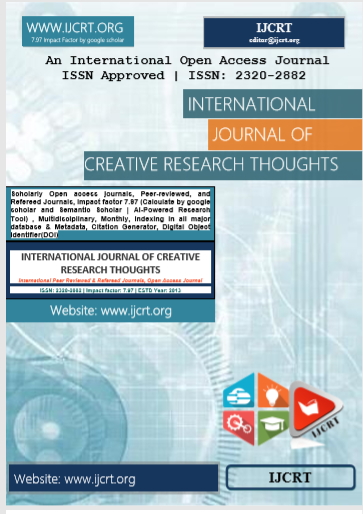 |
 |
|---|---|
| IJCRT Journal front page | IJCRT Journal Back Page |
Paper Title: Stress in the Modern World: Theoretical Insights and Practical Interventions
Author Name(s): Sangeeta Singh, Prof. Chandra Shekhar Pandey
Published Paper ID: - IJCRT2508618
Register Paper ID - 292697
Publisher Journal Name: IJPUBLICATION, IJCRT
DOI Member ID: 10.6084/m9.doi.one.IJCRT2508618 and DOI : https://doi.org/10.56975/ijcrt.v13i8.292697
Author Country : Indian Author, India, 221005 , VARANASI, 221005 , | Research Area: Social Science All Published Paper URL: http://ijcrt.org/viewfull.php?&p_id=IJCRT2508618 Published Paper PDF: download.php?file=IJCRT2508618 Published Paper PDF: http://www.ijcrt.org/papers/IJCRT2508618.pdf
Your Paper Publication Details:
Title: STRESS IN THE MODERN WORLD: THEORETICAL INSIGHTS AND PRACTICAL INTERVENTIONS
DOI (Digital Object Identifier) : https://doi.org/10.56975/ijcrt.v13i8.292697
Pubished in Volume: 13 | Issue: 8 | Year: August 2025
Publisher Name : IJCRT | www.ijcrt.org | ISSN : 2320-2882
Subject Area: Social Science All
Author type: Indian Author
Pubished in Volume: 13
Issue: 8
Pages: f400-f419
Year: August 2025
Downloads: 220
E-ISSN Number: 2320-2882
Abstract
Introduction: In today's world, stress have become an integral part of daily human life, to the extent that the present era is often labeled the "Age of Stress." Despite its pervasive influence across all aspects of life, there remains a noticeable lack of comprehensive and integrated literature on the subject. This paper seeks to bridge that gap by proposing a theoretical framework that synthesizes various perspectives and approaches to better understand and manage stress. Objective: The objective of this study is to explore the multifaceted nature of stress by examining its definitions, historical perspectives, conceptual frameworks, and psychological implications. It aims to highlight the universality and complexity of stress across life stages and cultures, distinguish between its adaptive and maladaptive effects, and emphasize the necessity of an integrated approach for understanding and managing stress. This analysis seeks to contribute to academic research and practical interventions that promote mental health and adaptive functioning in modern life. Data Source: This study is based on a comprehensive review of theoretical literature, empirical research studies, and authoritative definitions provided by leading psychological and occupational health organizations. Primary sources include the works of Richard S. Lazarus, Hans Selye, and Stephen Palmer (2006), as well as official definitions and guidelines from the APA, the National Institute for Occupational Safety and Health and the Health and Safety Executive. Supplementary insights are drawn from interdisciplinary research in psychology, neuroscience, and public health to support the discussion on the impact of stress on human functioning and well-being. Methods: The present study was designed as a systematic review. Information was collected from a variety of sources, including research articles and books. Only materials published in academic and scientific resources were included, based on their relevance to keywords such as stress, types, stress control and stress side effects. Result: Stress is recognized as a complex and multifaceted phenomenon that significantly affects cognitive performance, executive functioning, and overall mental health. Conclusion: Stress is an inevitable and universal part of human life, deeply rooted in the complexities of personal, social, and ecological environments. While moderate levels of stress can act as a motivating and adaptive force, excessive or prolonged stress poses serious risks to mental, emotional, and physical health.
Licence: creative commons attribution 4.0
License
Creative Commons Attribution 4.0 and The Open Definition

Keywords
Stress, Mental Health, Adaptive Functioning, Cognitive Performance, Emotional Health.
License
Creative Commons Attribution 4.0 and The Open Definition
Paper Title: Estimating An Individual's Water Footprint: A Review-Based Study
Author Name(s): Mr.Nage Rushikesh Lakshman
Published Paper ID: - IJCRT2508617
Register Paper ID - 292885
Publisher Journal Name: IJPUBLICATION, IJCRT
DOI Member ID: 10.6084/m9.doi.one.IJCRT2508617 and DOI :
Author Country : Indian Author, India, 431101 , Chatrapati Sambhajinagar, 431101 , | Research Area: Science and Technology Published Paper URL: http://ijcrt.org/viewfull.php?&p_id=IJCRT2508617 Published Paper PDF: download.php?file=IJCRT2508617 Published Paper PDF: http://www.ijcrt.org/papers/IJCRT2508617.pdf
Your Paper Publication Details:
Title: ESTIMATING AN INDIVIDUAL'S WATER FOOTPRINT: A REVIEW-BASED STUDY
DOI (Digital Object Identifier) :
Pubished in Volume: 13 | Issue: 8 | Year: August 2025
Publisher Name : IJCRT | www.ijcrt.org | ISSN : 2320-2882
Subject Area: Science and Technology
Author type: Indian Author
Pubished in Volume: 13
Issue: 8
Pages: f396-f399
Year: August 2025
Downloads: 205
E-ISSN Number: 2320-2882
Abstract
Water scarcity has emerged as a critical challenge, especially in water-stressed nations such as India. Effective water management requires understanding both direct uses (drinking, bathing, cleaning) and indirect uses (products, energy, diet). The concept of the water footprint measures both, revealing the hidden impacts of consumption. This study evaluates individual water footprints in rural and urban India using a questionnaire and the Water Footprint Network calculator. Results show indirect consumption, especially from diet, dominates over direct use. Meat and dairy intake raise footprints, while vegetarian diets lower them. Urban lifestyles, influenced by packaged foods and modern facilities, increase overall consumption compared to rural patterns. The findings stress the need for awareness, behavior change, rainwater harvesting, and efficient household fixtures.
Licence: creative commons attribution 4.0
License
Creative Commons Attribution 4.0 and The Open Definition
Keywords
Water footprint, direct consumption, indirect consumption, water scarcity, sustainable water use, urban versus rural, water conservation, India
License
Creative Commons Attribution 4.0 and The Open Definition
Paper Title: Impact of Population growth on Environment
Author Name(s): Ms. Rumi Gogoi
Published Paper ID: - IJCRT2508616
Register Paper ID - 292744
Publisher Journal Name: IJPUBLICATION, IJCRT
DOI Member ID: 10.6084/m9.doi.one.IJCRT2508616 and DOI :
Author Country : Indian Author, India, 787058 , Machkhowa, 787058 , | Research Area: Arts1 All Published Paper URL: http://ijcrt.org/viewfull.php?&p_id=IJCRT2508616 Published Paper PDF: download.php?file=IJCRT2508616 Published Paper PDF: http://www.ijcrt.org/papers/IJCRT2508616.pdf
Your Paper Publication Details:
Title: IMPACT OF POPULATION GROWTH ON ENVIRONMENT
DOI (Digital Object Identifier) :
Pubished in Volume: 13 | Issue: 8 | Year: August 2025
Publisher Name : IJCRT | www.ijcrt.org | ISSN : 2320-2882
Subject Area: Arts1 All
Author type: Indian Author
Pubished in Volume: 13
Issue: 8
Pages: f392-f395
Year: August 2025
Downloads: 334
E-ISSN Number: 2320-2882
Abstract
Population growth refers to the change in the number of individuals living in a particular region over a given period. This change can result from a disparity between birth rates and death rates, immigration and emigration. When the number of births exceeds the number of death, or when more people move into a region than those leaving it, positive population growth occurs. Population growth is fast becoming one of the most pressing issues of the 21" century, making managing and understanding the implications of rapid population growth imperative. Numerous factors influence this growth, ranging from economic developments, healthcare advancements, migration patterns and government policies. The rapid increase of human population is putting an incredible strain on our environment. While developed countries continue to pollute the environment and deplete its resources, developing countries are under increasing pressure to compete economically and their industrial advancements are damaging as well. The demands that this growth places on our global environment are threatening the future of sustainable life on earth. One of the largest environmental effects of human population growth is the problem of global warming. Some scientists fear that global warming will lead to rising sea levels and extreme weather condition in the future. The impact that this population explosion has on the environment has been just as striking as seen by change in greenhouse gas emissions, rate of soil erosion and the extinction of species. Nature reserves currently comprise about 10% of land area globally, but most are small, disconnected from other reserves, and subject to tremendous human pressures. Population size is clearly an important factor in measuring environmental impact. This paper highlighted how Population growth create bankrupt in forest sector.
Licence: creative commons attribution 4.0
License
Creative Commons Attribution 4.0 and The Open Definition
Keywords
Population Growth, Population Pressure, Environment
License
Creative Commons Attribution 4.0 and The Open Definition
Paper Title: Detection of Weeds and Diseases in Crops Using Deep Neural Networks
Author Name(s): Mr Pankaj Raghuwanshi, Mrs.Kiran Ankaley
Published Paper ID: - IJCRT2508615
Register Paper ID - 292706
Publisher Journal Name: IJPUBLICATION, IJCRT
DOI Member ID: 10.6084/m9.doi.one.IJCRT2508615 and DOI :
Author Country : Indian Author, India, 456010 , ujjian, 456010 , | Research Area: Science and Technology Published Paper URL: http://ijcrt.org/viewfull.php?&p_id=IJCRT2508615 Published Paper PDF: download.php?file=IJCRT2508615 Published Paper PDF: http://www.ijcrt.org/papers/IJCRT2508615.pdf
Your Paper Publication Details:
Title: DETECTION OF WEEDS AND DISEASES IN CROPS USING DEEP NEURAL NETWORKS
DOI (Digital Object Identifier) :
Pubished in Volume: 13 | Issue: 8 | Year: August 2025
Publisher Name : IJCRT | www.ijcrt.org | ISSN : 2320-2882
Subject Area: Science and Technology
Author type: Indian Author
Pubished in Volume: 13
Issue: 8
Pages: f374-f391
Year: August 2025
Downloads: 208
E-ISSN Number: 2320-2882
Abstract
Weeds and plant diseases significantly reduce crop yield and quality worldwide. Traditional detection methods are labour-intensive, time-consuming, and prone to error. The emergence of deep neural networks (DNNs), especially convolutional neural networks (CNNs), has revolutionized automated plant health monitoring. This review paper comprehensively explores the use of DNNs for detecting weeds and diseases in crops, examining architectures, datasets, methodologies, and performance. We also discuss challenges such as data scarcity, environmental variability, and model deployment. Finally, future directions involving multimodal data, edge computing, and explainable AI are considered.
Licence: creative commons attribution 4.0
License
Creative Commons Attribution 4.0 and The Open Definition
Keywords
Weeds detection ,Plant disease identification, Crop yield reduction, Traditional detection methods, Deep neural networks (DNNs),Convolutional neural networks (CNNs,)Automated plant health monitoring ,Image-based detection ,Dataset challenges
License
Creative Commons Attribution 4.0 and The Open Definition
Paper Title: Aristotle's Concept of Virtue Ethics and the Good Life: Applications in the 21st Century
Author Name(s): Thach lon, Prof. Dr. Gopal Sahu
Published Paper ID: - IJCRT2508614
Register Paper ID - 292880
Publisher Journal Name: IJPUBLICATION, IJCRT
DOI Member ID: 10.6084/m9.doi.one.IJCRT2508614 and DOI :
Author Country : Indian Author, India, - , -, - , | Research Area: Science and Technology Published Paper URL: http://ijcrt.org/viewfull.php?&p_id=IJCRT2508614 Published Paper PDF: download.php?file=IJCRT2508614 Published Paper PDF: http://www.ijcrt.org/papers/IJCRT2508614.pdf
Your Paper Publication Details:
Title: ARISTOTLE'S CONCEPT OF VIRTUE ETHICS AND THE GOOD LIFE: APPLICATIONS IN THE 21ST CENTURY
DOI (Digital Object Identifier) :
Pubished in Volume: 13 | Issue: 8 | Year: August 2025
Publisher Name : IJCRT | www.ijcrt.org | ISSN : 2320-2882
Subject Area: Science and Technology
Author type: Indian Author
Pubished in Volume: 13
Issue: 8
Pages: f370-f373
Year: August 2025
Downloads: 243
E-ISSN Number: 2320-2882
Abstract
Aristotle's virtue ethics, as articulated in the Nicomachean Ethics, offers a vision of the good life (eudaimonia) grounded in character, moral education, and the cultivation of virtues through practical wisdom. Unlike rule-based or consequence-oriented ethical theories, Aristotle emphasizes the moral agent's character and the lifelong pursuit of balance between extremes. This article examines Aristotle's concept of virtue ethics, its historical and philosophical foundations, and its continuing relevance in the 21st century. Particular attention is given to applications in psychology, leadership, education, environmental ethics, and global justice. The paper argues that Aristotle's framework, though rooted in ancient Greece, provides enduring insights into contemporary moral challenges, fostering both individual flourishing and communal well-being.
Licence: creative commons attribution 4.0
License
Creative Commons Attribution 4.0 and The Open Definition
Keywords
Aristotle's Concept of Virtue Ethics and the Good Life: Applications in the 21st Century
License
Creative Commons Attribution 4.0 and The Open Definition
Paper Title: Development And Standardization Of Self-Efficacy Scale
Author Name(s): Dr. P. Subramanian, R. Kalaichelvan
Published Paper ID: - IJCRT2508613
Register Paper ID - 292838
Publisher Journal Name: IJPUBLICATION, IJCRT
DOI Member ID: 10.6084/m9.doi.one.IJCRT2508613 and DOI : https://doi.org/10.56975/ijcrt.v13i8.292838
Author Country : Indian Author, India, 600 097 , Chennai, 600 097 , | Research Area: Social Science All Published Paper URL: http://ijcrt.org/viewfull.php?&p_id=IJCRT2508613 Published Paper PDF: download.php?file=IJCRT2508613 Published Paper PDF: http://www.ijcrt.org/papers/IJCRT2508613.pdf
Your Paper Publication Details:
Title: DEVELOPMENT AND STANDARDIZATION OF SELF-EFFICACY SCALE
DOI (Digital Object Identifier) : https://doi.org/10.56975/ijcrt.v13i8.292838
Pubished in Volume: 13 | Issue: 8 | Year: August 2025
Publisher Name : IJCRT | www.ijcrt.org | ISSN : 2320-2882
Subject Area: Social Science All
Author type: Indian Author
Pubished in Volume: 13
Issue: 8
Pages: f365-f369
Year: August 2025
Downloads: 248
E-ISSN Number: 2320-2882
Abstract
Constructing and standardizing a self-efficacy scale for assessing higher secondary school teachers' self-efficacy was the goal of the current study. Self-Efficacy is the belief in one's ability to carry out the necessary actions to achieve a certain desired outcome (Bandura 1997). Self-efficacy affects people's willingness to take on obstacles and how high they aim for their objectives. The degree of confidence teachers have in their abilities to help pupils succeed is known as teacher self-efficacy (CU-Portland). Studies reveal that educators who possess high levels of self-efficacy are more receptive to novel pedagogical approaches, establish more ambitious objectives, demonstrate a higher degree of preparation and organization, focus their energies on problem-solving, reach out for support, and modify their pedagogical approaches when confronted with challenges. The rough draft of self-efficacy scale consists of 30 items. Establishing the validity and reliability of this research scale self efficacy is the aim of the study.
Licence: creative commons attribution 4.0
License
Creative Commons Attribution 4.0 and The Open Definition
Keywords
Development, Standardization, Self-Efficacy Scale
License
Creative Commons Attribution 4.0 and The Open Definition
Paper Title: Symbolic Significance of Ibrahim Traore to Pan-Africanism and Fight against Neo-Colonialism
Author Name(s): Dr. Sumeet Thakur
Published Paper ID: - IJCRT2508612
Register Paper ID - 292774
Publisher Journal Name: IJPUBLICATION, IJCRT
DOI Member ID: 10.6084/m9.doi.one.IJCRT2508612 and DOI :
Author Country : Indian Author, India, - , -, - , | Research Area: Science and Technology Published Paper URL: http://ijcrt.org/viewfull.php?&p_id=IJCRT2508612 Published Paper PDF: download.php?file=IJCRT2508612 Published Paper PDF: http://www.ijcrt.org/papers/IJCRT2508612.pdf
Your Paper Publication Details:
Title: SYMBOLIC SIGNIFICANCE OF IBRAHIM TRAORE TO PAN-AFRICANISM AND FIGHT AGAINST NEO-COLONIALISM
DOI (Digital Object Identifier) :
Pubished in Volume: 13 | Issue: 8 | Year: August 2025
Publisher Name : IJCRT | www.ijcrt.org | ISSN : 2320-2882
Subject Area: Science and Technology
Author type: Indian Author
Pubished in Volume: 13
Issue: 8
Pages: f359-f364
Year: August 2025
Downloads: 215
E-ISSN Number: 2320-2882
Abstract
Licence: creative commons attribution 4.0
License
Creative Commons Attribution 4.0 and The Open Definition
Keywords
Symbolic Significance of Ibrahim Traore to Pan-Africanism and Fight against Neo-Colonialism
License
Creative Commons Attribution 4.0 and The Open Definition
Paper Title: "Atogepant: A Novel Therapeutic Agent in the Management of Migraine"
Author Name(s): Dr. Garlapati Usha Kiran, Maareedu Mahesh, Loya Pavan kumar, Kankanala Uma Satya Manikanta, Gollamudi Nehemiah
Published Paper ID: - IJCRT2508611
Register Paper ID - 292790
Publisher Journal Name: IJPUBLICATION, IJCRT
DOI Member ID: 10.6084/m9.doi.one.IJCRT2508611 and DOI :
Author Country : Indian Author, India, - , -, - , | Research Area: Science and Technology Published Paper URL: http://ijcrt.org/viewfull.php?&p_id=IJCRT2508611 Published Paper PDF: download.php?file=IJCRT2508611 Published Paper PDF: http://www.ijcrt.org/papers/IJCRT2508611.pdf
Your Paper Publication Details:
Title: "ATOGEPANT: A NOVEL THERAPEUTIC AGENT IN THE MANAGEMENT OF MIGRAINE"
DOI (Digital Object Identifier) :
Pubished in Volume: 13 | Issue: 8 | Year: August 2025
Publisher Name : IJCRT | www.ijcrt.org | ISSN : 2320-2882
Subject Area: Science and Technology
Author type: Indian Author
Pubished in Volume: 13
Issue: 8
Pages: f350-f358
Year: August 2025
Downloads: 230
E-ISSN Number: 2320-2882
Abstract
Migraine is a common neurological condition that can really take a toll on people's quality of life and productivity around the globe. It's marked by recurring headaches that often come with nausea, sensitivity to light, and sensitivity to sound. Traditional preventive treatments, like beta-blockers and antiepileptics, often fall short in terms of effectiveness and tolerability, which is why there's a need for new options. Enter atogepant, an oral calcitonin gene-related peptide (CGRP) receptor antagonist that's making waves in the world of migraine prevention. It got the green light from the FDA in 2021, followed by approvals from Health Canada and the EMA, making it the first oral CGRP antagonist specifically designed for preventing migraines. Atogepant is quickly absorbed, spreads widely in the body, and is mainly broken down by CYP3A4, boasting a half-life of about 11 hours, which allows for once-daily dosing. It works by blocking CGRP-induced vasodilation and neurogenic inflammation, helping to cut down on the frequency and intensity of migraines. Clinical trials have shown it effectively reduces the number of migraine days each month, with some common side effects like constipation, nausea, and fatigue. All in all, atogepant offers a safe, effective, and convenient oral solution, marking a big step forward in personalized migraine management.
Licence: creative commons attribution 4.0
License
Creative Commons Attribution 4.0 and The Open Definition
Keywords
Migraine, Atogepant, CGRP receptor antagonist, Episodic migraine prevention, Pathophysio logy, Pharmacokinetics, Neurogenic inflammation, Adverse effects, Drug interactions, Personalized migraine therapy
License
Creative Commons Attribution 4.0 and The Open Definition
Paper Title: Microbial Ecology of Composting: Role in Organic Waste Decomposition
Author Name(s): Ankita Suvagiya, Janvi Asodariya, Bansi Bhaliya, Krisha Panchasara, Devanshi Bhadarka
Published Paper ID: - IJCRT2508610
Register Paper ID - 292861
Publisher Journal Name: IJPUBLICATION, IJCRT
DOI Member ID: 10.6084/m9.doi.one.IJCRT2508610 and DOI :
Author Country : Indian Author, India, 362310 , Junagadh, 362310 , | Research Area: Life Sciences All Published Paper URL: http://ijcrt.org/viewfull.php?&p_id=IJCRT2508610 Published Paper PDF: download.php?file=IJCRT2508610 Published Paper PDF: http://www.ijcrt.org/papers/IJCRT2508610.pdf
Your Paper Publication Details:
Title: MICROBIAL ECOLOGY OF COMPOSTING: ROLE IN ORGANIC WASTE DECOMPOSITION
DOI (Digital Object Identifier) :
Pubished in Volume: 13 | Issue: 8 | Year: August 2025
Publisher Name : IJCRT | www.ijcrt.org | ISSN : 2320-2882
Subject Area: Life Sciences All
Author type: Indian Author
Pubished in Volume: 13
Issue: 8
Pages: f340-f349
Year: August 2025
Downloads: 234
E-ISSN Number: 2320-2882
Abstract
Compostingss is a technological waste management method in which organic material is broken down and stabilized into a biodegradable combination and then turned into compost with the aid of aerobic microbiological activity. This organic matter decomposition process has garnered a lot of interest lately because it uses eco-friendly techniques that prevent further pollution of the environment. The first mesophilic phase, the thermophilic phase, the second mesophilic phase, and the maturation phase are the four stages of the composting process. . The C/N ratio, temperature, humidity, substrate particle size, pH, oxygen content, and microbes are the main variables affecting the success of decomposition. In the process of breaking down organic waste, microorganisms like bacteria, fungus, and actinomycetes function as chemical decomposers, producing carbon dioxide, heat, water, hummus, and compost--a rather stable end organic product. Microorganisms break down the complex lignin, cellulose, and hemicellulose molecules during the composting process. The makeup of composite mixtures and temperature variations throughout the composting process have an impact on the existence of various microbe kinds. The temperature rises at the start of compression due to a large increase in microbial activity. The fungi that are most active during the compost maturation process take the place of the bacteria that once predominated. The purpose of this scientific paper is to provide an outline of the composting process and the part that helpful microorganisms play in the organic matter of the compost mixture's breakdown.
Licence: creative commons attribution 4.0
License
Creative Commons Attribution 4.0 and The Open Definition
Keywords
Compost, microorganisms, biodegradable materials, and microbiological breakdown
License
Creative Commons Attribution 4.0 and The Open Definition
Paper Title: Disinvestment of Public Sector Undertakings in India and Its Effects, Challenges and Trends
Author Name(s): M.Vadivel Prabu
Published Paper ID: - IJCRT2508609
Register Paper ID - 292862
Publisher Journal Name: IJPUBLICATION, IJCRT
DOI Member ID: 10.6084/m9.doi.one.IJCRT2508609 and DOI :
Author Country : Indian Author, India, 600005 , chepauk, 600005 , | Research Area: Arts All Published Paper URL: http://ijcrt.org/viewfull.php?&p_id=IJCRT2508609 Published Paper PDF: download.php?file=IJCRT2508609 Published Paper PDF: http://www.ijcrt.org/papers/IJCRT2508609.pdf
Your Paper Publication Details:
Title: DISINVESTMENT OF PUBLIC SECTOR UNDERTAKINGS IN INDIA AND ITS EFFECTS, CHALLENGES AND TRENDS
DOI (Digital Object Identifier) :
Pubished in Volume: 13 | Issue: 8 | Year: August 2025
Publisher Name : IJCRT | www.ijcrt.org | ISSN : 2320-2882
Subject Area: Arts All
Author type: Indian Author
Pubished in Volume: 13
Issue: 8
Pages: f331-f339
Year: August 2025
Downloads: 358
E-ISSN Number: 2320-2882
Abstract
In India, disinvestment policies have become an important part of economic reforms meant to improve the accountability, efficiency, and competitiveness of Public Sector Undertakings (PSUs). Disinvestment is the process of selling government shares in PSUs to the public or private sector. It was first implemented in the early 1990s as part of the liberalization program. The main goals are to lessen the financial load, enhance public finances, promote greater ownership, and develop a more vibrant, market-driven economy. Strategic disinvestment and the privatization of non-performing or non-strategic PSUs have replaced partial stake sales as India's disinvestment approach over the years. Although the government has benefited greatly from disinvestment in non-tax revenue, it has also triggered discussions about valuation, transparency, social impact, and the role of the state in the economy. The government's commitment to streamlining the public sector is demonstrated by important efforts such as the establishment of the Department of Investment and Public Asset Management (DIPAM) and policies on strategic disinvestment. With an emphasis on how it affects PSU performance, this article examines the idea, goals, significance, implementation problems, difficulties and ramifications of India's disinvestment strategy. This article also looks at the main problems that PSUs are facing today and examines the recent challenges in a fiercely competitive privatized economy.
Licence: creative commons attribution 4.0
License
Creative Commons Attribution 4.0 and The Open Definition
Keywords
PSUs, DIPAM, Disinvestment, LPG, Private Sector, Subsidy reforms
License
Creative Commons Attribution 4.0 and The Open Definition
Call For Paper August 2026
Call For Papers
August 2026
Volume 14 | Issue 8
Last Date :
31-Aug-2026
Submit Manuscript Online Impact Factor: 7.97 Review Results : Within 02-03 Days Paper Publication : Within 02-03 Days
August 2026
Volume 14 | Issue 8
Last Date :
31-Aug-2026
Submit Manuscript Online Impact Factor: 7.97 Review Results : Within 02-03 Days Paper Publication : Within 02-03 Days
Published Issue Details
For Authors
Forms / Downloads
Other IMP Links
Indexing Partner
Research Area
LICENSE





ISSN and 7.97 Impact Factor Details
ISSN: 2320-2882 Impact Factor: 7.97 and ISSN APPROVED Journal Starting Year (ESTD) : 2013


ISSN and 7.97 Impact Factor Details
ISSN: 2320-2882 Impact Factor: 7.97 and ISSN APPROVED Journal Starting Year (ESTD) : 2013
DOI Details
CONFERENCE
CONFERENCE MANAGMENT & PUBLICATION CONFERENCE PROPOSAL
RECENT CONFERENCE

CONFERENCE PROPOSAL CONFERENCE PROCEEDINGS
CONFERENCE PROPOSAL CONFERENCE PROCEEDINGS
For Reviewer /Referral (RMS) Earn 500 per paper
Important Links
NEWS & Conference
Digital Library
IJCRT RMS | Earn 500 Per Paper.

Open Access


LICENSE
Indexing Partner
Scholarly open access journals, Peer-reviewed, and Refereed Journals, Impact factor 7.97 (Calculate by google scholar and Semantic Scholar | AI-Powered Research Tool) , Multidisciplinary, Monthly, Indexing in all major database & Metadata, Citation Generator, Digital Object Identifier(DOI)