Important Details
IJCRT - International Peer Reviewed, Open Access Journal, Multidisciplinary, Monthly, Nominal(Low) Fees for Professional Research Services International Journal of Creative Research Thoughts - IJCRT Peer Review Journal, Refereed Journal, Peer Reviewed Journal , Referred Journal and Indexed Journal, Open access, Online and Print Journal,international Journal Open Access, Accepted by Indian and foreign university ,IJCRT Followed Norms, guidelines, requirement, listing criteria and methodology of score/point also applied from: Scopus , Web of Science , UGC Approved , UGC CARE, UGC-CARE .
UGC Approved Journal No: 49023 (18)
UGC approval Link
https://ijcrt.org/ugc%20approval.jpg
All Policy and Approval
Please Like Our Facebook Page | CrossRef DOI and Hard copy of Certificate Provide if required. | www.IJCRT.org | editor@IJCRT.org | IJCRT WhatsApp +91 7990172303
Publication Details:
- Paper Submission : 30-Jun-2026. Call For Paper (Volume 14 | Issue 6 | Month- June 2026)
- Acceptance/Rejection Notification: Within 02-04 Days.
- Paper Publish: Within 02-04 Days after submitting all documents.
-
Submit Your Paper Any time There No deadline.
-
Publication fees : 1570 INR for Indian author & 59$ for foreign International author.
Please Like Our Facebook Page | CrossRef DOI and Hard copy of Certificate Provide if required.
Licence and Indexing
Indexing In Google Scholar, SSRN, ResearcherID-Publons, Semantic Scholar | AI-Powered Research Tool, Microsoft Academic, Academia.edu, arXiv.org, Research Gate, CiteSeerX, ResearcherID Thomson Reuters, Mendeley : reference manager, DocStoc, ISSUU, Scribd, and many more | High Impact Factor: 7.97 | Digital object identifier (DOI) and Hard Copy of certificate Provided.




























Licence
DOI
ISSN Approved impact factor: 7.97 
Creative Common 
Valid as per new UGC Gazette regulations 

INTERNATIONAL JOURNAL OF CREATIVE RESEARCH THOUGHTS - IJCRT (IJCRT.ORG)
International Peer Reviewed & Refereed Journals, Open Access Journal
IJCRT Peer-Reviewed (Refereed) Journal as Per New UGC Rules.
ISSN Approved Journal No: 2320-2882 | Impact factor: 7.97 | ESTD Year: 2013
Call For Paper - Volume 14 | Issue 6 | Month- June 2026
Scholarly open access journals, Peer-reviewed, and Refereed Journals, Impact factor 7.97 (Calculate by google scholar and Semantic Scholar | AI-Powered Research Tool) , Multidisciplinary, Monthly, Indexing in all major database & Metadata, Citation Generator, Digital Object Identifier(CrossRef DOI)
IJCRT WhatsApp Contact
IJCRT Search Xplore - Search all paper by Paper Name , Author Name, and Title
Volume 14 | Issue 6 |
Volume 14 | Issue 6 | Month
Downlaod After Publication 1) Table of content index in PDF
2) Table of content index in HTML 2)Table of content index in HTML
3) Front Page 3) Front Page
4) Back Page 4) Back Page
5) Editor Board Member 5)Editor Board Member
6) OLD Style Issue 6)OLD Style Issue
 |
 |
|---|---|
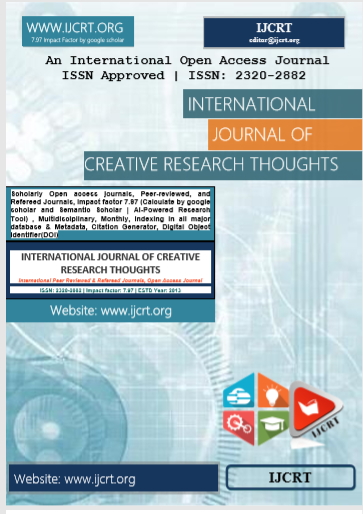
| IJCRT Journal front page | IJCRT Journal Back Page |
Paper Title: Affordable and Climate-Resilient Housing in Urban India: Integrating Accessibility, Inclusion and Sustainability
Author Name(s): MANISH KUMAR, Dr. Tapas Pal
Published Paper ID: - IJCRT2606390
Register Paper ID - 310274
Publisher Journal Name: IJPUBLICATION, IJCRT
DOI Member ID: 10.6084/m9.doi.one.IJCRT2606390 and DOI :
Author Country : Indian Author, India, 110014 , New Delhi, 110014 , | Research Area: Other area not in list Published Paper URL: http://ijcrt.org/viewfull.php?&p_id=IJCRT2606390 Published Paper PDF: download.php?file=IJCRT2606390 Published Paper PDF: http://www.ijcrt.org/papers/IJCRT2606390.pdf
Your Paper Publication Details:
Title: AFFORDABLE AND CLIMATE-RESILIENT HOUSING IN URBAN INDIA: INTEGRATING ACCESSIBILITY, INCLUSION AND SUSTAINABILITY
DOI (Digital Object Identifier) :
Pubished in Volume: 14 | Issue: 6 | Year: June 2026
Publisher Name : IJCRT | www.ijcrt.org | ISSN : 2320-2882
Subject Area: Other area not in list
Author type: Indian Author
Pubished in Volume: 14
Issue: 6
Pages: d543-d548
Year: June 2026
Downloads: 7
E-ISSN Number: 2320-2882
Abstract
India's urban transformation is occurring alongside rapid economic growth, expanding infrastructure, and increasing climate-related risks. As the country advances towards the vision of Viksit Bharat @2047, ensuring access to affordable, inclusive, and climate-resilient housing has become central to sustainable urban development. This paper examines the evolving concept of housing affordability in urban India, arguing that affordability extends beyond housing cost to encompass accessibility to livelihoods, public transport, social infrastructure, housing finance, and climate-resilient urban services. It highlights the importance of preserving existing community resilience mechanisms through in-situ upgrading, tenure security, and participatory planning rather than displacement-led redevelopment. The paper further explores the growing interaction between climate vulnerability and housing insecurity, particularly among low-income households residing in environmentally fragile locations. It emphasizes the need for climate-sensitive planning, resilient housing design, risk-informed land-use policies, and green infrastructure to reduce exposure to environmental hazards. The study reviews policy instruments for expanding affordable housing supply, including Transit-Oriented Development, land value capture, public-private partnerships, viability gap funding, rental housing reforms, and blended finance mechanisms. It also discusses the role of digital technologies in improving rental market transparency and housing governance. Additionally, the paper advocates for gender-responsive and universally accessible housing, integration of vernacular building knowledge with modern standards, passive cooling strategies, circular construction practices, and adoption of sustainable building frameworks. The analysis concludes that the future of affordable housing in India lies in the integration of accessibility, inclusion, resilience, sustainability, and economic opportunity. By aligning housing policy with climate adaptation and inclusive urbanization goals, India can create resilient communities that support social equity, environmental sustainability, and the aspirations of a developed nation by 2047.
Licence: creative commons attribution 4.0
License
Creative Commons Attribution 4.0 and The Open Definition

Keywords
Climate Resilient Housing, Viksit Bharat, Rental Housing, Housing Finance
License
Creative Commons Attribution 4.0 and The Open Definition
Paper Title: Generative AI in Writing Instruction: Opportunities, Challenges, and Future Directions in English Language Teaching
Author Name(s): A Pradheepa, Dr K. Gurusamy, N.Polraj alias goutham
Published Paper ID: - IJCRT2606389
Register Paper ID - 310446
Publisher Journal Name: IJPUBLICATION, IJCRT
DOI Member ID: 10.6084/m9.doi.one.IJCRT2606389 and DOI :
Author Country : Indian Author, India, 626125 , srivilliputtur, 626125 , | Research Area: Arts All Published Paper URL: http://ijcrt.org/viewfull.php?&p_id=IJCRT2606389 Published Paper PDF: download.php?file=IJCRT2606389 Published Paper PDF: http://www.ijcrt.org/papers/IJCRT2606389.pdf
Your Paper Publication Details:
Title: GENERATIVE AI IN WRITING INSTRUCTION: OPPORTUNITIES, CHALLENGES, AND FUTURE DIRECTIONS IN ENGLISH LANGUAGE TEACHING
DOI (Digital Object Identifier) :
Pubished in Volume: 14 | Issue: 6 | Year: June 2026
Publisher Name : IJCRT | www.ijcrt.org | ISSN : 2320-2882
Subject Area: Arts All
Author type: Indian Author
Pubished in Volume: 14
Issue: 6
Pages: d529-d542
Year: June 2026
Downloads: 4
E-ISSN Number: 2320-2882
Abstract
The rapid advancement of Generative Artificial Intelligence (GenAI) has significantly transformed English Language Teaching (ELT), particularly in the area of writing instruction. AI-powered tools such as ChatGPT, Google Gemini, Microsoft Copilot, and Grammarly have introduced new opportunities for supporting learners throughout various stages of the writing process, including idea generation, grammar correction, revision, and academic writing assistance. Despite these pedagogical benefits, concerns regarding academic integrity, ethical use, overreliance on AI, critical thinking, teacher readiness, data privacy, and equitable access continue to influence the adoption of these technologies in educational settings. This narrative review synthesizes recent literature published between 2020 and 2026 to examine the applications, opportunities, and challenges of Generative AI in writing instruction within English Language Teaching. The review is guided by the Technological Pedagogical Content Knowledge (TPACK) framework, which provides a theoretical lens for understanding the effective integration of AI technologies into writing pedagogy. The findings indicate that Generative AI can enhance writing quality, learner autonomy, personalized learning, and formative feedback when implemented within sound pedagogical practices. However, responsible integration requires comprehensive AI literacy, institutional policies, ethical governance, curriculum redesign, and continuous professional development for educators. The review further identifies several research gaps, including the need for longitudinal studies, comparative evaluations of emerging AI platforms, and investigations across diverse educational and cultural contexts. Overall, this review contributes to the growing body of literature by providing a comprehensive synthesis of current evidence and offering practical implications for educators, researchers, curriculum developers, and policymakers seeking to integrate Generative AI responsibly into ELT writing instruction.
Licence: creative commons attribution 4.0
License
Creative Commons Attribution 4.0 and The Open Definition
Keywords
Generative Artificial Intelligence, English Language Teaching, Writing Instruction, ChatGPT, TPACK, Artificial Intelligence, Academic Writing, AI Literacy, Educational Technology, Writing Pedagogy.
License
Creative Commons Attribution 4.0 and The Open Definition
Paper Title: Transforming Higher Education through VR and AR Combined Learning Systems: A Student Satisfaction Perspective
Author Name(s): Dr S Ayem Perumal, Dr P Yamunaa, Dr B Senthil Kumar
Published Paper ID: - IJCRT2606388
Register Paper ID - 308084
Publisher Journal Name: IJPUBLICATION, IJCRT
DOI Member ID: 10.6084/m9.doi.one.IJCRT2606388 and DOI :
Author Country : Indian Author, India, 600123 , Chennai, 600123 , | Research Area: Arts1 All Published Paper URL: http://ijcrt.org/viewfull.php?&p_id=IJCRT2606388 Published Paper PDF: download.php?file=IJCRT2606388 Published Paper PDF: http://www.ijcrt.org/papers/IJCRT2606388.pdf
Your Paper Publication Details:
Title: TRANSFORMING HIGHER EDUCATION THROUGH VR AND AR COMBINED LEARNING SYSTEMS: A STUDENT SATISFACTION PERSPECTIVE
DOI (Digital Object Identifier) :
Pubished in Volume: 14 | Issue: 6 | Year: June 2026
Publisher Name : IJCRT | www.ijcrt.org | ISSN : 2320-2882
Subject Area: Arts1 All
Author type: Indian Author
Pubished in Volume: 14
Issue: 6
Pages: d522-d528
Year: June 2026
Downloads: 24
E-ISSN Number: 2320-2882
Abstract
The rapid advancement of digital technologies has transformed the educational landscape across the globe. Among emerging technologies, Virtual Reality (VR) and Augmented Reality (AR) have gained significant attention in higher education due to their ability to create immersive and interactive learning experiences. Traditional teaching methods often fail to maintain student engagement and practical understanding, especially in technology-driven academic environments. This research paper explores how the integration of VR and AR combined learning systems can improve student satisfaction in higher education institutions. The study examines the impact of immersive technologies on learner engagement, academic performance, motivation, and experiential learning. It also discusses the challenges faced during implementation, including infrastructure limitations, faculty training, and accessibility issues. The paper adopts a qualitative and analytical approach by reviewing recent studies, technological developments, and educational practices related to VR and AR systems. Findings indicate that combined VR and AR learning environments significantly enhance student satisfaction by promoting active participation, real-time visualization, collaborative learning, and personalized educational experiences. Furthermore, immersive learning technologies support practical skill development and bridge the gap between theoretical and applied knowledge. The study concludes that VR and AR integrated learning systems have the potential to revolutionize higher education by creating learner-centered educational environments that improve both academic effectiveness and student satisfaction
Licence: creative commons attribution 4.0
License
Creative Commons Attribution 4.0 and The Open Definition
Keywords
Virtual Reality, Augmented Reality, Higher Education, Student Satisfaction, Immersive Learning, Educational Technology, Interactive Learning
License
Creative Commons Attribution 4.0 and The Open Definition
Paper Title: Factors Influencing Adoption of AI-Based Financial Services Among Indian Consumers
Author Name(s): Rakesh Kumar Sethi, Dr. Amrit Kumar Mohapatra
Published Paper ID: - IJCRT2606387
Register Paper ID - 310481
Publisher Journal Name: IJPUBLICATION, IJCRT
DOI Member ID: 10.6084/m9.doi.one.IJCRT2606387 and DOI :
Author Country : Indian Author, India, 759120 , Parjang, 759120 , | Research Area: Commerce and Management, MBA All Branch Published Paper URL: http://ijcrt.org/viewfull.php?&p_id=IJCRT2606387 Published Paper PDF: download.php?file=IJCRT2606387 Published Paper PDF: http://www.ijcrt.org/papers/IJCRT2606387.pdf
Your Paper Publication Details:
Title: FACTORS INFLUENCING ADOPTION OF AI-BASED FINANCIAL SERVICES AMONG INDIAN CONSUMERS
DOI (Digital Object Identifier) :
Pubished in Volume: 14 | Issue: 6 | Year: June 2026
Publisher Name : IJCRT | www.ijcrt.org | ISSN : 2320-2882
Subject Area: Commerce and Management, MBA All Branch
Author type: Indian Author
Pubished in Volume: 14
Issue: 6
Pages: d513-d521
Year: June 2026
Downloads: 4
E-ISSN Number: 2320-2882
Abstract
Artificial Intelligence (AI) is revolutionizing the financial services industry by enhancing customer experience, improving operational efficiency, and enabling personalized financial solutions. Despite the growing adoption of AI-powered financial services, consumer acceptance remains influenced by various technological and behavioural factors. This study investigates the factors influencing the adoption of AI-based financial services among Indian consumers. The research examines the impact of trust, perceived usefulness, perceived ease of use, security, privacy concerns, financial literacy, and social influence on consumers' adoption intention. A quantitative research design was employed, and primary data were collected from 400 respondents using a structured questionnaire based on a five-point Likert scale. The collected data were analysed using descriptive statistics, multiple regression analysis, and one-way ANOVA through SPSS. The findings revealed that trust emerged as the most influential predictor of adoption intention, followed by perceived usefulness, security, financial literacy, perceived ease of use, and social influence. Privacy concerns were found to negatively affect consumers' willingness to adopt AI-based financial services. Furthermore, significant differences in adoption intention were observed across age groups. The study contributes to the growing literature on AI adoption in financial services and provides valuable insights for financial institutions, fintech firms, and policymakers seeking to enhance consumer acceptance of AI-enabled financial technologies.
Licence: creative commons attribution 4.0
License
Creative Commons Attribution 4.0 and The Open Definition
Keywords
Artificial Intelligence, AI-Based Financial Services, Adoption Intention, Trust, Financial Literacy, Privacy Concerns, FinTech, Consumer Behaviour.
License
Creative Commons Attribution 4.0 and The Open Definition
Paper Title: ''INTEGRATIVE ONCOLOGY-ROLE OF AYURVEDA IN CANCER MANAGEMENT''
Author Name(s): Dr. Darshan B. Sarmalkar, Dr Pratiksha Rahul Gharde, Dr. Sooraj Vijay Yadav
Published Paper ID: - IJCRT2606386
Register Paper ID - 310356
Publisher Journal Name: IJPUBLICATION, IJCRT
DOI Member ID: 10.6084/m9.doi.one.IJCRT2606386 and DOI :
Author Country : Indian Author, India, - , -, - , | Research Area: Humanities All Published Paper URL: http://ijcrt.org/viewfull.php?&p_id=IJCRT2606386 Published Paper PDF: download.php?file=IJCRT2606386 Published Paper PDF: http://www.ijcrt.org/papers/IJCRT2606386.pdf
Your Paper Publication Details:
Title: ''INTEGRATIVE ONCOLOGY-ROLE OF AYURVEDA IN CANCER MANAGEMENT''
DOI (Digital Object Identifier) :
Pubished in Volume: 14 | Issue: 6 | Year: June 2026
Publisher Name : IJCRT | www.ijcrt.org | ISSN : 2320-2882
Subject Area: Humanities All
Author type: Indian Author
Pubished in Volume: 14
Issue: 6
Pages: d499-d512
Year: June 2026
Downloads: 4
E-ISSN Number: 2320-2882
Abstract
Cancer is the major killer among the major causes of death in the world. this dreadful condition has attracted the minds of physicians & surgeons from the very early times. it will be fascinating to note that sushruta (father of surgery) had mentioned about the cancer (arbuda). Ayurvedic texts mentioned about arbuda, which is considered as an equivalent of cancer. Acharya charaka described arbuda in the chapter on shopha i.e. Inflammatory & non-inflammatory swellings (cha.su.18.; cha.chi.12.). Acharya sushruta provided more information on arbuda, granthi, apachi, gandamala etc. Which is cancer related conditions. cancer is often compared to arbuda of ayurvedic classics, many other conditions are found to fall under different tumours. It is very important to do nidanpanchakatmaka study on ayurvedic approach of cancer.
Licence: creative commons attribution 4.0
License
Creative Commons Attribution 4.0 and The Open Definition
Keywords
Cancer, Arbuda, Tumour, Nidan, Rupa, management, preventive measures
License
Creative Commons Attribution 4.0 and The Open Definition
Paper Title: Zooplankton Population In Freshwater Of Kotdam (Jhunjhunun) Rajasthan, India
Author Name(s): SARITA kUMARI, Dr. ANAND KUMAR KHATRI
Published Paper ID: - IJCRT2606385
Register Paper ID - 310457
Publisher Journal Name: IJPUBLICATION, IJCRT
DOI Member ID: 10.6084/m9.doi.one.IJCRT2606385 and DOI :
Author Country : Indian Author, India, 334001 , BIKANER, 334001 , | Research Area: Science All Published Paper URL: http://ijcrt.org/viewfull.php?&p_id=IJCRT2606385 Published Paper PDF: download.php?file=IJCRT2606385 Published Paper PDF: http://www.ijcrt.org/papers/IJCRT2606385.pdf
Your Paper Publication Details:
Title: ZOOPLANKTON POPULATION IN FRESHWATER OF KOTDAM (JHUNJHUNUN) RAJASTHAN, INDIA
DOI (Digital Object Identifier) :
Pubished in Volume: 14 | Issue: 6 | Year: June 2026
Publisher Name : IJCRT | www.ijcrt.org | ISSN : 2320-2882
Subject Area: Science All
Author type: Indian Author
Pubished in Volume: 14
Issue: 6
Pages: d490-d498
Year: June 2026
Downloads: 4
E-ISSN Number: 2320-2882
Abstract
Zooplanktons are good indicator of the changes in water quality so their diversity is one of the most important ecological parameters in water quality assessment. Aquatic ecosystems consist of physico-chemical and biotic components. The present study was undertaken to explore the diversity and ecology of Zooplanktons in kotdam. The present observations were made for a period of 18 months from Aug. 2022 to Jan 2024.They were identified by following standard taxonomic keys and illustrations. The zooplanktons were identified in the kotdam water which was belonged to three groups: Rotifera, Crustacea and Protozoa. Crustacean was the dominant group followed by Protozoa and Rotifera. Zooplankton ostacoda showed the dominance like stenocypris, throughout the investigation. Therefore, they can be significantly applied as indicators of organic pollution. It can be concluded that rushing flood or rainy water with fertilizers and insecticides going in to kotdam to polluted and rapidly turning towards eutrophication in future. So our findings highlighted the deterioration of water quality of the kotdam due to urbanization and human activities. The study recommended avoiding as far as possible the discharge of untreated sewage and other pollutants into the water.
Licence: creative commons attribution 4.0
License
Creative Commons Attribution 4.0 and The Open Definition
Keywords
Zooplankton, kotdam, jhunjhunu, fertilizers, Eutrophication.
License
Creative Commons Attribution 4.0 and The Open Definition
Paper Title: Women's Rights: A Key Element of Fairness, Justice, and Human Progress
Author Name(s): INDU, Ms Amandeep Kaur
Published Paper ID: - IJCRT2606384
Register Paper ID - 310314
Publisher Journal Name: IJPUBLICATION, IJCRT
DOI Member ID: 10.6084/m9.doi.one.IJCRT2606384 and DOI :
Author Country : Indian Author, India, - , -, - , | Research Area: Arts All Published Paper URL: http://ijcrt.org/viewfull.php?&p_id=IJCRT2606384 Published Paper PDF: download.php?file=IJCRT2606384 Published Paper PDF: http://www.ijcrt.org/papers/IJCRT2606384.pdf
Your Paper Publication Details:
Title: WOMEN'S RIGHTS: A KEY ELEMENT OF FAIRNESS, JUSTICE, AND HUMAN PROGRESS
DOI (Digital Object Identifier) :
Pubished in Volume: 14 | Issue: 6 | Year: June 2026
Publisher Name : IJCRT | www.ijcrt.org | ISSN : 2320-2882
Subject Area: Arts All
Author type: Indian Author
Pubished in Volume: 14
Issue: 6
Pages: d481-d489
Year: June 2026
Downloads: 5
E-ISSN Number: 2320-2882
Abstract
Women's Rights: A Key Element of Fairness, Justice, and Human Progress
Licence: creative commons attribution 4.0
License
Creative Commons Attribution 4.0 and The Open Definition
Keywords
Women's Rights: A Key Element of Fairness, Justice, and Human Progress
License
Creative Commons Attribution 4.0 and The Open Definition
Paper Title: Physics-Based 3D Humanoid Locomotion Using Proximal Policy Optimization
Author Name(s): Irene Thomas, Shrimant Madbhavi, Vyshakh Nambiar
Published Paper ID: - IJCRT2606383
Register Paper ID - 310426
Publisher Journal Name: IJPUBLICATION, IJCRT
DOI Member ID: 10.6084/m9.doi.one.IJCRT2606383 and DOI :
Author Country : Indian Author, India, 411027 , Pune, 411027 , | Research Area: Science and Technology Published Paper URL: http://ijcrt.org/viewfull.php?&p_id=IJCRT2606383 Published Paper PDF: download.php?file=IJCRT2606383 Published Paper PDF: http://www.ijcrt.org/papers/IJCRT2606383.pdf
Your Paper Publication Details:
Title: PHYSICS-BASED 3D HUMANOID LOCOMOTION USING PROXIMAL POLICY OPTIMIZATION
DOI (Digital Object Identifier) :
Pubished in Volume: 14 | Issue: 6 | Year: June 2026
Publisher Name : IJCRT | www.ijcrt.org | ISSN : 2320-2882
Subject Area: Science and Technology
Author type: Indian Author
Pubished in Volume: 14
Issue: 6
Pages: d477-d480
Year: June 2026
Downloads: 8
E-ISSN Number: 2320-2882
Abstract
This paper presents a physics-based 3D humanoid locomotion system trained entirely via reinforcement learning using Proximal Policy Optimization (PPO) within the Unity ML-Agents framework. A multi-joint humanoid agent learns stable, goal-directed bipedal walking using proprioceptive observations including joint angles, angular velocities, body orientation, and binary foot-ground contact signals, without any hand-crafted controllers or motion capture data. The continuous action space drives 35 joint torques through PD control with joint limit constraints. A multi-term reward function promotes forward progress, upright posture, and contact discipline while penalizing falls and degenerate behaviors. Training employed 25 parallel agents over 2.8 million timesteps, completing in 1.23 hours. The final policy (ragdoll_smooth_v2) achieved a cumulative reward of +845.38, compared to approximately -12,000 at initialization, demonstrating significant policy improvement. The trained policy is exported as an ONNX model enabling real-time inference deployment. TensorBoard metrics including cumulative reward, episode length, policy loss, value loss, and curiosity loss confirm stable convergence and consistent gait emergence throughout training.
Licence: creative commons attribution 4.0
License
Creative Commons Attribution 4.0 and The Open Definition
Keywords
Reinforcement Learning; Proximal Policy Optimization; Humanoid Locomotion; Unity ML-Agents.
License
Creative Commons Attribution 4.0 and The Open Definition
Paper Title: Career Guidance and Skill Mapping Platfirm
Author Name(s): Prakash P, Mrs T.Sathya, Pradeep Kumar K, Nishanth K A, Nandish S
Published Paper ID: - IJCRT2606382
Register Paper ID - 310388
Publisher Journal Name: IJPUBLICATION, IJCRT
DOI Member ID: 10.6084/m9.doi.one.IJCRT2606382 and DOI :
Author Country : Indian Author, India, 641062 , Coimbatore, 641062 , | Research Area: Science and Technology Published Paper URL: http://ijcrt.org/viewfull.php?&p_id=IJCRT2606382 Published Paper PDF: download.php?file=IJCRT2606382 Published Paper PDF: http://www.ijcrt.org/papers/IJCRT2606382.pdf
Your Paper Publication Details:
Title: CAREER GUIDANCE AND SKILL MAPPING PLATFIRM
DOI (Digital Object Identifier) :
Pubished in Volume: 14 | Issue: 6 | Year: June 2026
Publisher Name : IJCRT | www.ijcrt.org | ISSN : 2320-2882
Subject Area: Science and Technology
Author type: Indian Author
Pubished in Volume: 14
Issue: 6
Pages: d474-d476
Year: June 2026
Downloads: 8
E-ISSN Number: 2320-2882
Abstract
The Career Guidance and Skill Mapping Platform is a web-based application designed to help students and job seekers identify suitable career paths based on their skills, interests, and qualifications. The system analyzes user profiles, maps existing skills with industry requirements, and provides personalized career recommendations. It also suggests courses and learning resources to bridge skill gaps. The platform aims to simplify career planning and improve employability by offering data-driven guidance and skill assessment tools.
Licence: creative commons attribution 4.0
License
Creative Commons Attribution 4.0 and The Open Definition
Keywords
Career Guidance, Skill Mapping, Career Recommendation System, Skill Gap Analysis, Employability Enhancement, MERN Stack, Student Career Planning, Learning Resources, Professional Development, Web-Based Platform, Skill Assessment, Career Counseling, Personalized Recommendations, Course Suggestions, Industry Requirements.
License
Creative Commons Attribution 4.0 and The Open Definition
Paper Title: A Geological and Paleontological Study on Petrified Wood in Western Rajasthan, INDIA
Author Name(s): Narendra singh Shekhawat
Published Paper ID: - IJCRT2606381
Register Paper ID - 310455
Publisher Journal Name: IJPUBLICATION, IJCRT
DOI Member ID: 10.6084/m9.doi.one.IJCRT2606381 and DOI :
Author Country : Indian Author, India, 313001 , Udaipur, 313001 , | Research Area: Science All Published Paper URL: http://ijcrt.org/viewfull.php?&p_id=IJCRT2606381 Published Paper PDF: download.php?file=IJCRT2606381 Published Paper PDF: http://www.ijcrt.org/papers/IJCRT2606381.pdf
Your Paper Publication Details:
Title: A GEOLOGICAL AND PALEONTOLOGICAL STUDY ON PETRIFIED WOOD IN WESTERN RAJASTHAN, INDIA
DOI (Digital Object Identifier) :
Pubished in Volume: 14 | Issue: 6 | Year: June 2026
Publisher Name : IJCRT | www.ijcrt.org | ISSN : 2320-2882
Subject Area: Science All
Author type: Indian Author
Pubished in Volume: 14
Issue: 6
Pages: d465-d473
Year: June 2026
Downloads: 6
E-ISSN Number: 2320-2882
Abstract
Abstract Western Rajasthan is a globally significant repository of petrified wood, offering crucial paleontological and geological insights into the Earth's deep past. The region contains ancient fossilized forests - predominantly found in the Jaisalmer and Barmer basins - that document the climatic transitions and shifting depositional environments of the Indian subcontinent over millions of years. The petrified wood of western Rajasthan is deeply tied to the geological history of the Thar Desert and surrounding sedimentary basins. The petrified wood of western Rajasthan is deeply tied to the geological history of the Thar Desert and surrounding sedimentary basins. The fossils are preserved within the Mesozoic strata (specifically the Lathi and Jaisalmer formations) and the Cenozoic Barmer Hill Formation. The ancient trees were swept into deltaic or marine environments, rapidly buried under thick sediments, and subjected to groundwater rich in silica. Over millions of years, organic plant matter was replaced with silicate minerals like quartz via permineralization, cell by cell. Akal Wood Fossil Park (Jaisalmer): Designated as a National Geological Monument, this 21- hectare park is the most famous site for petrified wood. It houses 25 petrified tree trunks (including extinct gymnosperms) dating back to the Early Jurassic period (~180 million years ago).
Licence: creative commons attribution 4.0
License
Creative Commons Attribution 4.0 and The Open Definition
Keywords
Key Words : petrified wood, Jurassic period, Palaeocene, wood-boring trace fossils, Sedimentary basins.
License
Creative Commons Attribution 4.0 and The Open Definition
Call For Paper June 2026
Call For Papers
June 2026
Volume 14 | Issue 6
Last Date :
30-Jun-2026
Submit Manuscript Online Impact Factor: 7.97 Review Results : Within 02-03 Days Paper Publication : Within 02-03 Days
June 2026
Volume 14 | Issue 6
Last Date :
30-Jun-2026
Submit Manuscript Online Impact Factor: 7.97 Review Results : Within 02-03 Days Paper Publication : Within 02-03 Days
Published Issue Details
For Authors
Forms / Downloads
Other IMP Links
Indexing Partner
Research Area
LICENSE





ISSN and 7.97 Impact Factor Details

ISSN: 2320-2882 Impact Factor: 7.97 and ISSN APPROVED Journal Starting Year (ESTD) : 2013


ISSN and 7.97 Impact Factor Details
ISSN: 2320-2882 Impact Factor: 7.97 and ISSN APPROVED Journal Starting Year (ESTD) : 2013
DOI Details
CONFERENCE
CONFERENCE MANAGMENT & PUBLICATION CONFERENCE PROPOSAL
RECENT CONFERENCE

CONFERENCE PROPOSAL CONFERENCE PROCEEDINGS
CONFERENCE PROPOSAL CONFERENCE PROCEEDINGS
For Reviewer /Referral (RMS) Earn 500 per paper
Important Links
NEWS & Conference
Digital Library
IJCRT RMS | Earn 500 Per Paper.

Open Access


LICENSE
Indexing Partner
Scholarly open access journals, Peer-reviewed, and Refereed Journals, Impact factor 7.97 (Calculate by google scholar and Semantic Scholar | AI-Powered Research Tool) , Multidisciplinary, Monthly, Indexing in all major database & Metadata, Citation Generator, Digital Object Identifier(DOI)