Important Details
IJCRT - International Peer Reviewed, Open Access Journal, Multidisciplinary, Monthly, Nominal(Low) Fees for Professional Research Services International Journal of Creative Research Thoughts - IJCRT Peer Review Journal, Refereed Journal, Peer Reviewed Journal , Referred Journal and Indexed Journal, Open access, Online and Print Journal,international Journal Open Access, Accepted by Indian and foreign university ,IJCRT Followed Norms, guidelines, requirement, listing criteria and methodology of score/point also applied from: Scopus , Web of Science , UGC Approved , UGC CARE, UGC-CARE .
UGC Approved Journal No: 49023 (18)
UGC approval Link
https://ijcrt.org/ugc%20approval.jpg
All Policy and Approval
Please Like Our Facebook Page | CrossRef DOI and Hard copy of Certificate Provide if required. | www.IJCRT.org | editor@IJCRT.org | WhatsApp: 7990172303
Publication Details:
- Paper Submission : 31-May-2026. Call For Paper (Volume 14 | Issue 4 | Month- April 2026)
- Acceptance/Rejection Notification: Within 02-04 Days.
- Paper Publish: Within 02-04 Days after submitting all documents.
-
Submit Your Paper Any time There No deadline.
-
Publication fees : 1570 INR for Indian author & 59$ for foreign International author.
Please Like Our Facebook Page | CrossRef DOI and Hard copy of Certificate Provide if required.
Licence and Indexing
Indexing In Google Scholar, SSRN, ResearcherID-Publons, Semantic Scholar | AI-Powered Research Tool, Microsoft Academic, Academia.edu, arXiv.org, Research Gate, CiteSeerX, ResearcherID Thomson Reuters, Mendeley : reference manager, DocStoc, ISSUU, Scribd, and many more | High Impact Factor: 7.97 | Digital object identifier (DOI) and Hard Copy of certificate Provided.




























Licence
DOI
ISSN Approved impact factor: 7.97 
Creative Common 
Valid as per new UGC Gazette regulations 

INTERNATIONAL JOURNAL OF CREATIVE RESEARCH THOUGHTS - IJCRT (IJCRT.ORG)
International Peer Reviewed & Refereed Journals, Open Access Journal
IJCRT Peer-Reviewed (Refereed) Journal as Per New UGC Rules.
ISSN Approved Journal No: 2320-2882 | Impact factor: 7.97 | ESTD Year: 2013
Call For Paper - Volume 14 | Issue 4 | Month- April 2026
Scholarly open access journals, Peer-reviewed, and Refereed Journals, Impact factor 7.97 (Calculate by google scholar and Semantic Scholar | AI-Powered Research Tool) , Multidisciplinary, Monthly, Indexing in all major database & Metadata, Citation Generator, Digital Object Identifier(CrossRef DOI)
Contact Us Click Here
WhatsApp Contact Click Here
IJCRT Search Xplore - Search all paper by Paper Name , Author Name, and Title
Volume 14 | Issue 4 |
Volume 14 | Issue 4 | Month
Downlaod After Publication 1) Table of content index in PDF
2) Table of content index in HTML 2)Table of content index in HTML
3) Front Page 3) Front Page
4) Back Page 4) Back Page
5) Editor Board Member 5)Editor Board Member
6) OLD Style Issue 6)OLD Style Issue
 |
 |
|---|---|
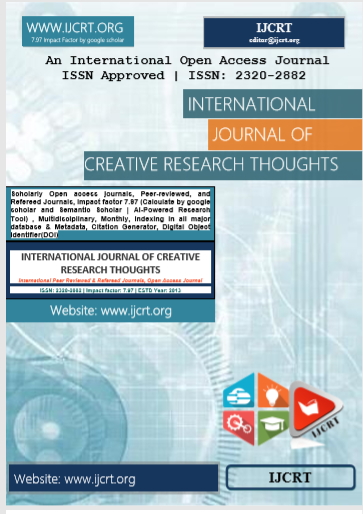
| IJCRT Journal front page | IJCRT Journal Back Page |
Paper Title: "PREVALENCE OF WORK-RELATED MUSCULOSKELETAL DISORDERS AMONG SHOPKEEPERS IN NASHIK CITY"
Author Name(s): Dr. Aaradhana Satish Shinde, Dr. Sarita Kulkarni,
Published Paper ID: - IJCRT26A4116
Register Paper ID - 306826
Publisher Journal Name: IJPUBLICATION, IJCRT
DOI Member ID: 10.6084/m9.doi.one.IJCRT26A4116 and DOI :
Author Country : Indian Author, India, 422222 , Nashik, 422222 , | Research Area: Humanities All Published Paper URL: http://ijcrt.org/viewfull.php?&p_id=IJCRT26A4116 Published Paper PDF: download.php?file=IJCRT26A4116 Published Paper PDF: http://www.ijcrt.org/papers/IJCRT26A4116.pdf
Your Paper Publication Details:
Title: "PREVALENCE OF WORK-RELATED MUSCULOSKELETAL DISORDERS AMONG SHOPKEEPERS IN NASHIK CITY"
DOI (Digital Object Identifier) :
Pubished in Volume: 14 | Issue: 4 | Year: April 2026
Publisher Name : IJCRT | www.ijcrt.org | ISSN : 2320-2882
Subject Area: Humanities All
Author type: Indian Author
Pubished in Volume: 14
Issue: 4
Pages: j606-j616
Year: April 2026
Downloads: 15
E-ISSN Number: 2320-2882
Abstract
Background: Work-related musculoskeletal disorders (WMSDs) are a major occupational health concern among shopkeepers due to prolonged working hours, repetitive tasks, and poor ergonomics, affecting their productivity and quality of life.Methodology: A cross-sectional study was conducted among 148 shopkeepers in Nashik city using purposive sampling over six months. Data were collected using the Nordic Musculoskeletal Questionnaire (NMQ) and Rapid Entire Body Assessment (REBA) scale. Statistical analysis was performed using SPSS version 26.0.Results: The highest prevalence of WMSDs was observed in the 30-39 age group (37.2%). Shoulder (19.59%) and upper back (17.57%) were the most affected regions. Most participants worked 11.6-13.2 hours daily. REBA analysis showed 43.24% at medium risk and 8.11% at high risk.Conclusion: WMSDs are highly prevalent among shopkeepers due to prolonged working hours and ergonomic risks. Targeted interventions such as ergonomic modifications, posture correction, and work-rest cycles are essential to reduce WMSDs and improve occupational health.Keywords:Work-related musculoskeletal disorders (WMSDs), Shopkeepers, Ergonomics, Nordic Musculoskeletal Questionnaire (NMQ), Rapid Entire Body Assessment (REBA), Occupational health, Prevalence, Nashik city
Licence: creative commons attribution 4.0
License
Creative Commons Attribution 4.0 and The Open Definition

Keywords
Work-related musculoskeletal disorders (WMSDs), Shopkeepers, Ergonomics, Nordic Musculoskeletal Questionnaire (NMQ), Rapid Entire Body Assessment (REBA), Occupational health, Prevalence, Nashik city
License
Creative Commons Attribution 4.0 and The Open Definition
Paper Title: Psychopathology in Indian fantasy / speculative fiction : Gendered Constructions of Mental Illness The Devourers - Indra Das, The Calcutta Chromosome - Amitav Ghosh, The Fantastic - A Structural Approach to a Literary Genre -Tzvetan Todorov, The Madwoman in the Attic - Sandra M. Gilbert & Susan Gubar
Author Name(s): Vanshika Singh
Published Paper ID: - IJCRT26A4115
Register Paper ID - 306806
Publisher Journal Name: IJPUBLICATION, IJCRT
DOI Member ID: 10.6084/m9.doi.one.IJCRT26A4115 and DOI :
Author Country : Indian Author, India, 201301 , Noida, 201301 , | Research Area: Other area not in list Published Paper URL: http://ijcrt.org/viewfull.php?&p_id=IJCRT26A4115 Published Paper PDF: download.php?file=IJCRT26A4115 Published Paper PDF: http://www.ijcrt.org/papers/IJCRT26A4115.pdf
Your Paper Publication Details:
Title: PSYCHOPATHOLOGY IN INDIAN FANTASY / SPECULATIVE FICTION : GENDERED CONSTRUCTIONS OF MENTAL ILLNESS THE DEVOURERS - INDRA DAS, THE CALCUTTA CHROMOSOME - AMITAV GHOSH, THE FANTASTIC - A STRUCTURAL APPROACH TO A LITERARY GENRE -TZVETAN TODOROV, THE MADWOMAN IN THE ATTIC - SANDRA M. GILBERT & SUSAN GUBAR
DOI (Digital Object Identifier) :
Pubished in Volume: 14 | Issue: 4 | Year: April 2026
Publisher Name : IJCRT | www.ijcrt.org | ISSN : 2320-2882
Subject Area: Other area not in list
Author type: Indian Author
Pubished in Volume: 14
Issue: 4
Pages: j594-j605
Year: April 2026
Downloads: 11
E-ISSN Number: 2320-2882
Abstract
This dissertation examines the gendered dimensions of psychopathology in Indian fantasy and speculative fiction, with particular focus on Indra Das's The Devourers (2015) and Amitav Ghosh's The Calcutta Chromosome (1995). Rather than treating mental illness as individual pathology, the study argues that these texts deploy psychological disturbance as a narrative and epistemological strategy, one that exposes the interlocking violence of colonial rationality, patriarchal containment, and biomedical authority. The analysis draws on two primary theoretical frameworks: Tzvetan Todorov's structural theory of the fantastic, which locates genre in the hesitation between rational and supernatural explanation, and Sandra Gilbert and Susan Gubar's feminist critique of literary madness in The Madwoman in the Attic. Read together, these frameworks reveal how Indian speculative fiction inherits and radically transforms the Victorian madwoman archetype, displacing her from attic to jungle, from clinical case to epistemic insurgent. Across both novels, madness is shown to be unevenly gendered, feminised as hysteria, silence, and bodily excess; masculinised as obsession and intellectual overreach. Yet neither is straightforwardly pathologised. Instead, the study traces how psychological instability becomes a site of resistance: Mangala's opacity subverts colonial science from within, while the shapeshifting Devourers embody a feral consciousness that dismantles humanist binaries of reason and instinct. Trauma, non-linear memory, and narrative fragmentation further complicate biomedical models of mental health, reframing fractured consciousness as a structural response to historical dispossession rather than cognitive failure. Ultimately, the dissertation contends that Indian speculative fiction does not represent madness so much as weaponise it, forging from psychological wreckage a counter-epistemology that challenges who may speak, who may know, and whose perception of reality is permitted to endure.
Licence: creative commons attribution 4.0
License
Creative Commons Attribution 4.0 and The Open Definition
Keywords
Psychopathology, Indian Speculative Fiction, Gendered Madness, Postcolonial Fantastic, Epistemic Violence, Feminist Literary Criticism, Non-Western Epistemologies, Female Hysteria
License
Creative Commons Attribution 4.0 and The Open Definition
Paper Title: Formulation And Evaluation Of Polyherbal Anti-Diabetic Granules
Author Name(s): OM PATEL, SONU DWIVEDI, KRUPA PATEL, MEGHA PATEL, NISHA PATEL
Published Paper ID: - IJCRT26A4114
Register Paper ID - 306795
Publisher Journal Name: IJPUBLICATION, IJCRT
DOI Member ID: 10.6084/m9.doi.one.IJCRT26A4114 and DOI :
Author Country : Indian Author, India, 389001 , GODHRA, 389001 , | Research Area: Pharmacy All Published Paper URL: http://ijcrt.org/viewfull.php?&p_id=IJCRT26A4114 Published Paper PDF: download.php?file=IJCRT26A4114 Published Paper PDF: http://www.ijcrt.org/papers/IJCRT26A4114.pdf
Your Paper Publication Details:
Title: FORMULATION AND EVALUATION OF POLYHERBAL ANTI-DIABETIC GRANULES
DOI (Digital Object Identifier) :
Pubished in Volume: 14 | Issue: 4 | Year: April 2026
Publisher Name : IJCRT | www.ijcrt.org | ISSN : 2320-2882
Subject Area: Pharmacy All
Author type: Indian Author
Pubished in Volume: 14
Issue: 4
Pages: j578-j593
Year: April 2026
Downloads: 13
E-ISSN Number: 2320-2882
Abstract
The present study focuses on the formulation and evaluation of polyherbal anti-diabetic granules for the effective management of diabetes mellitus, a chronic metabolic disorder characterized by elevated blood glucose levels and associated complications. The limitations and side effects of conventional synthetic drugs highlight the need for safer and more effective herbal alternatives.In this study, a polyherbal formulation was developed using Aegle marmelos, Gymnema sylvestre, and Momordica charantia, which possess well-established antidiabetic properties through multiple mechanisms such as reducing glucose absorption and improving insulin activity. The granules were prepared by the wet granulation method using suitable excipients including diluents, binders, lubricants, and flavoring agents.The prepared granules were evaluated for various pre-compression and post-formulation parameters such as angle of repose, bulk and tapped density, Carr's index, Hausner's ratio, particle size distribution, and moisture content. Further evaluation included phytochemical screening, organoleptic properties, and in-vitro antidiabetic activity using enzyme inhibition assays. Sachet evaluation tests were also performed to ensure uniform ity and quality.The study concludes that polyherbal anti- diabetic granules are a stable, effective, and patient- friendly dosage form with promising potential in the management of diabetes mellitus.
Licence: creative commons attribution 4.0
License
Creative Commons Attribution 4.0 and The Open Definition
Keywords
Polyherbal granules, Diabetes mellitus, Antidiabetic activity, Wet granulation, Herbal formulation, Phytochemicals, Enzyme inhibition
License
Creative Commons Attribution 4.0 and The Open Definition
Paper Title: TEACHING ON KNOWLEDGE REGARDING MYTHS AND MISCONCEPTIONS ABOUT MENTAL ILLNESS AMONG 17 TO 19 YEARS OF ADOLESCENTS FROM SELECTED COLLEGE."
Author Name(s): Ms. Mamta Khare, Mrs. Sonali Mene
Published Paper ID: - IJCRT26A4113
Register Paper ID - 306788
Publisher Journal Name: IJPUBLICATION, IJCRT
DOI Member ID: 10.6084/m9.doi.one.IJCRT26A4113 and DOI :
Author Country : Indian Author, India, - , -, - , | Research Area: Humanities All Published Paper URL: http://ijcrt.org/viewfull.php?&p_id=IJCRT26A4113 Published Paper PDF: download.php?file=IJCRT26A4113 Published Paper PDF: http://www.ijcrt.org/papers/IJCRT26A4113.pdf
Your Paper Publication Details:
Title: TEACHING ON KNOWLEDGE REGARDING MYTHS AND MISCONCEPTIONS ABOUT MENTAL ILLNESS AMONG 17 TO 19 YEARS OF ADOLESCENTS FROM SELECTED COLLEGE."
DOI (Digital Object Identifier) :
Pubished in Volume: 14 | Issue: 4 | Year: April 2026
Publisher Name : IJCRT | www.ijcrt.org | ISSN : 2320-2882
Subject Area: Humanities All
Author type: Indian Author
Pubished in Volume: 14
Issue: 4
Pages: j569-j577
Year: April 2026
Downloads: 9
E-ISSN Number: 2320-2882
Abstract
Health is a state of physical, mental, social and spiritual wellbeing of a person and not merely the absence of disease and infirmity. Most people believe that mental disorders are very rare and it is not going to be affected by a child. In fact, mental illness is very common and widespread. An estimated 13.7% of Indian people are affected with mental illness and 54 million Americans are affected in a year. Objectives: 1) To assess the pre-test level of knowledge regarding myths and misconceptions about mental illness among 17 to 19 years of adolescents from selected college.2) To assess the post-test level of knowledge regarding myths and misconceptions about mental illness among 17 to 19 years of adolescents from selected college.3) To determine association between the knowledge regarding myths and misconceptions about mental illness among 17 to 19 years of adolescents from their selected demographic variables. Methodology
Licence: creative commons attribution 4.0
License
Creative Commons Attribution 4.0 and The Open Definition
Keywords
TEACHING ON KNOWLEDGE REGARDING MYTHS AND MISCONCEPTIONS ABOUT MENTAL ILLNESS AMONG 17 TO 19 YEARS OF ADOLESCENTS FROM SELECTED COLLEGE."
License
Creative Commons Attribution 4.0 and The Open Definition
Paper Title: Implementation Of An AI-Driven Zero-Trust Identity Risk And Adaptive Access Engine
Author Name(s): Sanchit Dasharath Agalave, Sarang Ganesh Bele, Pushkar Patade, Sarthak Harpale, Prof. Rahul P. Bembade
Published Paper ID: - IJCRT26A4112
Register Paper ID - 306829
Publisher Journal Name: IJPUBLICATION, IJCRT
DOI Member ID: 10.6084/m9.doi.one.IJCRT26A4112 and DOI :
Author Country : Indian Author, India, 412307 , Pune, 412307 , | Research Area: Science and Technology Published Paper URL: http://ijcrt.org/viewfull.php?&p_id=IJCRT26A4112 Published Paper PDF: download.php?file=IJCRT26A4112 Published Paper PDF: http://www.ijcrt.org/papers/IJCRT26A4112.pdf
Your Paper Publication Details:
Title: IMPLEMENTATION OF AN AI-DRIVEN ZERO-TRUST IDENTITY RISK AND ADAPTIVE ACCESS ENGINE
DOI (Digital Object Identifier) :
Pubished in Volume: 14 | Issue: 4 | Year: April 2026
Publisher Name : IJCRT | www.ijcrt.org | ISSN : 2320-2882
Subject Area: Science and Technology
Author type: Indian Author
Pubished in Volume: 14
Issue: 4
Pages: j562-j568
Year: April 2026
Downloads: 10
E-ISSN Number: 2320-2882
Abstract
The traditional perimeter-based cybersecurity model is no longer effective against modern threats, leading to the adoption of Zero Trust Architecture (ZTA). This paper presents the implementation of an AI-driven Zero-Trust Identity Risk and Adaptive Access Engine. The system integrates machine learning techniques into the authentication process to dynamically evaluate user risk. A hybrid approach is used, combining Random Forest for contextual risk analysis and Isolation Forest for behavioral anomaly detection. The generated risk score is used to enforce adaptive access decisions such as granting access, triggering multi-factor authentication, or blocking access. The system is implemented using FastAPI and supports real-time decision-making with low latency. Additionally, a SIEM-based logging system and SOC dashboard are developed for monitoring and analysis. Experimental results show that the system achieves high performance and efficient real-time risk evaluation, making it suitable for modern cybersecurity environments.
Licence: creative commons attribution 4.0
License
Creative Commons Attribution 4.0 and The Open Definition
Keywords
Zero Trust, Machine Learning, Random Forest, Isolation Forest, Adaptive Access, Cybersecurity, FastAPI, SIEM
License
Creative Commons Attribution 4.0 and The Open Definition
Paper Title: Cyberbullying Detection in Social Media using NLP
Author Name(s): Divyanshi Diva, Srushti Aherkar, Mangali Choudhary, Sreaya Nair, Prof. Chetana Patil
Published Paper ID: - IJCRT26A4111
Register Paper ID - 306821
Publisher Journal Name: IJPUBLICATION, IJCRT
DOI Member ID: 10.6084/m9.doi.one.IJCRT26A4111 and DOI :
Author Country : Indian Author, India, 412207 , Pune, 412207 , | Research Area: Science and Technology Published Paper URL: http://ijcrt.org/viewfull.php?&p_id=IJCRT26A4111 Published Paper PDF: download.php?file=IJCRT26A4111 Published Paper PDF: http://www.ijcrt.org/papers/IJCRT26A4111.pdf
Your Paper Publication Details:
Title: CYBERBULLYING DETECTION IN SOCIAL MEDIA USING NLP
DOI (Digital Object Identifier) :
Pubished in Volume: 14 | Issue: 4 | Year: April 2026
Publisher Name : IJCRT | www.ijcrt.org | ISSN : 2320-2882
Subject Area: Science and Technology
Author type: Indian Author
Pubished in Volume: 14
Issue: 4
Pages: j555-j561
Year: April 2026
Downloads: 10
E-ISSN Number: 2320-2882
Abstract
The use of the Internet and social media has grown rapidly over the time, becoming an important part of our everyday lives. These platforms help people to express their thoughts, feelings, and ideas and stay connected with each other's. However, as social networking sites have become more popular, the problem of cyberbullying has also increased. Cyberbullying means using technology like social media or messaging platforms to harm or harass or bully someone. The Internet can sometimes spread negative and abusive content, which can cause emotional and mental harm to people. Using offensive or abusive language has become a common issue on social media. Such behavior often causes deep emotional pain, trauma, depression and can also lead to suicide attempts, specially in youngsters. The purpose of this project is to design and develop an automated system to detect and prevent cyberbullying on social networking sites using Natural Language Processing (NLP) and Machine Learning algorithms.
Licence: creative commons attribution 4.0
License
Creative Commons Attribution 4.0 and The Open Definition
Keywords
Cyberbullying Detection, Natural Language Processing (NLP), Machine Learning, Text Classification, Sentiment Analysis
License
Creative Commons Attribution 4.0 and The Open Definition
Paper Title: AI-Driven Zero-Trust Identity Risk And Adaptive Access Engine: A Literature Review
Author Name(s): Sanchit Dasharath Agalave, Sarang Ganesh Bele, Pushkar Patade, Sarthak Harpale, Prof. Rahul P. Bembade
Published Paper ID: - IJCRT26A4110
Register Paper ID - 306828
Publisher Journal Name: IJPUBLICATION, IJCRT
DOI Member ID: 10.6084/m9.doi.one.IJCRT26A4110 and DOI :
Author Country : Indian Author, India, 412307 , Pune, 412307 , | Research Area: Science and Technology Published Paper URL: http://ijcrt.org/viewfull.php?&p_id=IJCRT26A4110 Published Paper PDF: download.php?file=IJCRT26A4110 Published Paper PDF: http://www.ijcrt.org/papers/IJCRT26A4110.pdf
Your Paper Publication Details:
Title: AI-DRIVEN ZERO-TRUST IDENTITY RISK AND ADAPTIVE ACCESS ENGINE: A LITERATURE REVIEW
DOI (Digital Object Identifier) :
Pubished in Volume: 14 | Issue: 4 | Year: April 2026
Publisher Name : IJCRT | www.ijcrt.org | ISSN : 2320-2882
Subject Area: Science and Technology
Author type: Indian Author
Pubished in Volume: 14
Issue: 4
Pages: j546-j554
Year: April 2026
Downloads: 15
E-ISSN Number: 2320-2882
Abstract
The transition from traditional perimeter-based network security to Zero Trust Architecture (ZTA) represents a major shift in modern cybersecurity. This paper reviews the implementation of AI-driven continuous authentication mechanisms in Identity and Access Management (IAM) systems. It focuses on the use of hybrid machine learning models, combining Isolation Forest for anomaly detection and Random Forest for contextual risk evaluation. These models generate a dynamic risk score that enables adaptive access control decisions such as granting access, enforcing multi-factor authentication, or blocking sessions. The study also highlights the integration of identity risk telemetry with Security Information and Event Management (SIEM) systems using standardized schemas. The findings suggest that lightweight AI-based risk engines improve detection accuracy, reduce false positives, and support real-time security enforcement in Zero Trust environments.
Licence: creative commons attribution 4.0
License
Creative Commons Attribution 4.0 and The Open Definition
Keywords
Zero Trust Architecture, Machine Learning, Isolation Forest, Random Forest, Adaptive Access, Cybersecurity, SIEM, IAM
License
Creative Commons Attribution 4.0 and The Open Definition
Paper Title: Formulation And Evaluation Of Herbal Antiperspirant Roll-On Using Sage Extract
Author Name(s): Zainab hatim saherwala, Rashmika patel
Published Paper ID: - IJCRT26A4109
Register Paper ID - 306844
Publisher Journal Name: IJPUBLICATION, IJCRT
DOI Member ID: 10.6084/m9.doi.one.IJCRT26A4109 and DOI :
Author Country : Indian Author, India, 389001 , Godhra, 389001 , | Research Area: Pharmacy All Published Paper URL: http://ijcrt.org/viewfull.php?&p_id=IJCRT26A4109 Published Paper PDF: download.php?file=IJCRT26A4109 Published Paper PDF: http://www.ijcrt.org/papers/IJCRT26A4109.pdf
Your Paper Publication Details:
Title: FORMULATION AND EVALUATION OF HERBAL ANTIPERSPIRANT ROLL-ON USING SAGE EXTRACT
DOI (Digital Object Identifier) :
Pubished in Volume: 14 | Issue: 4 | Year: April 2026
Publisher Name : IJCRT | www.ijcrt.org | ISSN : 2320-2882
Subject Area: Pharmacy All
Author type: Indian Author
Pubished in Volume: 14
Issue: 4
Pages: j543-j545
Year: April 2026
Downloads: 13
E-ISSN Number: 2320-2882
Abstract
The present study focuses on the formulation and evaluation of a herbal antiperspirant roll-on as a safer alternative to synthetic products. Excessive sweating and body odor are commonly caused by microbial decomposition of sweat. Synthetic antiperspirants containing aluminum salts may lead to skin irritation, creating a demand for herbal alternatives. In this study, a roll-on formulation was prepared using sage extract, aloe vera, and tea tree oil along with suitable excipients such as Carbopol, glycerin, and camphor. The formulation was evaluated for parameters such as pH, viscosity, spreadability, drying time, and stability. The results indicated that the formulation had acceptable physicochemical properties and good stability. The herbal ingredients provided antimicrobial, soothing, and deodorizing effects. Hence, the developed formulation can be considered a safe and effective alternative to conventional antiperspirants.
Licence: creative commons attribution 4.0
License
Creative Commons Attribution 4.0 and The Open Definition
Keywords
Herbal Antiperspirant, Roll-On, Sage, Aloe vera, Tea Tree Oil, Carbopol Gel, Antimicrobial Activity, Deodorant, Cosmetic Formulation
License
Creative Commons Attribution 4.0 and The Open Definition
Paper Title: Humanistic Views of Gandhi - A Philosophical Analysis
Author Name(s): Dr Alladi Veerabhadra
Published Paper ID: - IJCRT26A4108
Register Paper ID - 306845
Publisher Journal Name: IJPUBLICATION, IJCRT
DOI Member ID: 10.6084/m9.doi.one.IJCRT26A4108 and DOI :
Author Country : Indian Author, India, 533001 , Kakinada, 533001 , | Research Area: Arts All Published Paper URL: http://ijcrt.org/viewfull.php?&p_id=IJCRT26A4108 Published Paper PDF: download.php?file=IJCRT26A4108 Published Paper PDF: http://www.ijcrt.org/papers/IJCRT26A4108.pdf
Your Paper Publication Details:
Title: HUMANISTIC VIEWS OF GANDHI - A PHILOSOPHICAL ANALYSIS
DOI (Digital Object Identifier) :
Pubished in Volume: 14 | Issue: 4 | Year: April 2026
Publisher Name : IJCRT | www.ijcrt.org | ISSN : 2320-2882
Subject Area: Arts All
Author type: Indian Author
Pubished in Volume: 14
Issue: 4
Pages: j538-j542
Year: April 2026
Downloads: 10
E-ISSN Number: 2320-2882
Abstract
Abstract: This paper explores the concept of humanism with special reference to Gandhian philosophy and its relevance in contemporary India. Humanism, derived from the Latin term humanities, emphasizes the dignity, value, and potential of human beings, promoting rational thinking, moral responsibility, and social welfare. Historically, humanism traces its roots to Greek thought, particularly Protagoras' idea that "man is the measure of all things," and later developed in both Western and Eastern traditions. While Western humanism often adopted an atheistic orientation, Indian humanism, reflected in the Vedas, Upanishads, and later reform movements, integrates spirituality with ethical living. The paper adopts a descriptive methodology based on secondary sources to analyse Gandhi's humanistic ideas. Gandhi's humanism was shaped by diverse influences, including his family, religious texts like the Bhagavad Gita, and thinkers such as Tolstoy and Ruskin. Central to his philosophy are truth, non-violence, service to humanity, and moral duty. Gandhi viewed religion as inseparable from daily life, defining it as dharma--a moral obligation that fosters both individual integrity and social harmony. Gandhian humanism advocates the creation of a just and humane society grounded in tolerance, unity, and ethical conduct. His vision of Ramarajya represents an ideal society based on justice, equality, and moral values. He emphasized duty over rights, believing that social transformation begins with inner moral development. In contemporary India, Gandhian humanism remains relevant as it addresses issues of inequality, conflict, and moral decline, offering a path toward peace, harmony, and holistic human development.
Licence: creative commons attribution 4.0
License
Creative Commons Attribution 4.0 and The Open Definition
Keywords
Humanism, Gandhian Humanism, Philosophy of Humanism, Gandhian Philosophy, Indian Philosophy
License
Creative Commons Attribution 4.0 and The Open Definition
Paper Title: Exploited Innocence: Child Abuse and Trafficking in Contemporary Society
Author Name(s): Dr. Ningombam Oligachanu Devi, Dr. Ningombam Andropov Singh
Published Paper ID: - IJCRT26A4107
Register Paper ID - 306841
Publisher Journal Name: IJPUBLICATION, IJCRT
DOI Member ID: 10.6084/m9.doi.one.IJCRT26A4107 and DOI :
Author Country : Indian Author, India, 600094 , Imphal, 600094 , | Research Area: Social Science All Published Paper URL: http://ijcrt.org/viewfull.php?&p_id=IJCRT26A4107 Published Paper PDF: download.php?file=IJCRT26A4107 Published Paper PDF: http://www.ijcrt.org/papers/IJCRT26A4107.pdf
Your Paper Publication Details:
Title: EXPLOITED INNOCENCE: CHILD ABUSE AND TRAFFICKING IN CONTEMPORARY SOCIETY
DOI (Digital Object Identifier) :
Pubished in Volume: 14 | Issue: 4 | Year: April 2026
Publisher Name : IJCRT | www.ijcrt.org | ISSN : 2320-2882
Subject Area: Social Science All
Author type: Indian Author
Pubished in Volume: 14
Issue: 4
Pages: j533-j537
Year: April 2026
Downloads: 13
E-ISSN Number: 2320-2882
Abstract
This paper examines the issue of child abuse and trafficking within the socio-economic and cultural context of Indian society. It highlights how poverty, gender discrimination, broken family structures, conflict situations, and lack of education make the child vulnerable to exploitation. The study discusses various forms of abuse, including labour exploitation, neglect, physical and emotional violence, trafficking, and discrimination against the girl child and children born out of wedlock. It also addresses the condition of the migrant child and those living in conflict-ridden regions who often suffer psychological and emotional trauma. The paper emphasizes that child abuse is socially constructed and therefore preventable through collective responsibility, policy intervention, educational reform, and economic development. It ultimately stresses the need to safeguard the child's rights and ensure holistic development, recognizing the child as the foundation of the nation's future.
Licence: creative commons attribution 4.0
License
Creative Commons Attribution 4.0 and The Open Definition
Keywords
Child, Abuse, Trafficking, Discrimination, Poverty
License
Creative Commons Attribution 4.0 and The Open Definition
Call For Paper April 2026
Call For Papers
April 2026
Volume 14 | Issue 4
Last Date :
31-May-2026
Submit Manuscript Online Impact Factor: 7.97 Review Results : Within 02-03 Days Paper Publication : Within 02-03 Days
April 2026
Volume 14 | Issue 4
Last Date :
31-May-2026
Submit Manuscript Online Impact Factor: 7.97 Review Results : Within 02-03 Days Paper Publication : Within 02-03 Days
Published Issue Details
For Authors
Forms / Downloads
Other IMP Links
Indexing Partner
Research Area
LICENSE





ISSN and 7.97 Impact Factor Details
ISSN: 2320-2882 Impact Factor: 7.97 and ISSN APPROVED Journal Starting Year (ESTD) : 2013


ISSN and 7.97 Impact Factor Details
ISSN: 2320-2882 Impact Factor: 7.97 and ISSN APPROVED Journal Starting Year (ESTD) : 2013
DOI Details
CONFERENCE
CONFERENCE MANAGMENT & PUBLICATION CONFERENCE PROPOSAL
RECENT CONFERENCE

CONFERENCE PROPOSAL CONFERENCE PROCEEDINGS
CONFERENCE PROPOSAL CONFERENCE PROCEEDINGS
For Reviewer /Referral (RMS) Earn 500 per paper
Important Links
NEWS & Conference
Digital Library
IJCRT RMS | Earn 500 Per Paper.

Open Access


LICENSE
Indexing Partner
Scholarly open access journals, Peer-reviewed, and Refereed Journals, Impact factor 7.97 (Calculate by google scholar and Semantic Scholar | AI-Powered Research Tool) , Multidisciplinary, Monthly, Indexing in all major database & Metadata, Citation Generator, Digital Object Identifier(DOI)