Important Details
IJCRT - International Peer Reviewed, Open Access Journal, Multidisciplinary, Monthly, Nominal(Low) Fees for Professional Research Services International Journal of Creative Research Thoughts - IJCRT Peer Review Journal, Refereed Journal, Peer Reviewed Journal , Referred Journal and Indexed Journal, Open access, Online and Print Journal,international Journal Open Access, Accepted by Indian and foreign university ,IJCRT Followed Norms, guidelines, requirement, listing criteria and methodology of score/point also applied from: Scopus , Web of Science , UGC Approved , UGC CARE, UGC-CARE .
UGC Approved Journal No: 49023 (18)
UGC approval Link
https://ijcrt.org/ugc%20approval.jpg
All Policy and Approval
Please Like Our Facebook Page | CrossRef DOI and Hard copy of Certificate Provide if required. | www.IJCRT.org | editor@IJCRT.org | WhatsApp: 7990172303
Publication Details:
- Paper Submission : 31-May-2026. Call For Paper (Volume 14 | Issue 4 | Month- April 2026)
- Acceptance/Rejection Notification: Within 02-04 Days.
- Paper Publish: Within 02-04 Days after submitting all documents.
-
Submit Your Paper Any time There No deadline.
-
Publication fees : 1570 INR for Indian author & 59$ for foreign International author.
Please Like Our Facebook Page | CrossRef DOI and Hard copy of Certificate Provide if required.
Licence and Indexing
Indexing In Google Scholar, SSRN, ResearcherID-Publons, Semantic Scholar | AI-Powered Research Tool, Microsoft Academic, Academia.edu, arXiv.org, Research Gate, CiteSeerX, ResearcherID Thomson Reuters, Mendeley : reference manager, DocStoc, ISSUU, Scribd, and many more | High Impact Factor: 7.97 | Digital object identifier (DOI) and Hard Copy of certificate Provided.




























Licence
DOI
ISSN Approved impact factor: 7.97 
Creative Common 
Valid as per new UGC Gazette regulations 

INTERNATIONAL JOURNAL OF CREATIVE RESEARCH THOUGHTS - IJCRT (IJCRT.ORG)
International Peer Reviewed & Refereed Journals, Open Access Journal
IJCRT Peer-Reviewed (Refereed) Journal as Per New UGC Rules.
ISSN Approved Journal No: 2320-2882 | Impact factor: 7.97 | ESTD Year: 2013
Call For Paper - Volume 14 | Issue 4 | Month- April 2026
Scholarly open access journals, Peer-reviewed, and Refereed Journals, Impact factor 7.97 (Calculate by google scholar and Semantic Scholar | AI-Powered Research Tool) , Multidisciplinary, Monthly, Indexing in all major database & Metadata, Citation Generator, Digital Object Identifier(CrossRef DOI)
Contact Us Click Here
WhatsApp Contact Click Here
IJCRT Search Xplore - Search all paper by Paper Name , Author Name, and Title
Volume 14 | Issue 4 |
Volume 14 | Issue 4 | Month
Downlaod After Publication 1) Table of content index in PDF
2) Table of content index in HTML 2)Table of content index in HTML
3) Front Page 3) Front Page
4) Back Page 4) Back Page
5) Editor Board Member 5)Editor Board Member
6) OLD Style Issue 6)OLD Style Issue
 |
 |
|---|---|
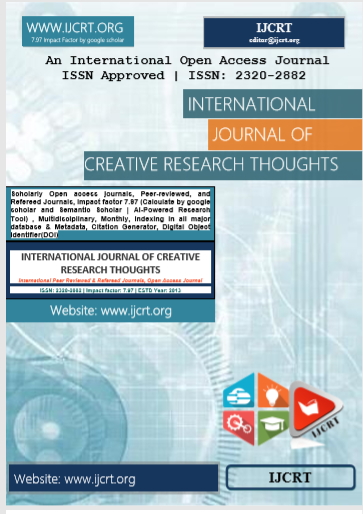
| IJCRT Journal front page | IJCRT Journal Back Page |
Paper Title: Beyond the Bug: A Study of Psychological Setback and Self-Alienation in Franz Kafka's novel "The Metamorphosis."
Author Name(s): Neethish Krupal D B, Dr. M Swamy
Published Paper ID: - IJCRT26A4267
Register Paper ID - 306783
Publisher Journal Name: IJPUBLICATION, IJCRT
DOI Member ID: 10.6084/m9.doi.one.IJCRT26A4267 and DOI :
Author Country : Indian Author, India, - , -, - , | Research Area: Arts All Published Paper URL: http://ijcrt.org/viewfull.php?&p_id=IJCRT26A4267 Published Paper PDF: download.php?file=IJCRT26A4267 Published Paper PDF: http://www.ijcrt.org/papers/IJCRT26A4267.pdf
Your Paper Publication Details:
Title: BEYOND THE BUG: A STUDY OF PSYCHOLOGICAL SETBACK AND SELF-ALIENATION IN FRANZ KAFKA'S NOVEL "THE METAMORPHOSIS."
DOI (Digital Object Identifier) :
Pubished in Volume: 14 | Issue: 4 | Year: April 2026
Publisher Name : IJCRT | www.ijcrt.org | ISSN : 2320-2882
Subject Area: Arts All
Author type: Indian Author
Pubished in Volume: 14
Issue: 4
Pages: k933-k935
Year: April 2026
Downloads: 9
E-ISSN Number: 2320-2882
Abstract
Franz Kafka's novel "The Metamorphosis" presents an unexplainable transformation of the main character of the novel, Gregor Samsa into a "monstrous vermin." This paper conveys that Gregor's physical change is not a random occurrence but the ultimate expression of his pre-existing self-alienation rooted in oppressive familial and financial duties. Even before his physical transformation, Gregor's psyche had been eroded by a mechanical, soul-crushing routine, effectively reducing him to a mindless machine serving a system and a family that valued his labour over his humanity.
Licence: creative commons attribution 4.0
License
Creative Commons Attribution 4.0 and The Open Definition

Keywords
Beyond the Bug: A Study of Psychological Setback and Self-Alienation in Franz Kafka's novel "The Metamorphosis."
License
Creative Commons Attribution 4.0 and The Open Definition
Paper Title: Continuity and Preservation of Indigenous Knowledge Systems: A Social Science Perspective on Education and Institutional Practices
Author Name(s): Himakshi Bandral, Vishab Partap Singh Chambyal, Priyanka Sharma, Dr. Aman Bhardwaj
Published Paper ID: - IJCRT26A4266
Register Paper ID - 305754
Publisher Journal Name: IJPUBLICATION, IJCRT
DOI Member ID: 10.6084/m9.doi.one.IJCRT26A4266 and DOI :
Author Country : Indian Author, India, 181143 , SAMBA, 181143 , | Research Area: Social Science All Published Paper URL: http://ijcrt.org/viewfull.php?&p_id=IJCRT26A4266 Published Paper PDF: download.php?file=IJCRT26A4266 Published Paper PDF: http://www.ijcrt.org/papers/IJCRT26A4266.pdf
Your Paper Publication Details:
Title: CONTINUITY AND PRESERVATION OF INDIGENOUS KNOWLEDGE SYSTEMS: A SOCIAL SCIENCE PERSPECTIVE ON EDUCATION AND INSTITUTIONAL PRACTICES
DOI (Digital Object Identifier) :
Pubished in Volume: 14 | Issue: 4 | Year: April 2026
Publisher Name : IJCRT | www.ijcrt.org | ISSN : 2320-2882
Subject Area: Social Science All
Author type: Indian Author
Pubished in Volume: 14
Issue: 4
Pages: k923-k932
Year: April 2026
Downloads: 13
E-ISSN Number: 2320-2882
Abstract
Indigenous Knowledge Systems (IKS) represent a vital component of cultural heritage embedded in local communities and transmitted through generations via social practices and lived experiences. This study examines the continuity, preservation, and representation of IKS from a social science perspective. It explores the influence of socio-cultural transformations such as globalization, modernization, and environmental change on the sustainability of IKS, revealing that while these factors contribute to knowledge erosion, community resilience, adaptive practices, and the role of cultural custodians support its continuity. The study further assesses the availability of institutional policies for long-term preservation of IKS in selected repositories, highlighting the absence of comprehensive frameworks despite emerging efforts in digital curation, ethical governance, and community-centered approaches, alongside challenges such as financial constraints and linguistic loss. Additionally, it evaluates the representation of IKS within educational curricula, indicating gradual inclusion with increasing recognition of its cultural and social significance, although limitations persist due to lack of teacher preparedness, standardization issues, and loss of contextual depth. The study concludes that effective preservation and promotion of IKS require strong community participation, supportive policy frameworks, and pedagogical transformation to ensure its relevance for cultural identity and sustainable development.
Licence: creative commons attribution 4.0
License
Creative Commons Attribution 4.0 and The Open Definition
Keywords
Indigenous Knowledge Systems (IKS), Knowledge Preservation, Value-Based Education, Cultural Heritage Education
License
Creative Commons Attribution 4.0 and The Open Definition
Paper Title: Psychological Effects Of Domestic Violence On Children
Author Name(s): Aysha Manahil, Kavya Vijayan
Published Paper ID: - IJCRT26A4265
Register Paper ID - 307218
Publisher Journal Name: IJPUBLICATION, IJCRT
DOI Member ID: 10.6084/m9.doi.one.IJCRT26A4265 and DOI :
Author Country : Indian Author, India, 581320 , bhatkal, 581320 , | Research Area: Social Science All Published Paper URL: http://ijcrt.org/viewfull.php?&p_id=IJCRT26A4265 Published Paper PDF: download.php?file=IJCRT26A4265 Published Paper PDF: http://www.ijcrt.org/papers/IJCRT26A4265.pdf
Your Paper Publication Details:
Title: PSYCHOLOGICAL EFFECTS OF DOMESTIC VIOLENCE ON CHILDREN
DOI (Digital Object Identifier) :
Pubished in Volume: 14 | Issue: 4 | Year: April 2026
Publisher Name : IJCRT | www.ijcrt.org | ISSN : 2320-2882
Subject Area: Social Science All
Author type: Indian Author
Pubished in Volume: 14
Issue: 4
Pages: k919-k922
Year: April 2026
Downloads: 4
E-ISSN Number: 2320-2882
Abstract
Domestic violence is a major public health and psychological concern that affects not only intimate partners but also children who witness or directly experience violence within the home. Exposure to domestic violence during childhood has profound consequences for emotional, cognitive, behavioral, and social development. Children living in violent households frequently experience chronic stress, fear, insecurity, and trauma, which may contribute to long-term psychopathology. This paper reviews the psychological effects of domestic violence on children, including anxiety, depression, post-traumatic stress disorder (PTSD), attachment disturbances, behavioral problems, academic difficulties, and intergenerational patterns of violence. It also discusses developmental differences in response to violence exposure and highlights the importance of early intervention, school-based support, and trauma-informed therapeutic approaches.
Licence: creative commons attribution 4.0
License
Creative Commons Attribution 4.0 and The Open Definition
Keywords
Domestic violence,Children,Psychological Effects,Anxiety,Trauma,Attachment
License
Creative Commons Attribution 4.0 and The Open Definition
Paper Title: AUTOMATIC READER FOR BLIND PEOPLE USING RASPBERRY PI
Author Name(s): DAMMANAGARI MALLIKA, HANUMAKONDA VARSHA, KONDA SRUJANA, PUPPALA RUCHITHA, Dr.B. SHRAVAN KUMAR
Published Paper ID: - IJCRT26A4264
Register Paper ID - 307062
Publisher Journal Name: IJPUBLICATION, IJCRT
DOI Member ID: 10.6084/m9.doi.one.IJCRT26A4264 and DOI :
Author Country : Indian Author, India, - , -, - , | Research Area: Science and Technology Published Paper URL: http://ijcrt.org/viewfull.php?&p_id=IJCRT26A4264 Published Paper PDF: download.php?file=IJCRT26A4264 Published Paper PDF: http://www.ijcrt.org/papers/IJCRT26A4264.pdf
Your Paper Publication Details:
Title: AUTOMATIC READER FOR BLIND PEOPLE USING RASPBERRY PI
DOI (Digital Object Identifier) :
Pubished in Volume: 14 | Issue: 4 | Year: April 2026
Publisher Name : IJCRT | www.ijcrt.org | ISSN : 2320-2882
Subject Area: Science and Technology
Author type: Indian Author
Pubished in Volume: 14
Issue: 4
Pages: k912-k918
Year: April 2026
Downloads: 4
E-ISSN Number: 2320-2882
Abstract
Visually impaired people often find it difficult to read everyday printed materials like books, newspapers, or documents. To address this problem, we built a simple and affordable automatic reading system using a Raspberry Pi 3 Model B, a 5MP camera, basic speakers with a 3.5 mm jack, and a standard 5V power supply. The entire setup is compact and easy to carry, making it practical for daily use.
Licence: creative commons attribution 4.0
License
Creative Commons Attribution 4.0 and The Open Definition
Keywords
Raspberry Pi 3, Smart Reader, Optical Character Recognition (OCR), Text-to-Speech (TTS), Assistive Technology, Pi Camera, USB Speakers, Image Processing, Visually Impaired.
License
Creative Commons Attribution 4.0 and The Open Definition
Paper Title: Safety Auto Brake System on Hill Station by Using MEMS Sensor
Author Name(s): Randeep Singh, Sanju Pouniya, Dr. Apoorva Dwivedi
Published Paper ID: - IJCRT26A4263
Register Paper ID - 307117
Publisher Journal Name: IJPUBLICATION, IJCRT
DOI Member ID: 10.6084/m9.doi.one.IJCRT26A4263 and DOI :
Author Country : Indian Author, India, - , -, - , | Research Area: Arts All Published Paper URL: http://ijcrt.org/viewfull.php?&p_id=IJCRT26A4263 Published Paper PDF: download.php?file=IJCRT26A4263 Published Paper PDF: http://www.ijcrt.org/papers/IJCRT26A4263.pdf
Your Paper Publication Details:
Title: SAFETY AUTO BRAKE SYSTEM ON HILL STATION BY USING MEMS SENSOR
DOI (Digital Object Identifier) :
Pubished in Volume: 14 | Issue: 4 | Year: April 2026
Publisher Name : IJCRT | www.ijcrt.org | ISSN : 2320-2882
Subject Area: Arts All
Author type: Indian Author
Pubished in Volume: 14
Issue: 4
Pages: k904-k911
Year: April 2026
Downloads: 4
E-ISSN Number: 2320-2882
Abstract
Road transportation in hilly regions poses significant safety challenges due to steep gradients, sharp curves, and varying road conditions. Conventional braking systems rely heavily on driver response, which may be insufficient in critical situations, leading to accidents such as vehicle rollback or loss of control during descent. This paper presents a Safety Auto Brake System (SABS) based on a Micro-Electro-Mechanical System (MEMS) sensor for real-time slope detection and automatic braking control. The MEMS sensor, acting as an accelerometer, continuously measures tilt and acceleration along multiple axes and transmits data to a microcontroller for processing. Based on predefined threshold values, the system automatically activates the braking mechanism under unsafe conditions. The proposed system effectively prevents rollback during uphill starts and controls vehicle speed during downhill motion, thereby enhancing stability and safety. The integration of MEMS technology offers advantages such as high sensitivity, fast response, compact size, and low power consumption. Additionally, the system reduces driver workload and can be implemented using cost-effective components, making it suitable for both new vehicles and retrofitting applications. Experimental analysis indicates that the proposed system significantly improves vehicle control and reduces accident risks in hilly terrain. Future work may include integration with advanced driver assistance systems and adaptive control techniques for improved performance.
Licence: creative commons attribution 4.0
License
Creative Commons Attribution 4.0 and The Open Definition
Keywords
Safety Auto Brake System on Hill Station by Using MEMS Sensor
License
Creative Commons Attribution 4.0 and The Open Definition
Paper Title: AI-Driven Automated Security Assessment Pipeline for Modern DevSecOps
Author Name(s): Mahale Amol Govinda, Shinde Tejas Ravsaheb, Smt.Shewale S.B
Published Paper ID: - IJCRT26A4262
Register Paper ID - 306751
Publisher Journal Name: IJPUBLICATION, IJCRT
DOI Member ID: 10.6084/m9.doi.one.IJCRT26A4262 and DOI :
Author Country : Indian Author, India, 423301 , Satana, 423301 , | Research Area: Science All Published Paper URL: http://ijcrt.org/viewfull.php?&p_id=IJCRT26A4262 Published Paper PDF: download.php?file=IJCRT26A4262 Published Paper PDF: http://www.ijcrt.org/papers/IJCRT26A4262.pdf
Your Paper Publication Details:
Title: AI-DRIVEN AUTOMATED SECURITY ASSESSMENT PIPELINE FOR MODERN DEVSECOPS
DOI (Digital Object Identifier) :
Pubished in Volume: 14 | Issue: 4 | Year: April 2026
Publisher Name : IJCRT | www.ijcrt.org | ISSN : 2320-2882
Subject Area: Science All
Author type: Indian Author
Pubished in Volume: 14
Issue: 4
Pages: k895-k903
Year: April 2026
Downloads: 5
E-ISSN Number: 2320-2882
Abstract
The convergence of DevOps practices and cybersecurity imperatives has given rise to the DevSecOps paradigm, demanding security processes that are as agile and automated as the pipelines they protect. Conventional security assessment methodologies -- manual penetration testing, rule-based static analysis, and fragmented dynamic scanning -- are unable to keep pace with the velocity, scale, and complexity of modern software delivery. This paper proposes and evaluates AI-ASAP (AI-driven Automated Security Assessment Pipeline), a comprehensive framework that embeds artificial intelligence at every stage of the security assessment lifecycle within CI/CD workflows. AI-ASAP integrates static application security testing (SAST) enhanced by natural language processing (NLP), reinforcement-learning-based dynamic fuzzing, graph neural network (GNN) dependency risk analysis, large language model (LLM) powered remediation generation, and continuous threat intelligence correlation. Evaluation across simulated enterprise environments demonstrates a 94.3% vulnerability detection rate, a 6.7% false positive rate, and a reduction in mean assessment time from days to under 45 minutes, with automated pull-request remediation capabilities. The proposed framework represents a significant advancement toward autonomous, continuous, and intelligent security assessment in modern software engineering.
Licence: creative commons attribution 4.0
License
Creative Commons Attribution 4.0 and The Open Definition
Keywords
DevSecOps, AI Security, SAST, DAST, CI/CD Pipeline, Vulnerability Assessment, LLM Remediation, Reinforcement Learning, Graph Neural Networks, Threat Intelligence.
License
Creative Commons Attribution 4.0 and The Open Definition
Paper Title: MiDAS : Real-Time Machine Insights and Data- Driven Maintenance System
Author Name(s): KIMBERLY ANTHONY, Siddhi Auti, Manjiri Chaudhary, David Verma, Sweta Wankhade
Published Paper ID: - IJCRT26A4261
Register Paper ID - 306625
Publisher Journal Name: IJPUBLICATION, IJCRT
DOI Member ID: 10.6084/m9.doi.one.IJCRT26A4261 and DOI :
Author Country : Indian Author, India, 411015 , Pune, 411015 , | Research Area: Science and Technology Published Paper URL: http://ijcrt.org/viewfull.php?&p_id=IJCRT26A4261 Published Paper PDF: download.php?file=IJCRT26A4261 Published Paper PDF: http://www.ijcrt.org/papers/IJCRT26A4261.pdf
Your Paper Publication Details:
Title: MIDAS : REAL-TIME MACHINE INSIGHTS AND DATA- DRIVEN MAINTENANCE SYSTEM
DOI (Digital Object Identifier) :
Pubished in Volume: 14 | Issue: 4 | Year: April 2026
Publisher Name : IJCRT | www.ijcrt.org | ISSN : 2320-2882
Subject Area: Science and Technology
Author type: Indian Author
Pubished in Volume: 14
Issue: 4
Pages: k885-k894
Year: April 2026
Downloads: 6
E-ISSN Number: 2320-2882
Abstract
MiDAS is a cost-effective and scalable automation platform developed to enhance the operational efficiency of small and medium-sized manufacturing enterprises (SMEs). Many SMEs still rely on manual methods for monitoring machine performance, which often leads to delayed maintenance, unexpected equipment failures, and suboptimal production efficiency. Although conventional industrial automation solutions such as PLC and SCADA systems provide robust capabilities, their high cost and implementation complexity make them less accessible to smaller industries. To address this gap, MiDAS integrates affordable Internet of Things (IoT) technologies with practical industrial monitoring needs. The system utilizes low-cost hardware components, including ESP32 microcontrollers, sensors, and a Raspberry Pi functioning as a local server. It captures real-time machine parameters such as punch count, vibration, and energy consumption, and transmits the data wirelessly using the MQTT protocol. The collected data is processed using analytical techniques such as aggregation, threshold-based anomaly detection, moving averages, and linear regression to generate predictive maintenance insights. A web-based dashboard, developed using React, provides real-time visualization of machine status, health metrics, and predictive alerts. By enabling continuous monitoring, early fault detection, and data-driven decision-making at a significantly lower cost than traditional systems, MiDAS empowers SMEs to reduce downtime, improve productivity, and adopt Industry 4.0 practices effectively.
Licence: creative commons attribution 4.0
License
Creative Commons Attribution 4.0 and The Open Definition
Keywords
Predictive maintenance, IIoT, ESP32, Raspberry Pi 4, proximity sensor, edge computing, real time monitoring, machine health, production output, maintenance notifications, industrial automation
License
Creative Commons Attribution 4.0 and The Open Definition
Paper Title: Reflections on STS in Sci-fi by Women: A Study of Mary Shelley's Frankenstein and Octavia Butler's Xenogenesis Trilogy: Dawn
Author Name(s): Minoti Billawaria
Published Paper ID: - IJCRT26A4260
Register Paper ID - 307203
Publisher Journal Name: IJPUBLICATION, IJCRT
DOI Member ID: 10.6084/m9.doi.one.IJCRT26A4260 and DOI :
Author Country : Indian Author, India, 180011 , Jammu, 180011 , | Research Area: Medical Science All Published Paper URL: http://ijcrt.org/viewfull.php?&p_id=IJCRT26A4260 Published Paper PDF: download.php?file=IJCRT26A4260 Published Paper PDF: http://www.ijcrt.org/papers/IJCRT26A4260.pdf
Your Paper Publication Details:
Title: REFLECTIONS ON STS IN SCI-FI BY WOMEN: A STUDY OF MARY SHELLEY'S FRANKENSTEIN AND OCTAVIA BUTLER'S XENOGENESIS TRILOGY: DAWN
DOI (Digital Object Identifier) :
Pubished in Volume: 14 | Issue: 4 | Year: April 2026
Publisher Name : IJCRT | www.ijcrt.org | ISSN : 2320-2882
Subject Area: Medical Science All
Author type: Indian Author
Pubished in Volume: 14
Issue: 4
Pages: k879-k884
Year: April 2026
Downloads: 4
E-ISSN Number: 2320-2882
Abstract
This paper examines Mary Shelley's Frankenstein (1818) and Octavia Butler's Dawn (1987) as science-fictional thought experiments that interrogate the ethical, social, and ecological consequences of scientific intervention in life. Drawing on the interdisciplinary framework of Science, Technology, and Society (STS), along with concepts from bioethics and ecofeminism, the study explores how both texts critique scientific rationality when it operates without ethical responsibility. Shelley's Frankenstein, often regarded as the foundational work of modern science fiction, exposes the dangers of unchecked ambition and irresponsible experimentation, anticipating contemporary debates on cloning, artificial life, and bioengineering. Butler's Dawn, situated in a post-apocalyptic and posthuman context, extends this critique by examining genetic manipulation, hybridity, colonisation, and ecological symbiosis. While Shelley foregrounds individual responsibility and the moral limits of scientific inquiry, Butler complicates ethical judgment by framing survival as contingent upon compromise, interdependence, and the redefinition of the human. Together, these texts demonstrate how science fiction functions as a critical and pedagogical space for reflecting on ethical science, environmental sustainability, and the future of human and non-human life in an age of technological acceleration and ecological crisis.
Licence: creative commons attribution 4.0
License
Creative Commons Attribution 4.0 and The Open Definition
Keywords
Science fiction; thought experiment; STS; bioethics; ecofeminism; hybridity; Anthropocene; posthumanism
License
Creative Commons Attribution 4.0 and The Open Definition
Paper Title: Data Science Plays a Crucial Role in Biology : Bioinformatics as an Emerging Field
Author Name(s): Raj Pravin Birgavale, Prem Vitthal Shinde, Riya Rohidas Rewale
Published Paper ID: - IJCRT26A4259
Register Paper ID - 307148
Publisher Journal Name: IJPUBLICATION, IJCRT
DOI Member ID: 10.6084/m9.doi.one.IJCRT26A4259 and DOI :
Author Country : Indian Author, India, 402106 , Nagothane, 402106 , | Research Area: Biological Science Published Paper URL: http://ijcrt.org/viewfull.php?&p_id=IJCRT26A4259 Published Paper PDF: download.php?file=IJCRT26A4259 Published Paper PDF: http://www.ijcrt.org/papers/IJCRT26A4259.pdf
Your Paper Publication Details:
Title: DATA SCIENCE PLAYS A CRUCIAL ROLE IN BIOLOGY : BIOINFORMATICS AS AN EMERGING FIELD
DOI (Digital Object Identifier) :
Pubished in Volume: 14 | Issue: 4 | Year: April 2026
Publisher Name : IJCRT | www.ijcrt.org | ISSN : 2320-2882
Subject Area: Biological Science
Author type: Indian Author
Pubished in Volume: 14
Issue: 4
Pages: k875-k878
Year: April 2026
Downloads: 4
E-ISSN Number: 2320-2882
Abstract
The rapid advancement of technology and the explosion of biological data have led to the emergence of bioinformatics, a field that integrates biology with data science. Bioinformatics utilizes computational tools, statistical models, and machine learning techniques to analyze complex biological data. This paper explores how data science has become indispensable in modern biology, the applications of bioinformatics, its challenges, and future prospects. The study highlights how bioinformatics is transforming healthcare, genomics, and drug discovery.
Licence: creative commons attribution 4.0
License
Creative Commons Attribution 4.0 and The Open Definition
Paper Title: SMART EVIDENCE PROTECTION SYSTEM
Author Name(s): Pragya Verma, Prakhar Malviya, Dr. Pankaj Kumar, Er. Mahesh Bahadur
Published Paper ID: - IJCRT26A4258
Register Paper ID - 307143
Publisher Journal Name: IJPUBLICATION, IJCRT
DOI Member ID: 10.6084/m9.doi.one.IJCRT26A4258 and DOI :
Author Country : Indian Author, India, 225001 , Barabanki, 225001 , | Research Area: Science and Technology Published Paper URL: http://ijcrt.org/viewfull.php?&p_id=IJCRT26A4258 Published Paper PDF: download.php?file=IJCRT26A4258 Published Paper PDF: http://www.ijcrt.org/papers/IJCRT26A4258.pdf
Your Paper Publication Details:
Title: SMART EVIDENCE PROTECTION SYSTEM
DOI (Digital Object Identifier) :
Pubished in Volume: 14 | Issue: 4 | Year: April 2026
Publisher Name : IJCRT | www.ijcrt.org | ISSN : 2320-2882
Subject Area: Science and Technology
Author type: Indian Author
Pubished in Volume: 14
Issue: 4
Pages: k870-k874
Year: April 2026
Downloads: 4
E-ISSN Number: 2320-2882
Abstract
Digital evidence forms the cornerstone of modern investigations but poses significant challenges for maintaining integrity and a verifiable chain-of-custody. This paper proposes a multi-layered evidence protection system that combines cryptographic hashing, and role-based access control (RBAC) to secure evidence from ingestion to analysis. The architecture allows authenticated users (investigators, officers, administrators, etc.) to upload evidence via a secure portal. Each file is split into chunks and hashed; SHA-256 hashes are aggregated into a MongoDB database stored with the evidence. RBAC enforces permissions for each role. An audit log records all actions. Experimental estimates indicate that hashing overhead is low, while modern hash functions are collision-resistant. Finally, we discuss future directions(e.g. Blockchain timestamping, explainable AI for forgery detection) and conclude that this framework greatly enhances evidence integrity and traceability.
Licence: creative commons attribution 4.0
License
Creative Commons Attribution 4.0 and The Open Definition
Keywords
Keywords-- Digital Evidence Management, Chain of Custody, Cryptographic Hash, SHA-256, Role-Based Access Control, Evidence Integrity.
License
Creative Commons Attribution 4.0 and The Open Definition
Call For Paper April 2026
Call For Papers
April 2026
Volume 14 | Issue 4
Last Date :
31-May-2026
Submit Manuscript Online Impact Factor: 7.97 Review Results : Within 02-03 Days Paper Publication : Within 02-03 Days
April 2026
Volume 14 | Issue 4
Last Date :
31-May-2026
Submit Manuscript Online Impact Factor: 7.97 Review Results : Within 02-03 Days Paper Publication : Within 02-03 Days
Published Issue Details
For Authors
Forms / Downloads
Other IMP Links
Indexing Partner
Research Area
LICENSE





ISSN and 7.97 Impact Factor Details
ISSN: 2320-2882 Impact Factor: 7.97 and ISSN APPROVED Journal Starting Year (ESTD) : 2013


ISSN and 7.97 Impact Factor Details
ISSN: 2320-2882 Impact Factor: 7.97 and ISSN APPROVED Journal Starting Year (ESTD) : 2013
DOI Details
CONFERENCE
CONFERENCE MANAGMENT & PUBLICATION CONFERENCE PROPOSAL
RECENT CONFERENCE

CONFERENCE PROPOSAL CONFERENCE PROCEEDINGS
CONFERENCE PROPOSAL CONFERENCE PROCEEDINGS
For Reviewer /Referral (RMS) Earn 500 per paper
Important Links
NEWS & Conference
Digital Library
IJCRT RMS | Earn 500 Per Paper.

Open Access


LICENSE
Indexing Partner
Scholarly open access journals, Peer-reviewed, and Refereed Journals, Impact factor 7.97 (Calculate by google scholar and Semantic Scholar | AI-Powered Research Tool) , Multidisciplinary, Monthly, Indexing in all major database & Metadata, Citation Generator, Digital Object Identifier(DOI)