Important Details
IJCRT - International Peer Reviewed, Open Access Journal, Multidisciplinary, Monthly, Nominal(Low) Fees for Professional Research Services International Journal of Creative Research Thoughts - IJCRT Peer Review Journal, Refereed Journal, Peer Reviewed Journal , Referred Journal and Indexed Journal, Open access, Online and Print Journal,international Journal Open Access, Accepted by Indian and foreign university ,IJCRT Followed Norms, guidelines, requirement, listing criteria and methodology of score/point also applied from: Scopus , Web of Science , UGC Approved , UGC CARE, UGC-CARE .
UGC Approved Journal No: 49023 (18)
UGC approval Link
https://ijcrt.org/ugc%20approval.jpg
All Policy and Approval
Please Like Our Facebook Page | CrossRef DOI and Hard copy of Certificate Provide if required. | www.IJCRT.org | editor@IJCRT.org | WhatsApp: 7990172303
Publication Details:
- Paper Submission : 30-Apr-2026. Call For Paper (Volume 14 | Issue 4 | Month- April 2026)
- Acceptance/Rejection Notification: Within 02-04 Days.
- Paper Publish: Within 02-04 Days after submitting all documents.
-
Submit Your Paper Any time There No deadline.
-
Publication fees : 1570 INR for Indian author & 59$ for foreign International author.
Please Like Our Facebook Page | CrossRef DOI and Hard copy of Certificate Provide if required.
Licence and Indexing
Indexing In Google Scholar, SSRN, ResearcherID-Publons, Semantic Scholar | AI-Powered Research Tool, Microsoft Academic, Academia.edu, arXiv.org, Research Gate, CiteSeerX, ResearcherID Thomson Reuters, Mendeley : reference manager, DocStoc, ISSUU, Scribd, and many more | High Impact Factor: 7.97 | Digital object identifier (DOI) and Hard Copy of certificate Provided.




























Licence
DOI
ISSN Approved impact factor: 7.97 
Creative Common 
Valid as per new UGC Gazette regulations 

INTERNATIONAL JOURNAL OF CREATIVE RESEARCH THOUGHTS - IJCRT (IJCRT.ORG)
International Peer Reviewed & Refereed Journals, Open Access Journal
IJCRT Peer-Reviewed (Refereed) Journal as Per New UGC Rules.
ISSN Approved Journal No: 2320-2882 | Impact factor: 7.97 | ESTD Year: 2013
Call For Paper - Volume 14 | Issue 4 | Month- April 2026
Scholarly open access journals, Peer-reviewed, and Refereed Journals, Impact factor 7.97 (Calculate by google scholar and Semantic Scholar | AI-Powered Research Tool) , Multidisciplinary, Monthly, Indexing in all major database & Metadata, Citation Generator, Digital Object Identifier(CrossRef DOI)
Contact Us Click Here
WhatsApp Contact Click Here
IJCRT Search Xplore - Search all paper by Paper Name , Author Name, and Title
Volume 14 | Issue 3 |
Volume 14 | Issue 3 | Month
Downlaod After Publication 1) Table of content index in PDF
2) Table of content index in HTML 2)Table of content index in HTML
3) Front Page 3) Front Page
4) Back Page 4) Back Page
5) Editor Board Member 5)Editor Board Member
6) OLD Style Issue 6)OLD Style Issue
 |
 |
|---|---|
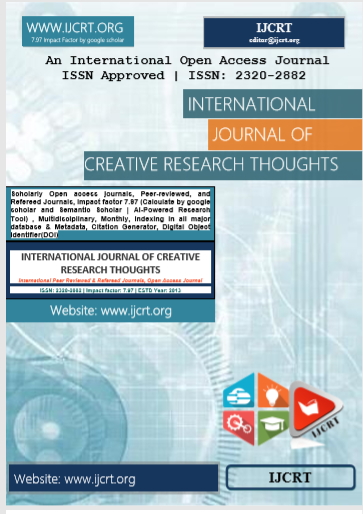
| IJCRT Journal front page | IJCRT Journal Back Page |
Paper Title: Enhancing Student Engagement through Adaptive Learning Technologies in Higher Education
Author Name(s): Dr Neeraj, Dr. Akhileshwar Rai, Dr. Nisha Jindal, Dr. Kajal Devi Manhas, Dr. Sapna Kashyap
Published Paper ID: - IJCRT2603249
Register Paper ID - 302832
Publisher Journal Name: IJPUBLICATION, IJCRT
DOI Member ID: 10.6084/m9.doi.one.IJCRT2603249 and DOI : https://doi.org/10.56975/ijcrt.v14i3.302832
Author Country : Indian Author, India, - , -, - , | Research Area: Science and Technology Published Paper URL: http://ijcrt.org/viewfull.php?&p_id=IJCRT2603249 Published Paper PDF: download.php?file=IJCRT2603249 Published Paper PDF: http://www.ijcrt.org/papers/IJCRT2603249.pdf
Your Paper Publication Details:
Title: ENHANCING STUDENT ENGAGEMENT THROUGH ADAPTIVE LEARNING TECHNOLOGIES IN HIGHER EDUCATION
DOI (Digital Object Identifier) : https://doi.org/10.56975/ijcrt.v14i3.302832
Pubished in Volume: 14 | Issue: 3 | Year: March 2026
Publisher Name : IJCRT | www.ijcrt.org | ISSN : 2320-2882
Subject Area: Science and Technology
Author type: Indian Author
Pubished in Volume: 14
Issue: 3
Pages: c68-c80
Year: March 2026
Downloads: 62
E-ISSN Number: 2320-2882
Abstract
This academic article examines how adaptive technologies improve learner engagement in higher education by personalising learning, providing immediate feedback, and using mastery-based pathways. A scoping review of 69 studies found that 59% reported better academic performance and 36% reported increased engagement. Key mechanisms such as gamification and personalisation are used in programs like Connect LearnSmart, which can raise grades by 25%. Despite these promising results, challenges like technological barriers, costs, digital divide and equity gaps, data privacy concerns, and faculty resistance persist. The paper stresses that hybrid models combining adaptive digital preparation with synchronous instruction, along with faculty training, equity assessments, and ethical governance, are essential for scalable, inclusive adoption. Future directions include innovations such as generative AI tutors, immersive VR/AR simulations, affective computing, and long-term research to verify sustained benefits and equity outcomes. Overall, adaptive learning technologies are shifting education from traditional lectures to a more student-centred approach, with great potential to enhance behavioural, emotional, and cognitive engagement when implemented thoughtfully and ethically. When used carefully, they can increase students' participation, interest, and deeper understanding of the learning process.
Licence: creative commons attribution 4.0
License
Creative Commons Attribution 4.0 and The Open Definition

Keywords
Adaptive learning, student engagement, Higher education, AI personalisation, personalised pathways, learning analytics, educational technology, retention rates.
License
Creative Commons Attribution 4.0 and The Open Definition
Paper Title: A REVIEW ON ARCHITECTURE IN TRANSITION
Author Name(s): Y.Jayadeep, N.Chandra Vidya, M.Srinivas, G.Jagadeeswar rao, M. Giri
Published Paper ID: - IJCRT2603248
Register Paper ID - 302770
Publisher Journal Name: IJPUBLICATION, IJCRT
DOI Member ID: 10.6084/m9.doi.one.IJCRT2603248 and DOI :
Author Country : Indian Author, India, - , -, - , | Research Area: Science and Technology Published Paper URL: http://ijcrt.org/viewfull.php?&p_id=IJCRT2603248 Published Paper PDF: download.php?file=IJCRT2603248 Published Paper PDF: http://www.ijcrt.org/papers/IJCRT2603248.pdf
Your Paper Publication Details:
Title: A REVIEW ON ARCHITECTURE IN TRANSITION
DOI (Digital Object Identifier) :
Pubished in Volume: 14 | Issue: 3 | Year: March 2026
Publisher Name : IJCRT | www.ijcrt.org | ISSN : 2320-2882
Subject Area: Science and Technology
Author type: Indian Author
Pubished in Volume: 14
Issue: 3
Pages: c64-c67
Year: March 2026
Downloads: 45
E-ISSN Number: 2320-2882
Abstract
Architecture has evolved significantly in response to cultural, environmental, and technological changes. This research examines architectural transition focusing on history, sustainability, and digital innovation in the built environment. Traditional architecture emphasized cultural identity and craftsmanship, while modern architecture focuses on functionality and efficiency. Sustainable architecture reduces environmental impact through energy-efficient designs and eco-friendly materials. Digital technologies such as Building Information Modeling and computer-aided design improve architectural accuracy and performance. The study uses literature review and comparative analysis. Results show that integration of sustainability and digital innovation improves building efficiency and environmental performance. Future architecture will depend on the integration of historical knowledge, sustainable practices, and digital innovation.
Licence: creative commons attribution 4.0
License
Creative Commons Attribution 4.0 and The Open Definition
Keywords
Architecture evolution, Sustainable architecture, Digital architecture, Built environment, Smart buildings, Green buildings, BIM, Digital innovation
License
Creative Commons Attribution 4.0 and The Open Definition
Paper Title: A modular multi-omics machine learning framework for robust triple-negative breast cancer classification under partial data availability.
Author Name(s): Kavya Gopal Bhat, Kesiya joy
Published Paper ID: - IJCRT2603247
Register Paper ID - 302732
Publisher Journal Name: IJPUBLICATION, IJCRT
DOI Member ID: 10.6084/m9.doi.one.IJCRT2603247 and DOI :
Author Country : Indian Author, India, 560026 , Bengaluru, 560026 , | Research Area: Life Sciences All Published Paper URL: http://ijcrt.org/viewfull.php?&p_id=IJCRT2603247 Published Paper PDF: download.php?file=IJCRT2603247 Published Paper PDF: http://www.ijcrt.org/papers/IJCRT2603247.pdf
Your Paper Publication Details:
Title: A MODULAR MULTI-OMICS MACHINE LEARNING FRAMEWORK FOR ROBUST TRIPLE-NEGATIVE BREAST CANCER CLASSIFICATION UNDER PARTIAL DATA AVAILABILITY.
DOI (Digital Object Identifier) :
Pubished in Volume: 14 | Issue: 3 | Year: March 2026
Publisher Name : IJCRT | www.ijcrt.org | ISSN : 2320-2882
Subject Area: Life Sciences All
Author type: Indian Author
Pubished in Volume: 14
Issue: 3
Pages: c52-c63
Year: March 2026
Downloads: 48
E-ISSN Number: 2320-2882
Abstract
Triple-negative breast cancer (TNBC) is an aggressive subtype lacking established therapeutic targets, making an accurate molecular classification a key research interest. Although computational methods of classification using molecular data are increasingly adopted, limited multi-omics availability remains a major analytical challenge. This study aims for a flexible machine-learning framework to classify TNBC using genomic, transcriptomic, and multi-omics data, enabling independent analysis of incomplete data. Public TCGA-BRCA resources were utilized, including genomic, transcriptomic, and clinical metadata for TNBC status annotation and model development. Individual genomic and transcriptomic data were independently processed and subsequently integrated using matched sample identifiers. ML models were trained on genomic, transcriptomic, and integrated datasets using consistent train-test splits. Logistic regression (LR), random forest (RF), support vector machine (SVM), and XGBoost were evaluated using ROC-AUC, recall, F1-score, accuracy, and runtime, with recall emphasized to improve TNBC detection sensitivity in this imbalanced dataset. Multi-omics integration provided the most desirable discriminative ability, the ROC-AUC of which was 0.95. In all modalities of data, the logistic regression provided the most reliable balance between TNBC recall, discrimination, computational efficiency, and model stability. Optimization of the probability decision threshold further improved TNBC sensitivity with insignificant effects on overall classification. This study indicates that the TNBC classification may be effectively aided by machine-learning models capable of operating under partial or complete multi-omics availability. The framework was deployed through a Streamlit-based web application for demonstrating research purposes. Overall, this study introduces scalable and interpretable TNBC classification and strong translational relevance using multi-omics machine learning.
Licence: creative commons attribution 4.0
License
Creative Commons Attribution 4.0 and The Open Definition
Keywords
triple-negative breast cancer, multi-omics, machine learning, genomics, transcriptomics.
License
Creative Commons Attribution 4.0 and The Open Definition
Paper Title: Electoral Reforms and Their Impact on Indian Democracy
Author Name(s): Dr.N.Uma Devi
Published Paper ID: - IJCRT2603246
Register Paper ID - 301619
Publisher Journal Name: IJPUBLICATION, IJCRT
DOI Member ID: 10.6084/m9.doi.one.IJCRT2603246 and DOI :
Author Country : Indian Author, India, 517001 , Chittoor, 517001 , | Research Area: Arts1 All Published Paper URL: http://ijcrt.org/viewfull.php?&p_id=IJCRT2603246 Published Paper PDF: download.php?file=IJCRT2603246 Published Paper PDF: http://www.ijcrt.org/papers/IJCRT2603246.pdf
Your Paper Publication Details:
Title: ELECTORAL REFORMS AND THEIR IMPACT ON INDIAN DEMOCRACY
DOI (Digital Object Identifier) :
Pubished in Volume: 14 | Issue: 3 | Year: March 2026
Publisher Name : IJCRT | www.ijcrt.org | ISSN : 2320-2882
Subject Area: Arts1 All
Author type: Indian Author
Pubished in Volume: 14
Issue: 3
Pages: c49-c51
Year: March 2026
Downloads: 52
E-ISSN Number: 2320-2882
Abstract
India, the world's largest democracy, functions through a well-established electoral system that ensures representation of the people. Free and fair elections are the foundation of democratic governance. However, challenges such as criminalization of politics, the influence of money power, voter apathy, and misuse of media have affected the quality of elections. Electoral reforms have been introduced from time to time to strengthen democratic values, improve transparency, and ensure accountability in the electoral process. This paper examines the concept of electoral reforms, major reforms introduced in India, and their impact on strengthening Indian democracy. The study is based on secondary sources such as books, journals, constitutional provisions, and reports of the Election Commission of India.
Licence: creative commons attribution 4.0
License
Creative Commons Attribution 4.0 and The Open Definition
Keywords
Electoral Reforms, Democracy, Indian Constitution, Governance, Elections
License
Creative Commons Attribution 4.0 and The Open Definition
Paper Title: "Multimodal Transformer-Based Fake News Detection: A Comprehensive Survey, Taxonomy, and Future Research"
Author Name(s): Samiksha Nager, Himanshu Yadav, Ajit Shrivastva
Published Paper ID: - IJCRT2603245
Register Paper ID - 302393
Publisher Journal Name: IJPUBLICATION, IJCRT
DOI Member ID: 10.6084/m9.doi.one.IJCRT2603245 and DOI :
Author Country : Indian Author, India, 462044 , Bhopal, 462044 , | Research Area: Science and Technology Published Paper URL: http://ijcrt.org/viewfull.php?&p_id=IJCRT2603245 Published Paper PDF: download.php?file=IJCRT2603245 Published Paper PDF: http://www.ijcrt.org/papers/IJCRT2603245.pdf
Your Paper Publication Details:
Title: "MULTIMODAL TRANSFORMER-BASED FAKE NEWS DETECTION: A COMPREHENSIVE SURVEY, TAXONOMY, AND FUTURE RESEARCH"
DOI (Digital Object Identifier) :
Pubished in Volume: 14 | Issue: 3 | Year: March 2026
Publisher Name : IJCRT | www.ijcrt.org | ISSN : 2320-2882
Subject Area: Science and Technology
Author type: Indian Author
Pubished in Volume: 14
Issue: 3
Pages: c34-c48
Year: March 2026
Downloads: 46
E-ISSN Number: 2320-2882
Abstract
The proliferation of misinformation across social media platforms has necessitated the development of advanced automated detection systems capable of handling multimodal content. While early fake news detection approaches relied on handcrafted linguistic features and unimodal deep learning models, recent research has shifted toward multimodal transformer-based architectures that enable joint reasoning over textual and visual information. This survey provides a comprehensive review of fake news detection methods, with a particular emphasis on multimodal transformer frameworks developed recently. We present a structured taxonomy that categorizes detection approaches into traditional machine learning, deep neural text models, CNN-based multimodal systems, unimodal transformers, and state-of-the-art multimodal transformer architectures. The survey further examines the transition from binary classification to fine-grained misinformation detection, highlighting the importance of cross-modal alignment and semantic consistency modelling. Comparative analysis demonstrates that multimodal transformers consistently outperform earlier paradigms due to their cross-modal attention mechanisms and shared representation learning capabilities. In addition, we identify key research challenges, including dataset bias, annotation subjectivity, adversarial robustness, computational scalability, and explainability. Emerging directions such as multimodal large language models, causal reasoning frameworks, graph-enhanced architectures, and lightweight deployment strategies are discussed to outline future research opportunities. This survey synthesizes recent advances and provides a unified analytical framework and research roadmap for advancing multimodal transformer-based fake news detection toward robust, interpretable, and real-world deployment-ready systems.
Licence: creative commons attribution 4.0
License
Creative Commons Attribution 4.0 and The Open Definition
Keywords
Multimodal Fake News Detection, Multimodal Transformers, Fine-Grained Classification, Vision-Language Models, Misinformation Analysis.
License
Creative Commons Attribution 4.0 and The Open Definition
Paper Title: Role of Neuroimaging in Understanding Schizophrenia
Author Name(s): AKRITI SINGH
Published Paper ID: - IJCRT2603244
Register Paper ID - 302763
Publisher Journal Name: IJPUBLICATION, IJCRT
DOI Member ID: 10.6084/m9.doi.one.IJCRT2603244 and DOI : https://doi.org/10.56975/ijcrt.v14i3.302763
Author Country : Indian Author, India, 226028 , Lucknow, 226028 , | Research Area: Medical Science All Published Paper URL: http://ijcrt.org/viewfull.php?&p_id=IJCRT2603244 Published Paper PDF: download.php?file=IJCRT2603244 Published Paper PDF: http://www.ijcrt.org/papers/IJCRT2603244.pdf
Your Paper Publication Details:
Title: ROLE OF NEUROIMAGING IN UNDERSTANDING SCHIZOPHRENIA
DOI (Digital Object Identifier) : https://doi.org/10.56975/ijcrt.v14i3.302763
Pubished in Volume: 14 | Issue: 3 | Year: March 2026
Publisher Name : IJCRT | www.ijcrt.org | ISSN : 2320-2882
Subject Area: Medical Science All
Author type: Indian Author
Pubished in Volume: 14
Issue: 3
Pages: c23-c33
Year: March 2026
Downloads: 65
E-ISSN Number: 2320-2882
Abstract
Schizophrenia is a severe psychiatric disorder characterized by disturbances in perception, cognition, emotional regulation, and behaviour. Increasing scientific evidence suggests that structural and functional abnormalities in the brain play a crucial role in the development and manifestation of the disorder. The present study examines the role of neuroimaging techniques in understanding schizophrenia and explores the relationship between neuroimaging findings and clinical symptom severity. A quantitative, descriptive, and correlational research design was adopted. The study included 17 individuals diagnosed with schizophrenia, comprising 9 males and 8 females. Symptom severity was assessed using the Positive and Negative Syndrome Scale (PANSS), while neuroimaging data were obtained from clinical records including Magnetic Resonance Imaging (MRI), Computed Tomography (CT), Positron Emission Tomography (PET), and Functional Magnetic Resonance Imaging (fMRI). Descriptive statistics were used to summarize the distribution of symptom severity across positive, negative, and general psychopathology domains. The Mann-Whitney U test was applied to examine gender differences, and Spearman's rank correlation was used to analyze relationships among symptom variables. The findings indicated that both male and female patients demonstrated comparable levels of symptom severity. Although females showed slightly higher mean scores across PANSS domains, these differences were not statistically significant. Correlation analysis revealed strong relationships among symptom domains but no significant association between gender and neuroimaging outcomes. The study highlights the importance of integrating neuroimaging findings with standardized clinical assessments to improve understanding of schizophrenia. Neuroimaging provides valuable insights into the biological basis of the disorder and supports the development of more comprehensive diagnostic and treatment approaches.
Licence: creative commons attribution 4.0
License
Creative Commons Attribution 4.0 and The Open Definition
Keywords
Keywords: Schizophrenia, Neuroimaging, PANSS, MRI, CT Scan, PET Scan, fMRI, Symptom Severity, Mann-Whitney U Test, Spearman Correlation.
License
Creative Commons Attribution 4.0 and The Open Definition
Paper Title: REVISITING THE LIVES OF THE BALIK-LOOB: TRANSFORMED UNDER THE ENHANCED COMPREHENSIVE LOCAL INTEGRATION PROGRAM (E-CLIP)
Author Name(s): CRISANTO MUNAR SAIT
Published Paper ID: - IJCRT2603243
Register Paper ID - 302522
Publisher Journal Name: IJPUBLICATION, IJCRT
DOI Member ID: 10.6084/m9.doi.one.IJCRT2603243 and DOI :
Author Country : Foreign Author, Phillipines, 3515 , Aparri, 3515 , | Research Area: Social Science All Published Paper URL: http://ijcrt.org/viewfull.php?&p_id=IJCRT2603243 Published Paper PDF: download.php?file=IJCRT2603243 Published Paper PDF: http://www.ijcrt.org/papers/IJCRT2603243.pdf
Your Paper Publication Details:
Title: REVISITING THE LIVES OF THE BALIK-LOOB: TRANSFORMED UNDER THE ENHANCED COMPREHENSIVE LOCAL INTEGRATION PROGRAM (E-CLIP)
DOI (Digital Object Identifier) :
Pubished in Volume: 14 | Issue: 3 | Year: March 2026
Publisher Name : IJCRT | www.ijcrt.org | ISSN : 2320-2882
Subject Area: Social Science All
Author type: Foreign Author
Pubished in Volume: 14
Issue: 3
Pages: c18-c22
Year: March 2026
Downloads: 50
E-ISSN Number: 2320-2882
Abstract
This study examined the reintegration experiences of former members of the Communist Party of the Philippines-New People's Army (CPP-NPA) who availed themselves of the Philippine government's Enhanced Comprehensive Local Integration Program (E-CLIP) in the Province of Cagayan. The research aimed to determine the current state of life of Balik-Loob beneficiaries in terms of self-adjustment, community intervention, and government assistance. Using a qualitative case study design, data were collected through semi-structured interviews with twenty (20) identified Balik-Loob recipients. Thematic analysis was employed to interpret participants' lived experiences. Findings revealed significant life changes among participants following their surrender, primarily motivated by their desire to reunite with their families and pursue a peaceful life. Government assistance through E-CLIP provided financial support and livelihood opportunities that facilitated reintegration. Community acceptance also played an important role in their adjustment. The study concludes that E-CLIP has contributed positively to the reintegration of former rebels in Cagayan, although sustained institutional and community support remains essential to ensure long-term stability.
Licence: creative commons attribution 4.0
License
Creative Commons Attribution 4.0 and The Open Definition
Keywords
Balik-Loob, E-CLIP, reintegration, former rebels, CPP-NPA
License
Creative Commons Attribution 4.0 and The Open Definition
Paper Title: Marital adjustment and positive life orientation among couples having one child and couple having no child
Author Name(s): Ishwani Srivastava
Published Paper ID: - IJCRT2603242
Register Paper ID - 302786
Publisher Journal Name: IJPUBLICATION, IJCRT
DOI Member ID: 10.6084/m9.doi.one.IJCRT2603242 and DOI : https://doi.org/10.56975/ijcrt.v14i3.302786
Author Country : Indian Author, India, 226010 , Lucknow, 226010 , | Research Area: Others area Published Paper URL: http://ijcrt.org/viewfull.php?&p_id=IJCRT2603242 Published Paper PDF: download.php?file=IJCRT2603242 Published Paper PDF: http://www.ijcrt.org/papers/IJCRT2603242.pdf
Your Paper Publication Details:
Title: MARITAL ADJUSTMENT AND POSITIVE LIFE ORIENTATION AMONG COUPLES HAVING ONE CHILD AND COUPLE HAVING NO CHILD
DOI (Digital Object Identifier) : https://doi.org/10.56975/ijcrt.v14i3.302786
Pubished in Volume: 14 | Issue: 3 | Year: March 2026
Publisher Name : IJCRT | www.ijcrt.org | ISSN : 2320-2882
Subject Area: Others area
Author type: Indian Author
Pubished in Volume: 14
Issue: 3
Pages: c1-c17
Year: March 2026
Downloads: 63
E-ISSN Number: 2320-2882
Abstract
The present study explore how opposite if life orientation characterised by optimism emotional positivity and supportive communication- marital adjustment among couple with different parental statuses. The research specification who have one child with couple who do not have children in order to understand whether the presence of a child influences are relationship between positively orientation and marital adjustment. Across sexual research design was used and participant completed standardised question Iyer measuring positively purientation and Marathi adjustment the result revealed that individuals who have demonstrated a stronger positively orientation tend to experience better adjustment regardless of whatever they have children. However couples with one child short slightly lower level of varietyl adjustment compared to couple without children, indicating that the responsibilities and pressure associated with parenting may introduce additional challenges into the miracle relationship . Despite these challenges , A positively orientation appears to play an important protective role by helping couples manage stress and maintain relationship satisfaction. Overall the finding suggest that encouraging optimism emotional support and constructive communication can strength miracle adjustment across different family statuses. The study also offers useful inside for miracle couple counselling and highlight area for further research in understanding me writer dynamics within an wearing family structure. The research explore how positively orientation a personality tendency reflex in optimism positive emotion and healthy interperson communications affects marital adjustment among couples with different parental situations. Across sectional research design was used and married participant completed question ire that measures their level of positively purientation and varietyl adjustment. The result show the clear positive relationship between positively purientation adjustment in both groups of couples . However, couples who had one child reportedly slightly lower level of merit adjustment compared to the Kapil without children. This suggest that the additional responsibilities and pressure associated with parenting may place strain on the miracle relationship. Despite these challenges positive liporentiation appears to function as protected factor that helps couples manage parenting related stress and maintain relationship satisfaction. The finding highlights the value of promoting positive emotion environmental effective communication within marriage. These result also provide useful inside counselling, family, focus intervention and future research on marital relationship and parenthood.
Licence: creative commons attribution 4.0
License
Creative Commons Attribution 4.0 and The Open Definition
Keywords
MARITAL ADJUSTMENT AND POSITIVE LIFE ORIENTATION MEASURING OPTIMISM EMOTIONAL POSITIVITY AND CONSTRUCTIVE COMMUNICATION AMONG COUPLES HAVING ONE CHILD AND COUPLES WITH NO CHILD
License
Creative Commons Attribution 4.0 and The Open Definition
Paper Title: IoT-Based Real-Time Microplastic Detection and Analysis System Using Deep Learning
Author Name(s): T.Vamsi, R.Pavan, V.Udhay, Dr K.S.Ramanujam, Mrs.M.Priyanga
Published Paper ID: - IJCRT2603241
Register Paper ID - 302785
Publisher Journal Name: IJPUBLICATION, IJCRT
DOI Member ID: 10.6084/m9.doi.one.IJCRT2603241 and DOI :
Author Country : Indian Author, India, 600095 , Chennai, 600095 , | Research Area: Science and Technology Published Paper URL: http://ijcrt.org/viewfull.php?&p_id=IJCRT2603241 Published Paper PDF: download.php?file=IJCRT2603241 Published Paper PDF: http://www.ijcrt.org/papers/IJCRT2603241.pdf
Your Paper Publication Details:
Title: IOT-BASED REAL-TIME MICROPLASTIC DETECTION AND ANALYSIS SYSTEM USING DEEP LEARNING
DOI (Digital Object Identifier) :
Pubished in Volume: 14 | Issue: 3 | Year: March 2026
Publisher Name : IJCRT | www.ijcrt.org | ISSN : 2320-2882
Subject Area: Science and Technology
Author type: Indian Author
Pubished in Volume: 14
Issue: 3
Pages: b974-b985
Year: March 2026
Downloads: 53
E-ISSN Number: 2320-2882
Abstract
Microplastic pollution has become a serious environmental issue affecting oceans, rivers, and drinking water. Detecting microplastics manually under a microscope is time-consuming, costly, and prone to human error. This paper presents a low-cost and automated microplastic detection system using an ESP32-CAM module and a Convolutional Neural Network (CNN) based deep learning model. The system captures images of water samples, processes them using image preprocessing techniques such as adaptive thresholding and morphological operations, and identifies microplastic particles automatically. In addition to detection, the system also counts the number of particles and estimates their size using pixel-to-millimeter calibration. A web-based dashboard is developed to display live streaming, detection results, confidence percentage, statistical graphs, and downloadable PDF reports. Experimental results show that the proposed system provides accurate detection with reduced processing time and lower cost compared to traditional laboratory methods. This solution can be used for real-time environmental monitoring and scalable water quality analysis.
Licence: creative commons attribution 4.0
License
Creative Commons Attribution 4.0 and The Open Definition
Keywords
Microplastic Detection, ESP32-CAM, Internet of Things (IoT), Convolutional Neural Network (CNN), Deep Learning, Image Processing, OpenCV, Particle Size Estimation, Environmental Monitoring, Real-Time Water Analysis, Computer Vision, Adaptive Thresholding.
License
Creative Commons Attribution 4.0 and The Open Definition
Paper Title: NAVIGATING SPACES AND HISTORIES: TRAVEL AS A CATALYST FOR IDENTITY IN THE MERMAID OF BLACK CONCH
Author Name(s): E M Sri Amirthavarshini, Dr.B.UmaaDevi
Published Paper ID: - IJCRT2603240
Register Paper ID - 302680
Publisher Journal Name: IJPUBLICATION, IJCRT
DOI Member ID: 10.6084/m9.doi.one.IJCRT2603240 and DOI :
Author Country : Indian Author, India, 638003 , Erode, 638003 , | Research Area: Medical Science All Published Paper URL: http://ijcrt.org/viewfull.php?&p_id=IJCRT2603240 Published Paper PDF: download.php?file=IJCRT2603240 Published Paper PDF: http://www.ijcrt.org/papers/IJCRT2603240.pdf
Your Paper Publication Details:
Title: NAVIGATING SPACES AND HISTORIES: TRAVEL AS A CATALYST FOR IDENTITY IN THE MERMAID OF BLACK CONCH
DOI (Digital Object Identifier) :
Pubished in Volume: 14 | Issue: 3 | Year: March 2026
Publisher Name : IJCRT | www.ijcrt.org | ISSN : 2320-2882
Subject Area: Medical Science All
Author type: Indian Author
Pubished in Volume: 14
Issue: 3
Pages: b969-b973
Year: March 2026
Downloads: 51
E-ISSN Number: 2320-2882
Abstract
Travel has long underpinned narratives of discovery, guiding characters through uncharted lands, cultures, and selves. In The Mermaid of Black Conch, travel transcends simple relocation, unfolding instead as a layered journey of cultural identity and collective memory. Set against the Caribbean's rich yet turbulent history, the novel traces Aycayia--a Taino woman cursed to live as a mermaid--whose return to human form ignites an intricate exploration of movement through time, space, and recollection. Drawing on travel theories from Mary Louise Pratt and James Clifford, this study positions the island of Black Conch as a "contact zone" where diverse histories, traditions, and identities converge. While echoes of magical realism infuse the story, the focus here is on travel as a catalyst for personal transformation and cultural exchange. Through the intertwined paths of Aycayia and David Baptiste, the narrative shows how encounters with the unfamiliar spark empathy, self-reflection, and a deeper historical consciousness. Ultimately, this analysis argues that contemporary Caribbean literature turns travel into a dynamic narrative device, linking individual quests with enduring questions of belonging, memory, and postcolonial identity.
Licence: creative commons attribution 4.0
License
Creative Commons Attribution 4.0 and The Open Definition
Keywords
Travel Literature; Cultural Identity and Mobility; Caribbean Literature; Character Transformation.
License
Creative Commons Attribution 4.0 and The Open Definition
Call For Paper April 2026
Call For Papers
April 2026
Volume 14 | Issue 4
Last Date :
30-Apr-2026
Submit Manuscript Online Impact Factor: 7.97 Review Results : Within 02-03 Days Paper Publication : Within 02-03 Days
April 2026
Volume 14 | Issue 4
Last Date :
30-Apr-2026
Submit Manuscript Online Impact Factor: 7.97 Review Results : Within 02-03 Days Paper Publication : Within 02-03 Days
Published Issue Details
For Authors
Forms / Downloads
Other IMP Links
Indexing Partner
Research Area
LICENSE





ISSN and 7.97 Impact Factor Details
ISSN: 2320-2882 Impact Factor: 7.97 and ISSN APPROVED Journal Starting Year (ESTD) : 2013


ISSN and 7.97 Impact Factor Details
ISSN: 2320-2882 Impact Factor: 7.97 and ISSN APPROVED Journal Starting Year (ESTD) : 2013
DOI Details
CONFERENCE
CONFERENCE MANAGMENT & PUBLICATION CONFERENCE PROPOSAL
RECENT CONFERENCE

CONFERENCE PROPOSAL CONFERENCE PROCEEDINGS
CONFERENCE PROPOSAL CONFERENCE PROCEEDINGS
For Reviewer /Referral (RMS) Earn 500 per paper
Important Links
NEWS & Conference
Digital Library
IJCRT RMS | Earn 500 Per Paper.

Open Access


LICENSE
Indexing Partner
Scholarly open access journals, Peer-reviewed, and Refereed Journals, Impact factor 7.97 (Calculate by google scholar and Semantic Scholar | AI-Powered Research Tool) , Multidisciplinary, Monthly, Indexing in all major database & Metadata, Citation Generator, Digital Object Identifier(DOI)