Important Details
IJCRT - International Peer Reviewed, Open Access Journal, Multidisciplinary, Monthly, Nominal(Low) Fees for Professional Research Services International Journal of Creative Research Thoughts - IJCRT Peer Review Journal, Refereed Journal, Peer Reviewed Journal , Referred Journal and Indexed Journal, Open access, Online and Print Journal,international Journal Open Access, Accepted by Indian and foreign university ,IJCRT Followed Norms, guidelines, requirement, listing criteria and methodology of score/point also applied from: Scopus , Web of Science , UGC Approved , UGC CARE, UGC-CARE .
UGC Approved Journal No: 49023 (18)
UGC approval Link
https://ijcrt.org/ugc%20approval.jpg
All Policy and Approval
Please Like Our Facebook Page | CrossRef DOI and Hard copy of Certificate Provide if required. | www.IJCRT.org | editor@IJCRT.org | IJCRT WhatsApp +91 94294 58311
Publication Details:
- Paper Submission : 31-Aug-2026. Call For Paper (Volume 14 | Issue 8 | Month- August 2026)
- Acceptance/Rejection Notification: Within 02-04 Days.
- Paper Publish: Within 02-04 Days after submitting all documents.
-
Submit Your Paper Any time There No deadline.
-
Publication fees : 1570 INR for Indian author & 59$ for foreign International author.
Please Like Our Facebook Page | CrossRef DOI and Hard copy of Certificate Provide if required.
Licence and Indexing
Indexing In Google Scholar, SSRN, ResearcherID-Publons, Semantic Scholar | AI-Powered Research Tool, Microsoft Academic, Academia.edu, arXiv.org, Research Gate, CiteSeerX, ResearcherID Thomson Reuters, Mendeley : reference manager, DocStoc, ISSUU, Scribd, and many more | High Impact Factor: 7.97 | Digital object identifier (DOI) and Hard Copy of certificate Provided.




























Licence
DOI
ISSN Approved impact factor: 7.97 
Creative Common 
Valid as per new UGC Gazette regulations 

INTERNATIONAL JOURNAL OF CREATIVE RESEARCH THOUGHTS - IJCRT (IJCRT.ORG)
International Peer Reviewed & Refereed Journals, Open Access Journal
IJCRT Peer-Reviewed (Refereed) Journal as Per New UGC Rules.
ISSN Approved Journal No: 2320-2882 | Impact factor: 7.97 | ESTD Year: 2013
Call For Paper - Volume 14 | Issue 8 | Month- August 2026
Scholarly open access journals, Peer-reviewed, and Refereed Journals, Impact factor 7.97 (Calculate by google scholar and Semantic Scholar | AI-Powered Research Tool) , Multidisciplinary, Monthly, Indexing in all major database & Metadata, Citation Generator, Digital Object Identifier(CrossRef DOI)
IJCRT WhatsApp Contact
IJCRT Search Xplore - Search all paper by Paper Name , Author Name, and Title
Volume 5 | Issue 4 |
Volume 5 | Issue 4 | Month
Downlaod After Publication 1) Table of content index in PDF
2) Table of content index in HTML 2)Table of content index in HTML
3) Front Page 3) Front Page
4) Back Page 4) Back Page
5) Editor Board Member 5)Editor Board Member
6) OLD Style Issue 6)OLD Style Issue
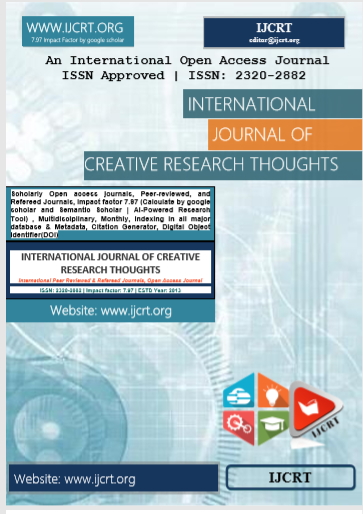 |
 |
|---|---|
| IJCRT Journal front page | IJCRT Journal Back Page |
Paper Title: Religious Minorities and Electoral Politics: Understanding Muslim Voting Behavior in India
Author Name(s): Dr. Md. Hasin Akhtar
Published Paper ID: - IJCRT1136061
Register Paper ID - 289718
Publisher Journal Name: IJPUBLICATION, IJCRT
DOI Member ID: 10.6084/m9.doi.one.IJCRT1136061 and DOI :
Author Country : Indian Author, India, - , -, - , | Research Area: Science and Technology Published Paper URL: http://ijcrt.org/viewfull.php?&p_id=IJCRT1136061 Published Paper PDF: download.php?file=IJCRT1136061 Published Paper PDF: http://www.ijcrt.org/papers/IJCRT1136061.pdf
Your Paper Publication Details:
Title: RELIGIOUS MINORITIES AND ELECTORAL POLITICS: UNDERSTANDING MUSLIM VOTING BEHAVIOR IN INDIA
DOI (Digital Object Identifier) :
Pubished in Volume: 5 | Issue: 4 | Year: November 2017
Publisher Name : IJCRT | www.ijcrt.org | ISSN : 2320-2882
Subject Area: Science and Technology
Author type: Indian Author
Pubished in Volume: 5
Issue: 4
Pages: 422-434
Year: November 2017
Downloads: 172
E-ISSN Number: 2320-2882
Abstract
The study examines Indian Muslims' election behaviour and focuses on the determination of their choices using historical, political, and socio-economic drivers. It reflects on how political involvement among Indian Muslims evolved along with its implication on identity politics. The study utilizes a mixed-method design to examine patterns of votes between 2004 and 2014 with a focus on a consistent preference for secular and opposition parties, such as the Indian National Congress (INC), and local parties, such as the Samajwadi Party (SP) and Trinamool Congress (TMC). While comprising a significant minority, Muslims are disproportionately represented in parliaments, with their political choices impacted by communal myths, socio-political issues, and policy considerations. The study finds that whereas socioeconomic conditions and geographic distinctions affect voting, religious identity concerns and inclusiveness matter most in informing political decisions. The Bharatiya Janata Party (BJP) continues to draw little support from Muslims because it is identified with majority politics. The findings emphasize the political relevance of Muslim votes and the impact this has on representative democracy. Policy suggestions involve increasing Muslim representation, strengthening anti-discrimination efforts, and promoting civic education to build political participation. Future research must examine the political conduct of young Muslim voters and the political impact of new media on their electoral choices.
Licence: creative commons attribution 4.0
License
Creative Commons Attribution 4.0 and The Open Definition

Keywords
Electoral Politics, Identity Politics, Muslim Voting, Political Representation, Voting Behavior.
License
Creative Commons Attribution 4.0 and The Open Definition
Paper Title: The Role of Environmental Awareness in Shaping Sustainable Urban Development: A Cross-Cultural Study
Author Name(s): Jyotsna Bora
Published Paper ID: - IJCRT1136060
Register Paper ID - 290154
Publisher Journal Name: IJPUBLICATION, IJCRT
DOI Member ID: 10.6084/m9.doi.one.IJCRT1136060 and DOI :
Author Country : Indian Author, India, - , -, - , | Research Area: Science and Technology Published Paper URL: http://ijcrt.org/viewfull.php?&p_id=IJCRT1136060 Published Paper PDF: download.php?file=IJCRT1136060 Published Paper PDF: http://www.ijcrt.org/papers/IJCRT1136060.pdf
Your Paper Publication Details:
Title: THE ROLE OF ENVIRONMENTAL AWARENESS IN SHAPING SUSTAINABLE URBAN DEVELOPMENT: A CROSS-CULTURAL STUDY
DOI (Digital Object Identifier) :
Pubished in Volume: 5 | Issue: 4 | Year: December 2017
Publisher Name : IJCRT | www.ijcrt.org | ISSN : 2320-2882
Subject Area: Science and Technology
Author type: Indian Author
Pubished in Volume: 5
Issue: 4
Pages: 409-421
Year: December 2017
Downloads: 184
E-ISSN Number: 2320-2882
Abstract
Environmental awareness is a foundational pillar for achieving sustainable urban development, especially in the face of rapid urbanization and cultural diversity. This study explores how environmental consciousness, shaped by cultural values, education, and public participation, influences urban sustainability across global contexts. It emphasizes that localized knowledge, media influence, and civic engagement are instrumental in fostering eco-friendly practices such as waste management, green infrastructure, and low-carbon transport. Through a comparative lens, the research highlights how Western, Eastern, Indigenous, and African environmental values guide urban planning differently, underscoring the need for culturally sensitive approaches. Public awareness is shown to be a catalyst in shaping green policies, driving behavioural change, promoting green entrepreneurship, and encouraging public-private partnerships. Education and media emerge as vital tools in embedding environmental values from a young age and disseminating information widely. Community involvement further amplifies the impact of sustainability initiatives through inclusive planning and localized actions. Government and NGO-led programs, including Smart Cities Mission and grassroots waste management efforts, are evaluated for their effectiveness in creating environmentally conscious urban spaces. Case studies such as the Auroville Foundation case and Noida Twin Towers demolition illustrate the legal reinforcement of sustainable development principles. However, the study also acknowledges challenges in bridging cultural gaps, such as differing worldviews, communication barriers, and socio-economic disparities. Ultimately, it advocates for an integrative, culturally adaptive framework that prioritizes environmental awareness as the bridge between policy intent and practical urban transformation, ensuring resilient, equitable, and ecologically sound cities for future generations.
Licence: creative commons attribution 4.0
License
Creative Commons Attribution 4.0 and The Open Definition
Keywords
Environmental awareness, sustainable urban development, cross-cultural perspectives, public participation, eco-friendly policies, education, media, green infrastructure, cultural adaptation, urban planning.
License
Creative Commons Attribution 4.0 and The Open Definition
Paper Title: The Impact of Digital Literacy on Learning Outcomes among Secondary School Students in Jorhat District, Assam
Author Name(s): Alaka Gogoi, Ritamoni Borah
Published Paper ID: - IJCRT1136059
Register Paper ID - 290169
Publisher Journal Name: IJPUBLICATION, IJCRT
DOI Member ID: 10.6084/m9.doi.one.IJCRT1136059 and DOI :
Author Country : Indian Author, India, - , -, - , | Research Area: Science and Technology Published Paper URL: http://ijcrt.org/viewfull.php?&p_id=IJCRT1136059 Published Paper PDF: download.php?file=IJCRT1136059 Published Paper PDF: http://www.ijcrt.org/papers/IJCRT1136059.pdf
Your Paper Publication Details:
Title: THE IMPACT OF DIGITAL LITERACY ON LEARNING OUTCOMES AMONG SECONDARY SCHOOL STUDENTS IN JORHAT DISTRICT, ASSAM
DOI (Digital Object Identifier) :
Pubished in Volume: 5 | Issue: 4 | Year: December 2017
Publisher Name : IJCRT | www.ijcrt.org | ISSN : 2320-2882
Subject Area: Science and Technology
Author type: Indian Author
Pubished in Volume: 5
Issue: 4
Pages: 390-408
Year: December 2017
Downloads: 207
E-ISSN Number: 2320-2882
Abstract
This study examines the relationship between digital literacy and academic achievement among secondary school students in the Jorhat region of Assam. Digital literacy, which extends beyond basic computer abilities in a culture that is becoming more and more digitalized, includes the capacity to evaluate, create, and distribute information across a range of digital platforms. The rapid shift to online education brought about by the COVID-19 epidemic has brought attention to both the advantages and disadvantages of digital education, particularly in places like Jorhat where significant infrastructural, device accessibility, and teacher preparedness shortages still exist. To ensure equitable representation of both genders, private and public schools, and urban and rural locations, 100 secondary students were selected by stratified random sampling for this study, which employed a descriptive survey approach. The data was gathered using a standardized Digital Literacy Scale (DLS), and the findings were analyzed using Pearson's correlation coefficient, independent t-tests, and descriptive statistics using SPSS software. The results, which revealed minimal differences in digital literacy levels across school types, gender, and location--with rural students marginally outperforming their urban counterparts--challenged conventional wisdom on internet availability and proficiency. These findings highlight the critical need for inclusive digital education policies that promote equitable access to technology, enhance teacher preparation, and address infrastructural deficiencies. Such measures are necessary to improve academic performance and provide students with the abilities they need to thrive in a global, digitally driven world.
Licence: creative commons attribution 4.0
License
Creative Commons Attribution 4.0 and The Open Definition
Keywords
Digital Access, ICT in Education, Secondary School Students, Digital Competency, and Educational Outcomes.
License
Creative Commons Attribution 4.0 and The Open Definition
Paper Title: Issues and concerns of choice based credit system (CBCS): an analytical study
Author Name(s): Buddhadev Basumatary
Published Paper ID: - IJCRT1136058
Register Paper ID - 290106
Publisher Journal Name: IJPUBLICATION, IJCRT
DOI Member ID: 10.6084/m9.doi.one.IJCRT1136058 and DOI :
Author Country : Indian Author, India, - , -, - , | Research Area: Science and Technology Published Paper URL: http://ijcrt.org/viewfull.php?&p_id=IJCRT1136058 Published Paper PDF: download.php?file=IJCRT1136058 Published Paper PDF: http://www.ijcrt.org/papers/IJCRT1136058.pdf
Your Paper Publication Details:
Title: ISSUES AND CONCERNS OF CHOICE BASED CREDIT SYSTEM (CBCS): AN ANALYTICAL STUDY
DOI (Digital Object Identifier) :
Pubished in Volume: 5 | Issue: 4 | Year: December 2017
Publisher Name : IJCRT | www.ijcrt.org | ISSN : 2320-2882
Subject Area: Science and Technology
Author type: Indian Author
Pubished in Volume: 5
Issue: 4
Pages: 385-389
Year: December 2017
Downloads: 169
E-ISSN Number: 2320-2882
Abstract
Over the last decades systematic Academic and administrative Reforms had been initiated in Higher Education. Following the Gnanam Committee recommendation, Conventional annual system has been replaced with Semester system. Further semester system has been reconfigured with choice based credit system. The University Grants Commission has announced that from 2015, all the Universities and Higher Education Institutions will have followed the Choice Based Credit System. The imperatives behind the initiatives are to cope with the 21" Century changing Knowledge landscape and to set at par with global standard. Many empirical studies show that even after graduation there is skill gap particularly Communication skill resulting many youthunemployable. Further syllabus of Higher Education was not up-to-date. There was not scope of flexibility in choice of courses and no scope of student mobility. Evaluation system was not continuous and comprehensive. Skill Component courses are minimal in the existing course curriculum. Against this backdrop CBCS system has been introduced with noble focus on learner-centric method, interdisciplinary approach, emphasis on skill based courses, flexibility of courses and student mobility:.This paper is an attempt to study issues and challenges that confront in practical implementation of CBCS.
Licence: creative commons attribution 4.0
License
Creative Commons Attribution 4.0 and The Open Definition
Keywords
learner-centric approach, interdisciplinary approach Choice Based Credit System.
License
Creative Commons Attribution 4.0 and The Open Definition
Paper Title: EMPOWERING RAILWAY HAWKERS: RECOGNIZING THEIR CONTRIBUTION AND ENHANCING THEIR WORKING CONDITIONS- A STUDY IN THE ROUTE OF NEW COOCHBEHAR TO NEW JALPAIGURI AND DHUBRI
Author Name(s): Hasib Md Iqbal, Diganta Biswas
Published Paper ID: - IJCRT1136049
Register Paper ID - 289722
Publisher Journal Name: IJPUBLICATION, IJCRT
DOI Member ID: 10.6084/m9.doi.one.IJCRT1136049 and DOI :
Author Country : Indian Author, India, - , -, - , | Research Area: Science and Technology Published Paper URL: http://ijcrt.org/viewfull.php?&p_id=IJCRT1136049 Published Paper PDF: download.php?file=IJCRT1136049 Published Paper PDF: http://www.ijcrt.org/papers/IJCRT1136049.pdf
Your Paper Publication Details:
Title: EMPOWERING RAILWAY HAWKERS: RECOGNIZING THEIR CONTRIBUTION AND ENHANCING THEIR WORKING CONDITIONS- A STUDY IN THE ROUTE OF NEW COOCHBEHAR TO NEW JALPAIGURI AND DHUBRI
DOI (Digital Object Identifier) :
Pubished in Volume: 5 | Issue: 4 | Year: November 2017
Publisher Name : IJCRT | www.ijcrt.org | ISSN : 2320-2882
Subject Area: Science and Technology
Author type: Indian Author
Pubished in Volume: 5
Issue: 4
Pages: 334-341
Year: November 2017
Downloads: 183
E-ISSN Number: 2320-2882
Abstract
Hawkers operates their business in informal sector in developing countries and are ignored in terms of planning and implementation of policies. Through empirical observation the sector contributions toward employment and generation of income have showed great concern. The several reviewed studies were done mostly in looking for the challenges facing by the hawkers. The study has revealed that, the central government and local government have not played their role to develop hawkers and contribute to economic development. The Paper tries to cover randomly on the route of New Coochbehar to New Jalpaiguri and Dhubri to New Jalpaiguri for the purpose of this study.In most of the cases, the temporary jobs are of low income and the job security is pitiable (Alivelu, 2008). Hawking is covering a big portion of the informal sector of Indian economy (Bhowmik, 2009). An enormous number of people undeterred by unemployment have chosen this profession who sell out all possible items on footpath, roads, bus stands even to passengers on trains and at stations.The New Jalpaiguri-New Coochbehar and New Jalpaiguri -Dhubri railway lines are connecting the railway station of Assam and rest of the North East. NJP and NCB is busiest route under Alipurduar Division. Many people of the adjacent to Railway station of these two railway route directly or indirectly maintain their livelihoods by working as a hawker in the train or opening different types of stall in the different railway station. This paper explores the realities of train hawking and the difficulties of train hawkers. This paper try to looks at the dynamics of their business and highlights their daily struggle from different angle and their survival with the situation.
Licence: creative commons attribution 4.0
License
Creative Commons Attribution 4.0 and The Open Definition
Keywords
Hawkers,Train, Passengers, Business,Station,Platform.
License
Creative Commons Attribution 4.0 and The Open Definition
Paper Title: Adoption of Organic Farming in Karnataka: Economic Feasibility and Market Linkages
Author Name(s): Suresh C
Published Paper ID: - IJCRT1136029
Register Paper ID - 287082
Publisher Journal Name: IJPUBLICATION, IJCRT
DOI Member ID: 10.6084/m9.doi.one.IJCRT1136029 and DOI :
Author Country : Indian Author, India, 572104 , Tumkur, 572104 , | Research Area: Arts All Published Paper URL: http://ijcrt.org/viewfull.php?&p_id=IJCRT1136029 Published Paper PDF: download.php?file=IJCRT1136029 Published Paper PDF: http://www.ijcrt.org/papers/IJCRT1136029.pdf
Your Paper Publication Details:
Title: ADOPTION OF ORGANIC FARMING IN KARNATAKA: ECONOMIC FEASIBILITY AND MARKET LINKAGES
DOI (Digital Object Identifier) :
Pubished in Volume: 5 | Issue: 4 | Year: December 2017
Publisher Name : IJCRT | www.ijcrt.org | ISSN : 2320-2882
Subject Area: Arts All
Author type: Indian Author
Pubished in Volume: 5
Issue: 4
Pages: 193-197
Year: December 2017
Downloads: 212
E-ISSN Number: 2320-2882
Abstract
The shift from conventional to organic farming has gained substantial momentum in recent years, both globally and in India. This transition is driven by an increasing awareness of environmental degradation, health concerns associated with chemical-laden produce, and the growing consumer demand for sustainable, organic products. Karnataka, a state characterized by diverse agro-climatic zones and a history of progressive agricultural policies, is emerging as a significant hub for organic agriculture in India. Small and marginal farmers across the state are increasingly turning to organic farming as a means to improve long-term soil health, reduce input costs, and tap into premium markets. This paper investigates the economic feasibility of adopting organic farming in Karnataka and explores the market linkages that facilitate or hinder the success of these farmers. Drawing from a comprehensive review of literature, policy analysis, case studies from multiple districts, and stakeholder interviews, the study evaluates critical factors such as input costs, yield trends, subsidy mechanisms, certification processes, and access to domestic and international markets. Findings reveal that, while organic farming is environmentally beneficial and potentially profitable, significant barriers remain. These include high transition costs, a lack of streamlined certification systems, inadequate marketing infrastructure, and limited farmer awareness. The paper concludes by offering strategic recommendations to strengthen institutional frameworks, reduce certification burdens, enhance market connectivity, and improve farmer education for a more inclusive and viable organic farming ecosystem in Karnataka.
Licence: creative commons attribution 4.0
License
Creative Commons Attribution 4.0 and The Open Definition
Keywords
Organic farming, Karnataka agriculture, economic feasibility, sustainable farming, market linkages, organic certification, smallholder farmers, traditional agriculture, eco-friendly farming, farm income diversification.
License
Creative Commons Attribution 4.0 and The Open Definition
Paper Title: Strength Test of Concrete Blocks Made with Recycled Plastic Waste
Author Name(s): Kum. Divya Mohanbhai Patel
Published Paper ID: - IJCRT1136023
Register Paper ID - 286197
Publisher Journal Name: IJPUBLICATION, IJCRT
DOI Member ID: 10.6084/m9.doi.one.IJCRT1136023 and DOI :
Author Country : Indian Author, India, - , -, - , | Research Area: Science and Technology Published Paper URL: http://ijcrt.org/viewfull.php?&p_id=IJCRT1136023 Published Paper PDF: download.php?file=IJCRT1136023 Published Paper PDF: http://www.ijcrt.org/papers/IJCRT1136023.pdf
Your Paper Publication Details:
Title: STRENGTH TEST OF CONCRETE BLOCKS MADE WITH RECYCLED PLASTIC WASTE
DOI (Digital Object Identifier) :
Pubished in Volume: 5 | Issue: 4 | Year: November 2017
Publisher Name : IJCRT | www.ijcrt.org | ISSN : 2320-2882
Subject Area: Science and Technology
Author type: Indian Author
Pubished in Volume: 5
Issue: 4
Pages: 146-155
Year: November 2017
Downloads: 189
E-ISSN Number: 2320-2882
Abstract
Millions of tons of non-biodegradable plastic waste are accumulated in landfill and ocean each year which causes one of the biggest sources of pollution globally. At the same time, the construction developers are under pressure to adopt sustainable materials. The survey will look at the feasibility of using recycled plastic waste material as a partial replacement for fine aggregates in concrete block production. This study uses polyethylene terephthalate (PET) as sand replacement in varying proportions (5%,10%,15%,20 %) for building Concrete blocks after they were tested for their strength. The results show that up to 10% replacing output comparable compressive strength to conventional concrete, but higher replacing degree reduces compressive strength due to poor interfacial soldering and increased void message The survey looked at loser mechanism, denseness variation, and mix behaviour. Microstructural analytic thinking shows that plastic atoms can reduce cleft extension. The potential welfare is offset by decreased coherence and rigidness when plastic message exceeds optimal threshold. The comprehension of recycled plastic helps address environmental concerns and contributes to lightweight building solutions. The determination supports the usage of recycled plastic as a viable constituent for non-loading-heading application and paves the manner for further inquiry into hybrid waste material integrating, long-condition lastingness appraisal and insurance policy evolution for sustainable building practice.
Licence: creative commons attribution 4.0
License
Creative Commons Attribution 4.0 and The Open Definition
Keywords
Recycled plastic waste, PET concrete, compressive strength, sustainable concrete, plastic aggregate, lightweight construction, eco-friendly building materials, concrete block testing, waste utilization, non-structural applications
License
Creative Commons Attribution 4.0 and The Open Definition
Paper Title: India's Balance of Payments - An Overview
Author Name(s): Krishne Gowda B S
Published Paper ID: - IJCRT1135972
Register Paper ID - 280092
Publisher Journal Name: IJPUBLICATION, IJCRT
DOI Member ID: 10.6084/m9.doi.one.IJCRT1135972 and DOI :
Author Country : Indian Author, India, - , -, - , | Research Area: Science and Technology Published Paper URL: http://ijcrt.org/viewfull.php?&p_id=IJCRT1135972 Published Paper PDF: download.php?file=IJCRT1135972 Published Paper PDF: http://www.ijcrt.org/papers/IJCRT1135972.pdf
Your Paper Publication Details:
Title: INDIA'S BALANCE OF PAYMENTS - AN OVERVIEW
DOI (Digital Object Identifier) :
Pubished in Volume: 5 | Issue: 4 | Year: December 2017
Publisher Name : IJCRT | www.ijcrt.org | ISSN : 2320-2882
Subject Area: Science and Technology
Author type: Indian Author
Pubished in Volume: 5
Issue: 4
Pages: 779-783
Year: December 2017
Downloads: 195
E-ISSN Number: 2320-2882
Abstract
The balance of payments is a comprehensive record of all economic transactions between a country and the rest of the world over a specific period. A trade surplus occurs when a country's exports exceed its imports. A trade deficit occurs when a country's imports exceed its exports. The balance of payments provide a more complete picture of a country's economic interactions with the rest of the world, encompassing not only trade in goods but also services, financial transactions, capital flows. This paper made an attempt to know the balance of payments in terms of trade balance, current account deficit, capital account surplus, invisible income and to identify the bilateral trade surplus and deficit countries. To know all these results the data have been collected from the various secondary sources like books, magazines and other concerned annual reports. The collected numerical data have been analyzed and presented in the tables.
Licence: creative commons attribution 4.0
License
Creative Commons Attribution 4.0 and The Open Definition
Keywords
Balance of trade, balance of payments, bilateral trade, India.
License
Creative Commons Attribution 4.0 and The Open Definition
Paper Title: Obligations: A Path Forward for Climate-Displaced Communities
Author Name(s): Mr. Prasanta Kumar Das
Published Paper ID: - IJCRT1135938
Register Paper ID - 278101
Publisher Journal Name: IJPUBLICATION, IJCRT
DOI Member ID: 10.6084/m9.doi.one.IJCRT1135938 and DOI :
Author Country : Indian Author, India, - , -, - , | Research Area: Science and Technology Published Paper URL: http://ijcrt.org/viewfull.php?&p_id=IJCRT1135938 Published Paper PDF: download.php?file=IJCRT1135938 Published Paper PDF: http://www.ijcrt.org/papers/IJCRT1135938.pdf
Your Paper Publication Details:
Title: OBLIGATIONS: A PATH FORWARD FOR CLIMATE-DISPLACED COMMUNITIES
DOI (Digital Object Identifier) :
Pubished in Volume: 5 | Issue: 4 | Year: October 2017
Publisher Name : IJCRT | www.ijcrt.org | ISSN : 2320-2882
Subject Area: Science and Technology
Author type: Indian Author
Pubished in Volume: 5
Issue: 4
Pages: 556-569
Year: October 2017
Downloads: 195
E-ISSN Number: 2320-2882
Abstract
Climate change has become one of the most significant forces shaping contemporary discussions on human rights, intersecting with environmental law, development studies, and ethical governance. While the 1951 Refugee Convention protects those fleeing persecution, it does not encompass individuals and communities forced from their homes by climate-induced disasters such as rising sea levels, prolonged droughts, and extreme weather events. These climate-displaced communities occupy a regulatory gray area, often unable to claim formal protection under traditional refugee or human rights frameworks. At the same time, environmental justice movements around the globe have called for equitable distribution of environmental benefits and burdens, emphasizing participation and redress for historically marginalized groups. This article argues that the future of human rights hinges on an integrated approach that recognizes environmental degradation and climate change not merely as ecological or economic problems but as fundamental human rights crises. Through an in-depth examination of philosophical underpinnings, the evolution of international and national human rights regimes, and the practical dilemmas of forced migration, this piece explores how to reconcile state sovereignty with transnational obligations. It examines the inadequacy of current legal instruments--focusing on how human rights treaties, climate accords, and domestic constitutions fail to protect climate refugees--and proposes pathways toward a rights-based climate displacement framework. Empirical examples highlight communities in low-lying island nations, flood-prone deltas, and drought-stricken rural regions. Policy recommendations urge binding treaties for corporate accountability, expanded refugee definitions or new environmental displacement protocols, and community-driven adaptation efforts ensuring that environmental solutions align with the principles of dignity, participation, and non-discrimination. Ultimately, bridging environmental justice and established human rights doctrines offers a moral, legal, and pragmatic route to uphold the dignity of climate-displaced populations while fostering sustainable development and global solidarity.
Licence: creative commons attribution 4.0
License
Creative Commons Attribution 4.0 and The Open Definition
Keywords
climate displacement, environmental justice, human rights, climate refugees, international law, sovereignty, corporate accountability, sustainable development.
License
Creative Commons Attribution 4.0 and The Open Definition
Paper Title: CYBER BULLYING DETECTION
Author Name(s): Mahendra R S, Zareena Taj, Mahesha L S
Published Paper ID: - IJCRT1135935
Register Paper ID - 277892
Publisher Journal Name: IJPUBLICATION, IJCRT
DOI Member ID: 10.6084/m9.doi.one.IJCRT1135935 and DOI : http://doi.one/10.1729/Journal.43787
Author Country : Indian Author, India, 573201 , Hassan, 573201 , | Research Area: Science and Technology Published Paper URL: http://ijcrt.org/viewfull.php?&p_id=IJCRT1135935 Published Paper PDF: download.php?file=IJCRT1135935 Published Paper PDF: http://www.ijcrt.org/papers/IJCRT1135935.pdf
Your Paper Publication Details:
Title: CYBER BULLYING DETECTION
DOI (Digital Object Identifier) : http://doi.one/10.1729/Journal.43787
Pubished in Volume: 5 | Issue: 4 | Year: October 2017
Publisher Name : IJCRT | www.ijcrt.org | ISSN : 2320-2882
Subject Area: Science and Technology
Author type: Indian Author
Pubished in Volume: 5
Issue: 4
Pages: 531-534
Year: October 2017
Downloads: 204
E-ISSN Number: 2320-2882
Abstract
Through social media, users may have access to a lot of information as well as a pleasant communication experience. Social media, on the other hand, can have negative implications, such as online bullying, which can have a negative impact on people's life, particularly children and teenagers. Cyberbullying is defined as an individual or a group of individuals engaging in aggressive, deliberate acts against a victim using digital communication channels such as sending texts and writing comments. Unlike traditional bullying, which occurs in a face-to-face interaction at school, online bullying on social media sites can occur anywhere at any time.
Licence: creative commons attribution 4.0
License
Creative Commons Attribution 4.0 and The Open Definition
Keywords
Cyber Crime, Cyber Bullying, Speech to Text,social media, OCR.
License
Creative Commons Attribution 4.0 and The Open Definition
Call For Paper August 2026
Call For Papers
August 2026
Volume 14 | Issue 8
Last Date :
31-Aug-2026
Submit Manuscript Online Impact Factor: 7.97 Review Results : Within 02-03 Days Paper Publication : Within 02-03 Days
August 2026
Volume 14 | Issue 8
Last Date :
31-Aug-2026
Submit Manuscript Online Impact Factor: 7.97 Review Results : Within 02-03 Days Paper Publication : Within 02-03 Days
Published Issue Details
For Authors
Forms / Downloads
Other IMP Links
Indexing Partner
Research Area
LICENSE





ISSN and 7.97 Impact Factor Details
ISSN: 2320-2882 Impact Factor: 7.97 and ISSN APPROVED Journal Starting Year (ESTD) : 2013


ISSN and 7.97 Impact Factor Details
ISSN: 2320-2882 Impact Factor: 7.97 and ISSN APPROVED Journal Starting Year (ESTD) : 2013
DOI Details
CONFERENCE
CONFERENCE MANAGMENT & PUBLICATION CONFERENCE PROPOSAL
RECENT CONFERENCE

CONFERENCE PROPOSAL CONFERENCE PROCEEDINGS
CONFERENCE PROPOSAL CONFERENCE PROCEEDINGS
For Reviewer /Referral (RMS) Earn 500 per paper
Important Links
NEWS & Conference
Digital Library
IJCRT RMS | Earn 500 Per Paper.

Open Access


LICENSE
Indexing Partner
Scholarly open access journals, Peer-reviewed, and Refereed Journals, Impact factor 7.97 (Calculate by google scholar and Semantic Scholar | AI-Powered Research Tool) , Multidisciplinary, Monthly, Indexing in all major database & Metadata, Citation Generator, Digital Object Identifier(DOI)